


Masoabi Sefojane: The Structural Invisibility of Bleeding Disorders in the Global South
Masoabi Sefojane, Geographic Expansion Lead, Africa and Asia Pacific at MicroHealth , shared a post on LinkedIn:
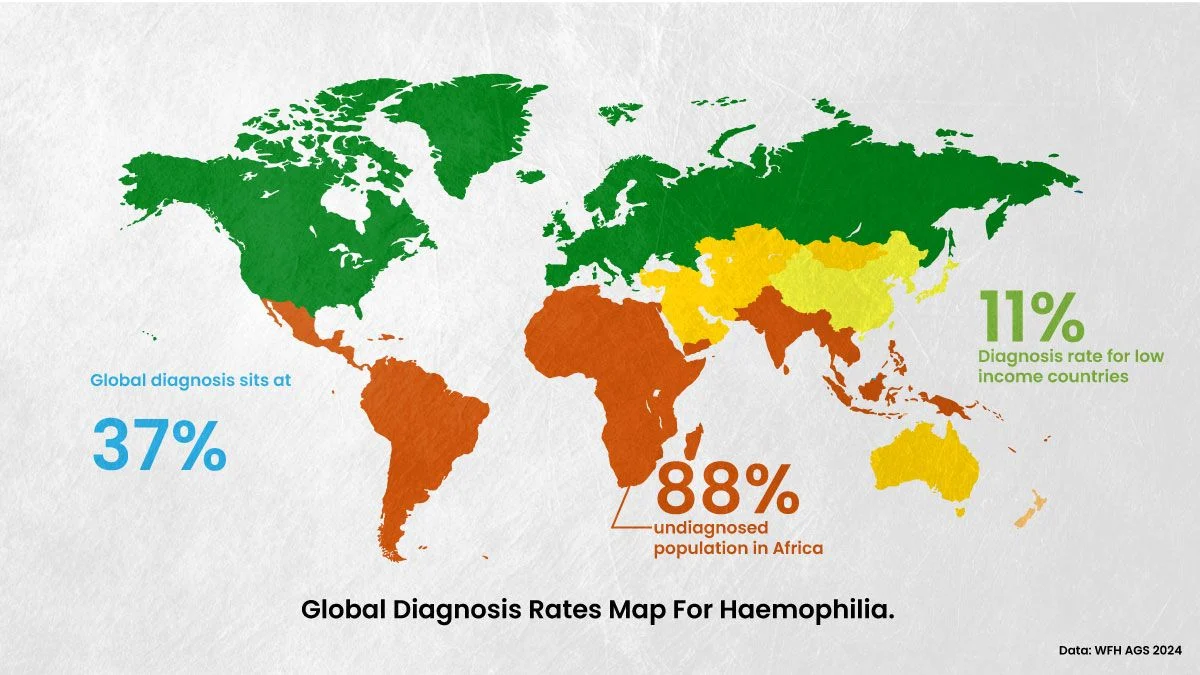
“The World Federation of Haemophilia identifies 37 percent of people with haemophilia globally.
In low-income countries? 11 percent.
In Africa? An estimated 88 percent remain undiagnosed.
Let me be direct: these numbers represent invisibility by design.
Not because diagnosis is impossible.
But because the systems to find people were built for certain geographies and certain people.
When my brother was 6 years old in Phuthaditjhaba, South Africa, he didn’t exist in any global haemophilia dataset.
He was bleeding, my family was desperate, but he was invisible.
No screening protocol would find him.
No registry would record him.
No system knew he existed.
This could have been my story if it wasn’t for my brothers.
Ask any bleeding disorder patient in the global south and you will hear similar stories and a pattern will also emerge.
Meanwhile, a child born with the same severe Hemophilia A in Amsterdam?
Known by age 1. Registered. Part of the data that shapes global priorities.
Same disease. Different visibility.
Here’s what the data shows: Africa, with 18 percent of the world’s population, represents less than 3 percent of identified haemophilia patients globally.
That’s not because Hemophilia is rare in Africa.
It’s because the systems designed to find Hemophilia were never designed to reach Africa.
The invisibility isn’t accidental.
It’s structural.
When a patient is invisible, they don’t exist in clinical trials.
They’re not counted in epidemiology.
They don’t influence treatment guidelines.
Their outcomes don’t matter because nobody’s measuring them.
The question we need to ask: Are we actually looking for these patients?
Or have we built systems that only find the ones in certain places?
Because that’s the real diagnosis gap.”
Other posts featuring Masoabi Sefojane on Hemostasis Today.
-
Oct 16, 2026, 13:59Aya Akmal Amin: Antiphospholipid Syndrome Management and Risk Stratification
-
Oct 16, 2026, 13:10Emanuel Sueldo: CAHT 2026 Celebrates Scientific Progress and Team Achievements
-
Oct 16, 2026, 13:05Maha Othman: Queen’s Health Sciences Advances CAT Risk Models and Pediatric ISTH-BAT Cut-Offs
-
Oct 16, 2026, 13:03Thrombosis Awareness Must Lead to Timely Action – Roche
-
Oct 16, 2026, 12:49Wolfgang Miesbach: 5-Year CBDR Data Confirms Emicizumab Safety and Efficacy in Hemophilia A
-
Oct 16, 2026, 12:40Edward Lee Carter: How Factor XI Inhibition Could Transform Anticoagulation Therapy
-
Oct 16, 2026, 12:40Marc Carrier: Looking Ahead to ISTH 2027 in Vancouver
-
Oct 16, 2026, 12:30Bob Lempke: How One Blood Donation Can Save Up to Three Lives
-
Oct 16, 2026, 12:30Why VWF Therapies Belong on the EU Critical Medicines List – EHC