


Andreas Ejlegard: The Promise of Smarter Antithrombotic Therapy with Cereno Scientific
Andreas Ejlegard, Sales Development Manager at Rexel Sverige, shared a post on LinkedIn about recent article by Livia Stanger et al., published in Blood Journal, adding:
“In thrombosis, the tradeoff has almost always been the same.
Reduce clotting
- increase bleeding risk
That balance defines much of cardiovascular medicine today.
Which is why programs aiming to break that paradigm are so interesting.
A great update highlighting how Cereno Scientific is expanding CS585 into antiphospholipid syndrome, APS.
APS is a rare autoimmune thrombotic disease where abnormal clot formation can lead to severe long term complications.
And this is where CS585 stands out conceptually.
Not just another anticoagulant.
But a selective oral IP receptor agonist designed to:
- inhibit platelet activation
- prevent thrombosis
- preserve normal coagulation function
- potentially avoid increased bleeding risk
That last part is the holy grail in thrombosis.
Because current antithrombotic therapies are often limited precisely by bleeding complications.
What also deserves attention is the scientific foundation behind the program.
CS585 originated from research at the University of Michigan and continues to advance through collaboration with Michael Holinstat and his team.
Strong credit to Michael Holinstat and the translational work behind the platform.
The preclinical data have already shown something highly unusual:
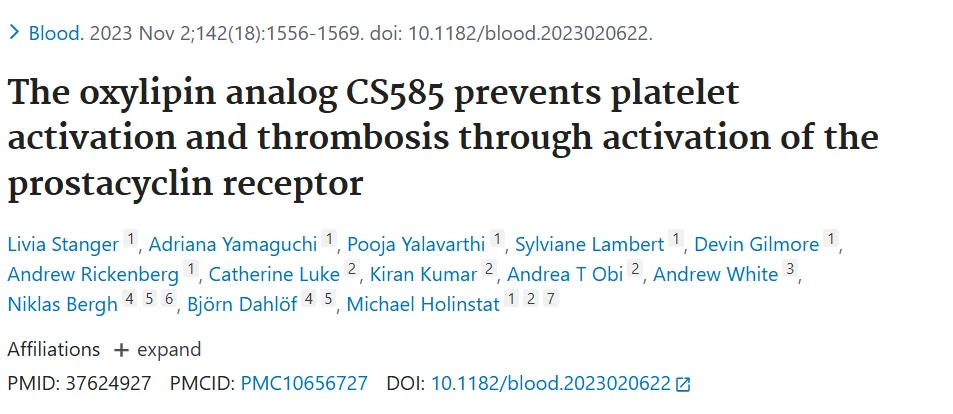
prevention of thrombosis without increased risk of bleeding (The oxylipin analog CS585 prevents platelet activation and thrombosis through activation of the prostacyclin receptor, 10.1182/blood.2023020622)
If replicated clinically, that is not incremental improvement.
That is category redefining.
Especially in diseases requiring long term thrombosis prevention, where physicians constantly balance efficacy against safety.
So the expansion into APS feels strategically logical.
Not just broadening indication scope.
But stress testing the biology in one of the most clinically challenging thrombotic settings.
Not just thinner blood.
But smarter thrombosis control.”
Title: The oxylipin analog CS585 prevents platelet activation and thrombosis through activation of the prostacyclin receptor
Authors: Livia Stanger, Adriana Yamaguchi, Pooja Yalavarthi, Sylviane Lambert, Devin Gilmore, Andrew Rickenberg, Catherine Luke, Kiran Kumar, Andrea T Obi, Andrew White, Niklas Bergh, Björn Dahlöf, Michael Holinstat
Stay updated on all scientific advances with Hemostasis Today.
-
Oct 20, 2026, 16:51Suzan Nakasendwa: A Growing Stroke Challenge in Uganda
-
Oct 20, 2026, 16:38Steve Moon: How Does Smoking Cessation Duration Affect Ischemic Stroke Risk
-
Oct 20, 2026, 16:25Cedrice Mentor: Reducing Platelet Wastage Through Cold Storage
-
Oct 20, 2026, 16:09Thirunavukkarasu Angappan: Can a Purified Fibrinogen Concentrate Replace Cryoprecipitate
-
Oct 20, 2026, 16:01Kalyan Roy: Platelet Conservation Through Evidence-Based Transfusion Practice
-
Oct 20, 2026, 15:28Stacy E. Croteau: 33 Countries, One Mission – Better Bleeding Disorder Care
-
Oct 20, 2026, 15:19Teresa Barnes: What Does a Pulmonary Embolism Mean for Jalen Hurts?
-
Oct 20, 2026, 15:04Laura S.: Could Speaking Up Prevent Maternal Deaths from Thrombosis?
-
Oct 20, 2026, 14:44Pete Stibbs: VTE in Professional Athletes – When Fitness Is Not Enough