

Vanduyn Hoven Sibarani: Impact of Pac Dosing on Raw Water Coagulation Performance
Vanduyn Hoven Sibarani, Staff Engineer, Water Treatment Plant and Waste Water Treatment Plant at Pt Oki Pulp and Paper Mills, shard a post on LinkedIn:
“Impact of Pac Dosing on Raw Water Coagulation Performance
One of the most critical challenges in Water Treatment Plant (WTP) operation is determining the correct PAC (Poly Aluminium Chloride) dosage during the coagulation process.
Many people assume that adding more chemical will automatically improve water clarity.
In reality, both underdosing and overdosing PAC can significantly reduce treatment performance and create serious downstream operational problems.
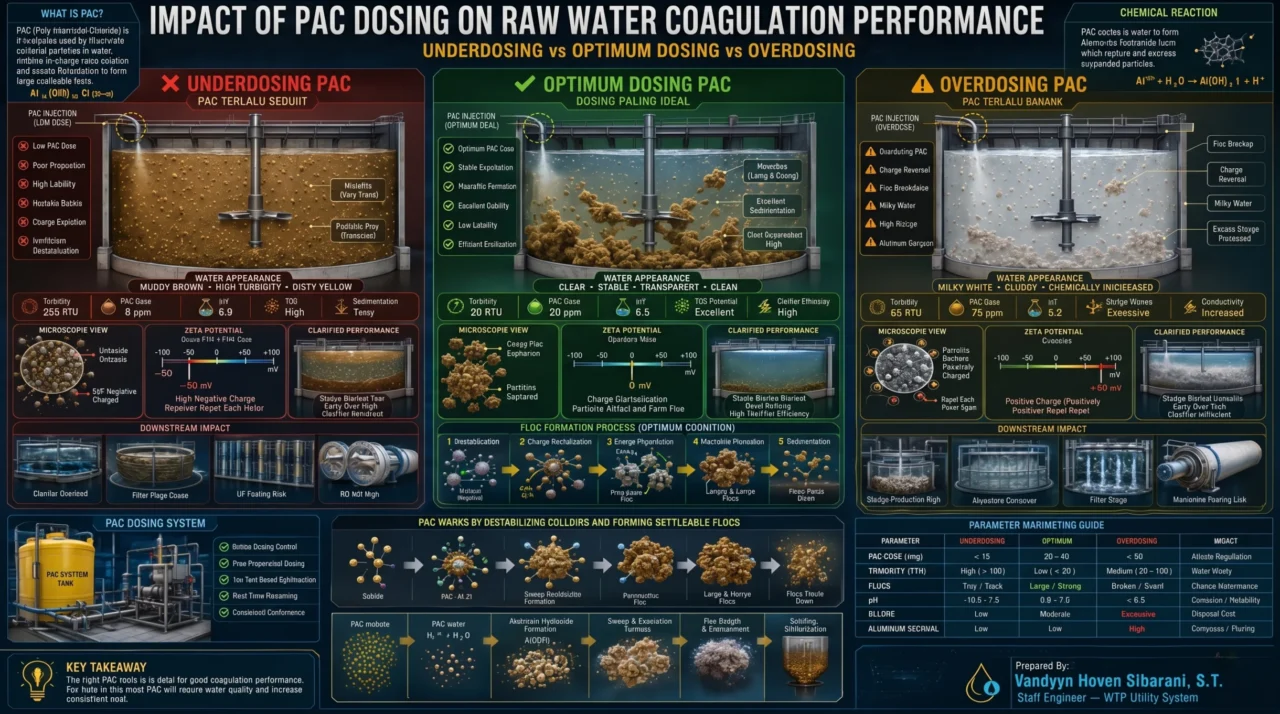
This engineering visualization was created to demonstrate the real industrial impact of PAC dosing conditions on raw water coagulation performance.
The comparison shows three actual operating scenarios commonly encountered in industrial WTP systems:
Underdosing Pac:
When PAC dosage is too low:
- Colloidal particles remain stable
- Turbidity stays high
- Floc formation becomes weak
- Sedimentation performance decreases
- and filters become overloaded much faster.
In this condition, the water usually appears:
- Muddy brown
- Highly turbid
- Unstable
- Full of suspended solids
Optimum Pac Dosing:
This is the ideal operating condition.
At optimum dosage:
- Colloidal charges are properly neutralized
- Macrofloc formation becomes stable
- Sedimentation efficiency improves
- Sludge settles properly
- and clarified water quality becomes significantly better.
This is where coagulation chemistry, hydraulic mixing, and flocculation energy work together in balance.
Overdosing Pac:
One of the most misunderstood conditions in water treatment.
Excessive PAC dosing can cause:
- Charge reversal
- Floc breakdown
- Aluminum carryover
- Excessive sludge generation
- Unstable clarification
- and membrane fouling risk.
Visually, the water may appear:
- Milky white
- Cloudy
- Chemically overloaded
This happens because excessive coagulant destabilizes the coagulation balance and causes particles to repel each other again.
Through this visualization, I wanted to simplify a complex coagulation phenomenon into a more understandable engineering presentation — not only for operators and engineers, but also for management, clients, and industrial stakeholders.
In modern industrial utilities, understanding chemical behavior is just as important as understanding pumps, piping, and equipment.
Because in water treatment, a few ppm difference in chemical dosing can completely change the performance of an entire plant.”
Stay updated with Hemostasis Today.
-
Oct 20, 2026, 16:51Suzan Nakasendwa: A Growing Stroke Challenge in Uganda
-
Oct 20, 2026, 16:38Steve Moon: How Does Smoking Cessation Duration Affect Ischemic Stroke Risk
-
Oct 20, 2026, 16:25Cedrice Mentor: Reducing Platelet Wastage Through Cold Storage
-
Oct 20, 2026, 16:09Thirunavukkarasu Angappan: Can a Purified Fibrinogen Concentrate Replace Cryoprecipitate
-
Oct 20, 2026, 16:01Kalyan Roy: Platelet Conservation Through Evidence-Based Transfusion Practice
-
Oct 20, 2026, 15:28Stacy E. Croteau: 33 Countries, One Mission – Better Bleeding Disorder Care
-
Oct 20, 2026, 15:19Teresa Barnes: What Does a Pulmonary Embolism Mean for Jalen Hurts?
-
Oct 20, 2026, 15:04Laura S.: Could Speaking Up Prevent Maternal Deaths from Thrombosis?
-
Oct 20, 2026, 14:44Pete Stibbs: VTE in Professional Athletes – When Fitness Is Not Enough