

Francisco Chacón-Lozsán: Anticoagulation Strategies for Complex ICU Patients
Francisco Chacón-Lozsán, Fellow at World Extreme Medicine, Member of European Society of Intensive Care Medicine (ESICM) and American College of Cardiology, shared a post on LinkedIn about a recent article by Mark A. Creager et al, published in Circulation, adding:
“Anticoagulation in the ICU is not one protocol.
It is a daily balance between thrombosis, bleeding, renal clearance, procedure timing, and the reason for anticoagulation.
Recent PubMed indexed guidance reinforces that critically ill patients need systematic VTE prophylaxis unless bleeding risk is prohibitive. (Bounes et al., 2024; Arabi and Mehta, 2025)
But dose is context.
Standard ICU prophylaxis is often enoxaparin 40 mg once daily or UFH 5000 IU every 8 to 12 hours.
In obesity, fixed low dosing may underdose patients, reflecting the need for higher or weight adjusted prophylaxis in selected patients. (Arcelus et al., 2024)
In AKI or severe CKD, UFH is often safer than LMWH because accumulation is less problematic and reversal is easier.
Therapeutic anticoagulation is a different question.
AF in the ICU requires stroke risk, bleeding risk, rhythm duration, procedures, renal function, and enteral absorption assessment.
The 2023 ACC/AHA/ACCP/HRS AF guideline supports DOACs over warfarin for most non valvular AF, but not for mechanical valves or moderate to severe rheumatic mitral stenosis. (Joglar et al., 2023)
PE in shock is not ‘just anticoagulation.’
It is anticoagulation plus reperfusion assessment.
The 2026 AHA/ACC multisociety PE guideline focuses on risk stratification, anticoagulation, catheter based therapy, thrombolysis, surgical embolectomy, and IVC filters when anticoagulation is impossible. (AHA/ACC/ACCP/ACEP/CHEST/SCAI/SHM/SIR/SVM Writing Committee, 2026)
Mechanical valves remain warfarin territory.
DOACs are not substitutes.
Bridging decisions must consider valve type, position, prior stroke, AF, LV dysfunction, and bleeding risk.
Liver failure is not ‘auto anticoagulated.’
Cirrhosis creates rebalanced but fragile hemostasis.
Hospitalized cirrhotic patients can thrombose and may still need prophylaxis or treatment when bleeding risk is controlled. (Roark et al., 2024)
Recent stroke, major surgery, ACS, elderly frailty, thrombocytopenia, and renal dysfunction all change the equation.
Mechanical prophylaxis may be useful when pharmacological prophylaxis is temporarily unsafe, and a 2024 meta analysis supports intermittent pneumatic compression as an option in surgical patients, especially when bleeding risk limits anticoagulants. (Kim et al., 2024)
References
- AHA/ACC/ACCP/ACEP/CHEST/SCAI/SHM/SIR/SVM Writing Committee. Circulation.
- Arabi, Y. M. Intensive Care Medicine, 51, 1508–1510.
- Arcelus, J. I., Eur J Anaesthesiol. 2024 Aug 1;41(8):607-611.
- Bounes, F., European Journal of Anaesthesiology, 41(8), 582–588.
- Joglar, J. A., Circulation, 149(1), e1–e156.
- Kim, N. Y. PLOS ONE, 19(7), e0307602.
- Roark, R., Clin Liver Dis (Hoboken). 2024 Jun 19;23(1):e0186.”
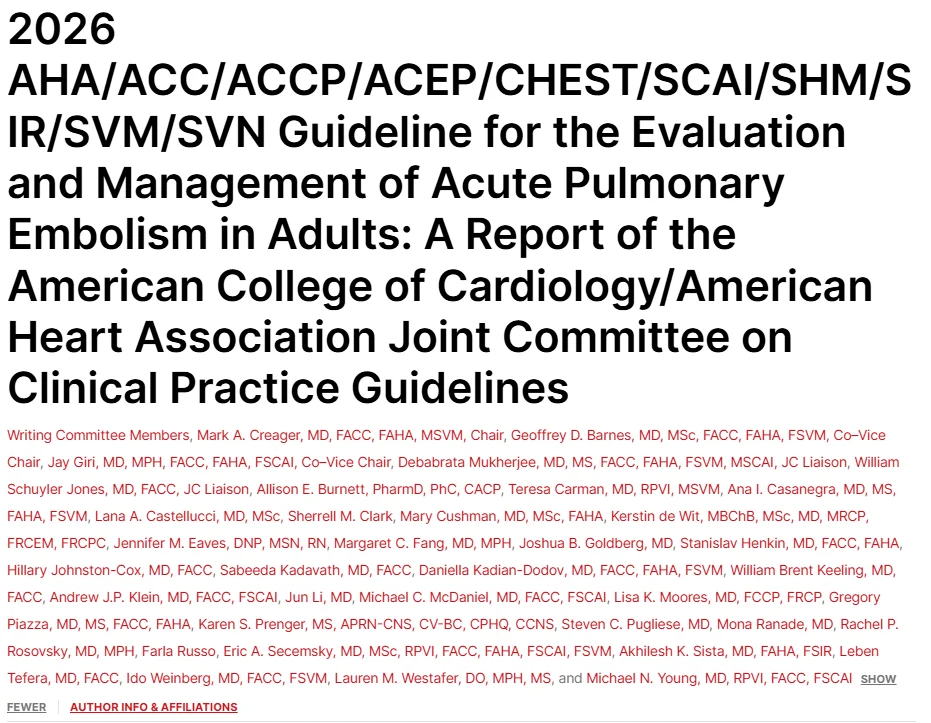
Title: 2026 AHA/ACC/ACCP/ACEP/CHEST/SCAI/SHM/SIR/SVM/SVN Guideline for the Evaluation and Management of Acute Pulmonary Embolism in Adults: A Report of the American College of Cardiology/American Heart Association Joint Committee on Clinical Practice Guidelines
Authors: Mark A. Creager, Geoffrey D. Barnes, Jay Giri, Debabrata Mukherjee, William Schuyler Jones, Allison E. Burnett, Teresa Carman, Ana I. Casanegra, Lana A. Castellucci, Sherrell M. Clark, Mary Cushman, Kerstin de Wit, Jennifer M. Eaves, Margaret C. Fang, Joshua B. Goldberg, Stanislav Henkin, Hillary Johnston-Cox, Sabeeda Kadavath, Daniella Kadian-Dodov, William Brent Keeling, Andrew J.P. Klein, Jun Li, Michael C. McDaniel, Lisa K. Moores, Gregory Piazza, Karen S. Prenger, Steven C. Pugliese, Mona Ranade, Rachel P. Rosovsky, Farla Russo, Eric A. Secemsky, Akhilesh K. Sista, Leben Tefera, Ido Weinberg, Lauren M. Westafer, Michael N. Young
Stay updated on all scientific advances with Hemostasis Today.
-
Oct 13, 2026, 02:01Nour Al-Mozain: Is It Really Anti-D? – Unraveling Auto-Anti-LW in the Transfusion Laboratory
-
Oct 13, 2026, 01:51Berenice Villegas: The Role of Morphologic Evaluation in Body Fluid Differential Analysis
-
Oct 13, 2026, 01:44Debadrita Ray: Evaluating vWF and VITRO Score for Detecting CSPH in cACLD Patients
-
Oct 13, 2026, 01:34Nagesh Ramesh: Donating Blood for International Plasma Awareness Week
-
Oct 12, 2026, 21:51Sam Botchey: Orthobiologics Are Advancing but the Evidence Must Keep Pace
-
Oct 12, 2026, 21:50Serum Vitamin D, Platelet Function, and Bleeding in Primary ITP – Platelets Journal
-
Oct 12, 2026, 21:30Nika Samadzadeh Tabrizi: Looking Forward to the PACeS Trial on Anticoagulation for POAF
-
Oct 12, 2026, 21:28Michael Megaly: Does Coronary Ectasia Affect Outcomes in Acute Coronary Syndromes?
-
Oct 12, 2026, 21:25Vitor Borin P. de Souza: Think Twice Before Anticoagulating an Isolated Subsegmental PE