


Ming Y Lim: The Burden and Impact of Bleeding in Newly Diagnosed Cancer Patients
Ming Y Lim, Clinical Associate Professor at the University of Utah, shared on LinkedIn about a recent article she and her colleagues co-authored, published in AJH, adding
”There is substantial focus on the prevention and management of cancer-associated thrombosis given its high prevalence and well-established impact on cancer outcomes.
However, as a hematologist, I am equally consulted for cancer-associated bleeding; an issue that is just as common but remains underrecognized by both oncologists and hematologists.
Notably, there is a paucity of data describing the incidence of bleeding in patients with newly diagnosed cancer, as most prior studies have focused on bleeding in the context of anticoagulation for cancer-associated thrombosis.
In this study, we analyzed over 2.4 million patients with newly diagnosed cancer across U.S. health systems.
We found that the cumulative incidence of clinically relevant bleeding (CRB) was 6.3% within the first year after cancer diagnosis.
Similar to thrombosis, the risk of CRB was higher among patients with advanced disease, greater comorbidity burden, recent hospitalizations, and those receiving systemic therapy.
Importantly, bleeding events were independently associated with increased mortality, particularly intracranial and gastrointestinal hemorrhage.
These findings highlight that bleeding risk in cancer patients is substantial and comparable in magnitude to thrombotic risk.
This underscores an urgent need for validated bleeding risk models that can be integrated alongside thrombosis prediction tools to guide safer, more personalized thromboprophylaxis strategies in cancer care.”
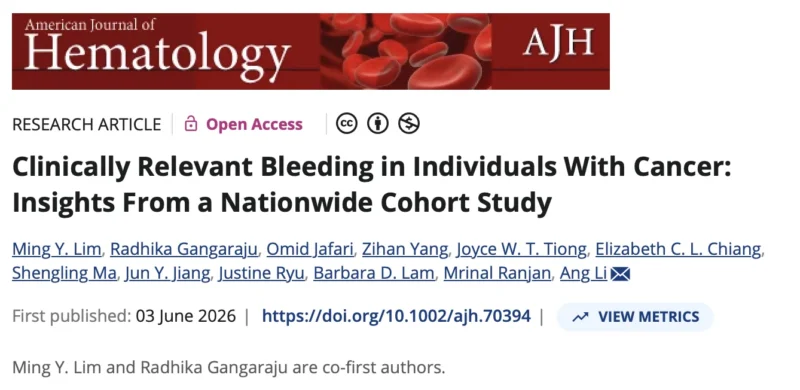
Title: Clinically Relevant Bleeding in Individuals With Cancer: Insights From a Nationwide Cohort Study
Authors: Ming Y. Lim, Radhika Gangaraju, Omid Jafari, Zihan Yang, Joyce W. T. Tiong, Elizabeth C. L. Chiang, Shengling Ma, Jun Y. Jiang, Justine Ryu, Barbara D. Lam, Mrinal Ranjan, Ang Li
Stay updated on all scientific advances with Hemostasis Today.
-
Sep 20, 2026, 13:29Factor XI Deficiency and the Challenge of Unpredictable Bleeding – EHC
-
Sep 20, 2026, 13:18Cindy Howry: FDA Approves First Treatment for Ataxia-Telangiectasia
-
Sep 20, 2026, 13:08Mohammad Salar Amoli: When Routine Coagulation Tests Miss von Willebrand Disease
-
Sep 20, 2026, 12:55Stelios Andreadis։ Human Salivary Gland Organoids Offer New Potential for Regenerative Medicine
-
Sep 20, 2026, 12:43Obi Light Ogbonnia: The Power of Lived Experience in Sickle Cell Care
-
Sep 20, 2026, 12:34Sabrine Mekni: Advancing HSCT for Children With Fanconi Anemia
-
Sep 20, 2026, 12:11Giacomo Buso: Silent Atherosclerosis Begins Earlier Than Expected
-
Sep 20, 2026, 12:0310 Posts Not to Miss This Week
-
Sep 20, 2026, 11:27Edward Lee Carter: Prasugrel Dosing Matters in P2Y12 Inhibitor Comparisons After PCI