


Andreas Calatzis: Chasing Biologically Inactive Heparin?
Andreas Calatzis, Managing Director of Eonis GmbH and Dynabyte GmbH, shared a post on LinkedIn:
”Chasing biologically inactive heparin?
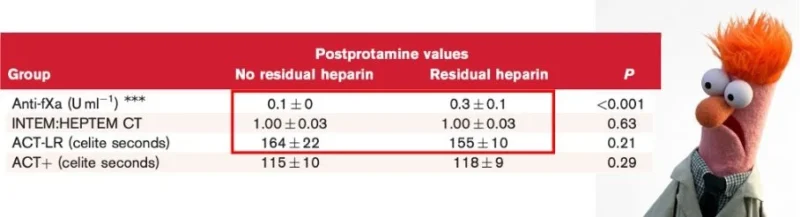
Look at this figure (fig. 3 in (1)). The authors conclude ‘Both the ACT-LR and ACT plus tests of Hemochron Signature Elite device and the INTEM:HEPTEM CT ratio of ROTEM Sigma device have poor ability to detect residual heparin shortly after protamine administration’.
My interpretation is that the ‘residual heparin’ reported in the study, is actually biologically inactive and correctly not detected by the whole blood tests and incorrectly detected by the anti-Xa.
Therefore the ‘poor ability to detect residual heparin’ claimed by the authors, is actually based on a wrong assumption that anti-Xa is a valid reference in this clinical context.
This interpretation is based on recent publications, which show that dextran sulfate used in anti-Xa assays can liberate biologically inactive heparin and thus lead to false positive results (2-3, by Michael Hardy, Francois Mullier, Jonathan Douxfils et al).
Almost all anti-Xa tests available on the market (by Werfen, Siemens and Hyphen/Sysmex) contain dextran sulfate, a chemical which is intended to make the test more robust.
However as highlighted in (2-3) this chemical can also release biologically inactive heparin, which should not be detected by a heparin assay.
Another aspect supporting my suspicion that the anti-Xa results are wrong in this study (1), is the fact that it is simply implausible that 3 heparin-sensitive assays would show zero signal at 0.3 U heparin /ml.
A more detailed discussion of this problem (assuming that anti-Xa is a validated reference for applications it was neither developed nor validated for) can be found in our recent perspective article (4).
- (1) Moilanen J, Pada M, Ohtonen P, Kaakinen T, Taskinen P, Savolainen ER, Erkinaro T. Thromboelastometry and two activated clotting tests in detecting residual heparin after protamine in cardiac surgical patients: A prospective cohort study. Eur J Anaesthesiol. 2025 May 1;42(5):398-406.
- (2) Hardy, M, Cabo, J, Deliège, A, Douxfils, J, Gouin-Thibault, I, Lecompte, T, and Mullier, F. Reassessment of dextran sulfate in anti-Xa assay for unfractionated heparin laboratory monitoring. Res Pract Thromb Haemost. (2023) 7:102257.
- (3) Lasne, D, Toussaint-Hacquard, M, Delassasseigne, C, Bauters, A, Flaujac, C, Savard, P, Mouton, C, De Maistre, E, Stepanian, A, Eschwège, V, Delrue, M, Georges, JL, Gros, A, Mansour, A, Leroy, G, Jouffroy, R, Mattei, M, Beurton, A, Pontis, A, Neuwirth, M, Nedelec-Gac, F, Lecompte, T, Curis, E, Siguret, V, and Gouin-Thibault, I. Factors influencing anti-Xa assays: a multicenter prospective study in critically ill and noncritically ill patients receiving unfractionated heparin. Thromb Haemost. (2023) 123:1105–15.
- (4) Weber CF, Zacharowski K, Calatzis A, Lindner ML. Monitoring unfractionated heparin in ECMO and cardiac surgery: the search for a valid reference standard. Front Med. 2026;13:1818646. doi:10.3389/fmed.2026.1818646. doi:10.3389/fmed.2026.1818646.”
Stay updated on all scientific advances with Hemostasis Today.
-
Sep 20, 2026, 13:29Factor XI Deficiency and the Challenge of Unpredictable Bleeding – EHC
-
Sep 20, 2026, 13:18Cindy Howry: FDA Approves First Treatment for Ataxia-Telangiectasia
-
Sep 20, 2026, 13:08Mohammad Salar Amoli: When Routine Coagulation Tests Miss von Willebrand Disease
-
Sep 20, 2026, 12:55Stelios Andreadis։ Human Salivary Gland Organoids Offer New Potential for Regenerative Medicine
-
Sep 20, 2026, 12:43Obi Light Ogbonnia: The Power of Lived Experience in Sickle Cell Care
-
Sep 20, 2026, 12:34Sabrine Mekni: Advancing HSCT for Children With Fanconi Anemia
-
Sep 20, 2026, 12:11Giacomo Buso: Silent Atherosclerosis Begins Earlier Than Expected
-
Sep 20, 2026, 12:0310 Posts Not to Miss This Week
-
Sep 20, 2026, 11:27Edward Lee Carter: Prasugrel Dosing Matters in P2Y12 Inhibitor Comparisons After PCI