


Pall T. Onundarson: Discussion at NEQAS Revives Interest in Precision Warfarin Monitoring
Pall T. Onundarson, Professor Emeritus at Landspitali University Hospital, shared on LinkedIn:
”At the NEQAS meeting in Sheffield, UK, last week, a session entitled ‘Vitamin K antagonists; past, present and future’, focused on the continued need for warfarin and other VKAs despite the advent of DOACs.
The speakers were Dr. Mark Crowther of McMaster University, Canada, and Dr. Deepa Arachchillage of Hammersmith Hospital/Imperial College London.
To my delight, much of the discussion that followed centered on the need to improve warfarin management by replacing conventional PT/INR monitoring, potentially with the Fiix normalized ratio (Fiix-NR, also known as the ‘Icelandic normalized ratio’).
Dr. Steve Kitchen and others contributed to the discussion.
Dr. Crowther jokingly described warfarin as ‘a precision drug ahead of its time’ – but in need of an improved monitoring method.
He emphasized that warfarin remains more effective and safer than DOACs in patients with mechanical heart valves (MHV), rheumatic heart disease (RHD), and antiphospholipid syndrome (APLAS).
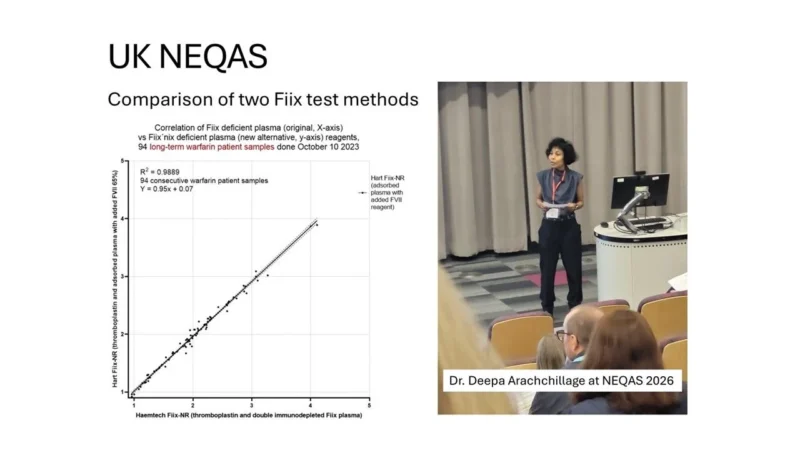
He noted that warfarin management in the pivotal atrial fibrillation DOAC trials was suboptimal, which may have biased results in favor of the newer drugs. Dr. Arachchillage (shown in picture speaking at NEQAS) reviewed the Fiix test and presented results from her ongoing studies, conducted together with Saran Vinayagam and colleagues, focusing on APLAS.
Both speakers expressed optimism about the potential of the Fiix test.
Both have initiated independent studies comparing Fiix-guided VKA management with conventional PT/INR monitoring.
It has now been 14 years since our original Fiix test publication in Thrombosis Research and 11 years since the Fiix randomized trial was published in The Lancet Haematology.
After all that time, to my knowledge, this was the first time the Fiix test has been discussed by leading experts at a major meeting.
Interestingly, key opinion leaders in the field often focus on new drugs rather than improving the use of older, inexpensive ones.
One wonders why?
In principle, the Fiix test can be performed using three different protected methods.
The currently CE marketed version, produced by Hart Biologicals in the UK, uses adsorbed plasma supplemented with purified factor VII, making the assay sensitive only to reductions in factors II and X when clotting is activated with thromboplastin.
Its performance compares extremely well with that of the original double immunodepleted Fiix method, as shown in the accompanying graph from our laboratory.”
Stay updated on all scientific advances with Hemostasis Today.
-
Sep 13, 2026, 14:52Omar Al Hammadi: Integrating Diabetes and Dyslipidemia in Modern Clinical Care
-
Sep 13, 2026, 14:37Mohammad Zamrood Khan: Hereditary Spherocytosis and Protein C/S Deficiency Case Report Submitted
-
Sep 13, 2026, 14:33Heghine Khachatryan: A Resource-Adapted Approach to Hemophilia Joint Care
-
Sep 13, 2026, 14:23Simon Fletcher: The Unmet Burden of Factor VII Deficiency
-
Sep 13, 2026, 14:10Azusa Nagao: The Evolving Burden of Haemophilia Prophylaxis
-
Sep 13, 2026, 13:50Priya Sriskandarajah: The Challenge of Thrombotic Risk in Myeloproliferative Neoplasms
-
Sep 13, 2026, 12:31Vishakha K. Kumar: ISTH Opens Public Comment Period on New Guidance
-
Sep 13, 2026, 12:13Tahsin Ara Mim: Takayasu’s Arteritis Case Report Secures 2nd Runner-Up
-
Sep 13, 2026, 11:26Tareq Abadl: When Good Samples Give Bad Numbers – Spotting EDTA Contamination in the Lab