


Emmanuel Obeng Ofori: Diagnosing Anaemia – Why Treating the Root Cause Matters More Than Simply Raising the Haemoglobin
Emmanuel Obeng Ofori, Student Intern at GA East Municipal Hospital, shared a post on LinkedIn:
“Every day in hospitals across the world, one of the most frequently requested laboratory investigations is the Full Blood Count (FBC), also known as the Complete Blood Count (CBC).
To many patients, it may appear to be just another routine blood test. To clinicians and medical laboratory professionals, however, it is one of the most informative investigations, often providing the first clue to one of the world’s most common clinical conditions – anaemia.
Yet, despite how common anaemia is, many people misunderstand what it actually means. More importantly, they often believe that once the haemoglobin level has been raised, the problem has been solved.
In reality, diagnosing anaemia is only the beginning. The real challenge is identifying why it occurred.
What is anaemia?
Anaemia is not a disease. It is a clinical finding that indicates an underlying problem.
It is defined as a reduction in the haemoglobin concentration below the normal reference range for an individual’s age, sex and physiological status (such as pregnancy). Since normal haemoglobin values differ between infants, children, adult males, adult females and pregnant women, the diagnosis of anaemia must always be interpreted using the appropriate reference interval.
Haemoglobin is the oxygen-carrying protein contained within red blood cells. When its concentration falls below the expected range, the blood’s oxygen-carrying capacity decreases, reducing oxygen delivery to tissues.
Patients may therefore present with symptoms such as:
- Fatigue
- General body weakness
- Dizziness
- Shortness of breath
- Palpitations
- Headaches
- Poor concentration
- Reduced exercise tolerance
The important question is not simply:
‘Is this patient anaemic?’
The more important question is:
‘Why has this patient become anaemic?’
The Full Blood Count: More than just a haemoglobin result
The Full Blood Count is much more than a test that reports whether haemoglobin is low.
It evaluates several components of blood, including:
- Haemoglobin (Hb)
- Red Blood Cell (RBC) count
- Haematocrit (HCT/PCV)
- Mean Corpuscular Volume (MCV)
- Mean Corpuscular Haemoglobin (MCH)
- Mean Corpuscular Haemoglobin Concentration (MCHC)
- Red Cell Distribution Width (RDW)
- White Blood Cell (WBC) count
- Platelet count
When interpreted together, these parameters help classify anaemia, narrow the differential diagnosis and guide further laboratory investigations.
Classifying anaemia using the Full Blood Count
One of the most useful indices is the Mean Corpuscular Volume (MCV), which measures the average size of red blood cells.
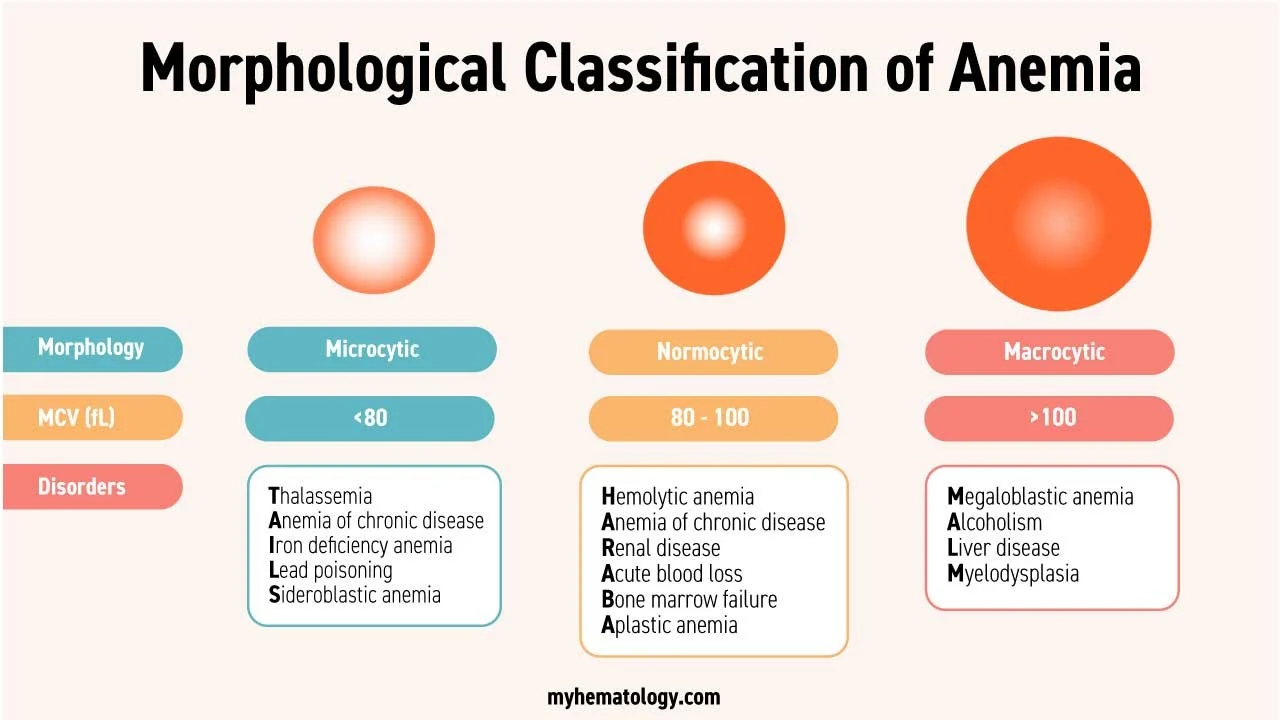
1. Microcytic anaemia (Low MCV)
Microcytic anaemia is characterised by smaller-than-normal red blood cells.
Common causes include:
- Iron deficiency anaemia
- Thalassaemia
- Anaemia of chronic disease (particularly longstanding inflammatory conditions)
- Sideroblastic anaemia
- Lead poisoning
The MCH and MCHC are often reduced as well, producing a microcytic hypochromic anaemia, where red cells are both small and pale because they contain less haemoglobin.
2. Normocytic anaemia (Normal MCV)
Here, the red blood cells are normal in size, but the haemoglobin concentration is reduced.
Common causes include:
- Acute blood loss
- Early iron deficiency
- Anaemia of chronic disease
- Chronic kidney disease (due to reduced erythropoietin production)
- Haemolytic anaemias
- Bone marrow disorders
Further investigations such as the reticulocyte count, renal function tests and blood film are often required to determine the exact cause.
3. Macrocytic anaemia (High MCV)
Macrocytic anaemia is characterised by larger-than-normal red blood cells.
Common causes include:
- Vitamin B12 deficiency
- Folate deficiency
- Liver disease
- Alcohol misuse
- Hypothyroidism
- Certain medications
- Myelodysplastic syndromes
A peripheral blood film and vitamin assays often provide additional diagnostic clues.
The laboratory provides clues – not just numbers
An experienced clinician or laboratory scientist rarely interprets haemoglobin alone.
Parameters such as the RDW, reticulocyte count, blood film findings, iron studies, vitamin B12, folate levels, bilirubin, lactate dehydrogenase and haptoglobin may all contribute to identifying the underlying cause.
The laboratory is therefore not simply producing numbers—it is telling a clinical story.
Treat the cause, not just the haemoglobin
One of the biggest misconceptions is that correcting a low haemoglobin level means the patient has been cured.
Not necessarily.
A blood transfusion is an extremely important and often life-saving intervention. In patients with severe anaemia, acute blood loss, haemodynamic instability or significant symptoms, transfusion rapidly restores the blood’s oxygen-carrying capacity and can prevent serious complications or death.
However, it is important to understand what a transfusion does – and what it does not do.
A transfusion replaces red blood cells; it does not eliminate the underlying disease responsible for the anaemia.
If the root cause remains untreated, the patient may become anaemic again after the transfused cells have served their lifespan.
For example:
- Iron deficiency requires iron replacement and investigation for the source of blood loss.
- Vitamin B12 deficiency requires vitamin replacement and evaluation for malabsorption or pernicious anaemia.
- Chronic kidney disease may require erythropoiesis-stimulating agents in addition to treating the kidney disease.
- Chronic infections and inflammatory disorders require management of the underlying condition.
- Haemolytic anaemias require identification and treatment of the cause of red cell destruction.
- Bone marrow disorders require specialised haematological evaluation and management.
In other words, the haemoglobin may improve temporarily, but unless the underlying cause is addressed, the anaemia itself has not truly been treated.
The role of laboratory medicine
The laboratory is central to patient care.
A Full Blood Count does more than detect anaemia – it guides diagnosis, informs further investigations and helps clinicians choose the most appropriate treatment.
Behind every haemoglobin result is a patient whose body is communicating that something requires attention.
The role of the medical laboratory scientist is to ensure those signals are recognised accurately and interpreted correctly.
Final thoughts
Anaemia is one of the most common conditions encountered in clinical practice, but it should never be viewed as a diagnosis in itself.
It is a sign.
The Full Blood Count provides the first clues, but good clinical practice goes beyond identifying a low haemoglobin value.
While blood transfusion remains an essential, evidence-based and sometimes life-saving treatment, lasting recovery depends on identifying and correcting the underlying cause.
Ultimately, the goal is not simply to raise a laboratory value.I t is to restore the patient’s health by treating the disease responsible for the anaemia in the first place.
If you found this insightful, feel free to engage or share your thoughts.”
Stay updated with Hemostasis Today.
-
Oct 5, 2026, 22:55Steve Humphreys: A Big Thank You to BSHT for Providing Me With a Recent Skills Exchange Award
-
Oct 5, 2026, 22:52William McKeown: Great to Be in Istanbul for the Opening of the EHC 2026
-
Oct 5, 2026, 22:48Laura Quintas Lorenzo: A New Approach to Healthcare for von Willebrand Disease at EHC 2026
-
Oct 5, 2026, 22:46Anas Zayad: Pleased to Share Our New Review on Thrombosis in SCD and Beta Thalassemia
-
Oct 5, 2026, 22:44Cihan Ay: Honouring Eric Kandel and Eugene Braunwald at the Medical University of Vienna
-
Oct 5, 2026, 22:42Heather L. Gornik: Testing for Aortic and Arterial Thrombosis at VSS 2026
-
Oct 5, 2026, 22:34Hasan Abbas Zaheer: Honoured to Have Co-Authored One of the Four Reviews in The Lancet Thalassemia Series
-
Oct 5, 2026, 22:34Kamyar Shameli: Understanding the Coagulation Cascade – How Anticoagulants Prevent Blood Clots
-
Oct 5, 2026, 22:31Risika Samanta: Pediatric ITP in a 12-year-old – An Atypical Presentation without a Viral Prodrome