

A Century of VWD: Redefining Its Role Beyond Hemostasis
One hundred years after Erik von Willebrand first described the bleeding disorder that carries his name, the J. Evan Sadler Memorial Plenary Lecture delivered by Prof. David Lillicrap at ISTH 2026 highlighted a remarkable scientific transformation.
Von Willebrand disease (VWD) is no longer viewed solely as a disorder of defective platelet adhesion and bleeding.
Instead, it has become a powerful model for understanding the complex interactions between hemostasis, endothelial biology, angiogenesis, inflammation and precision medicine.
While hemophilia has undergone a period of extraordinary therapeutic innovation, VWD is now entering its own era of discovery, driven by advances in molecular genetics, functional diagnostics, vascular biology, and targeted treatment strategies.
A Century of Discovery: From Clinical Description to Molecular Understanding
The history of VWD represents one of hematology’s most significant scientific journeys.
Over the past century, research has transformed VWD from a clinical observation into a genetically and biologically defined disorder.
The identification of the VWF gene, characterization of molecular subtypes, development of standardized Bleeding Assessment Tools (BATs), improvements in functional assays, and establishment of international diagnostic and treatment guidelines have fundamentally changed clinical practice.
A particularly important advance has been the recognition that women and girls represent a large proportion of patients with clinically significant VWD, yet remain frequently underdiagnosed due to historical misconceptions about abnormal bleeding.
Modern VWD care is therefore moving beyond simply identifying low VWF levels toward understanding disease mechanisms at molecular, cellular, and genomic levels.
Beyond Hemostasis The Expanding Biological Role of VWF
One of the central messages of the lecture was a shift in how von Willebrand factor is understood.
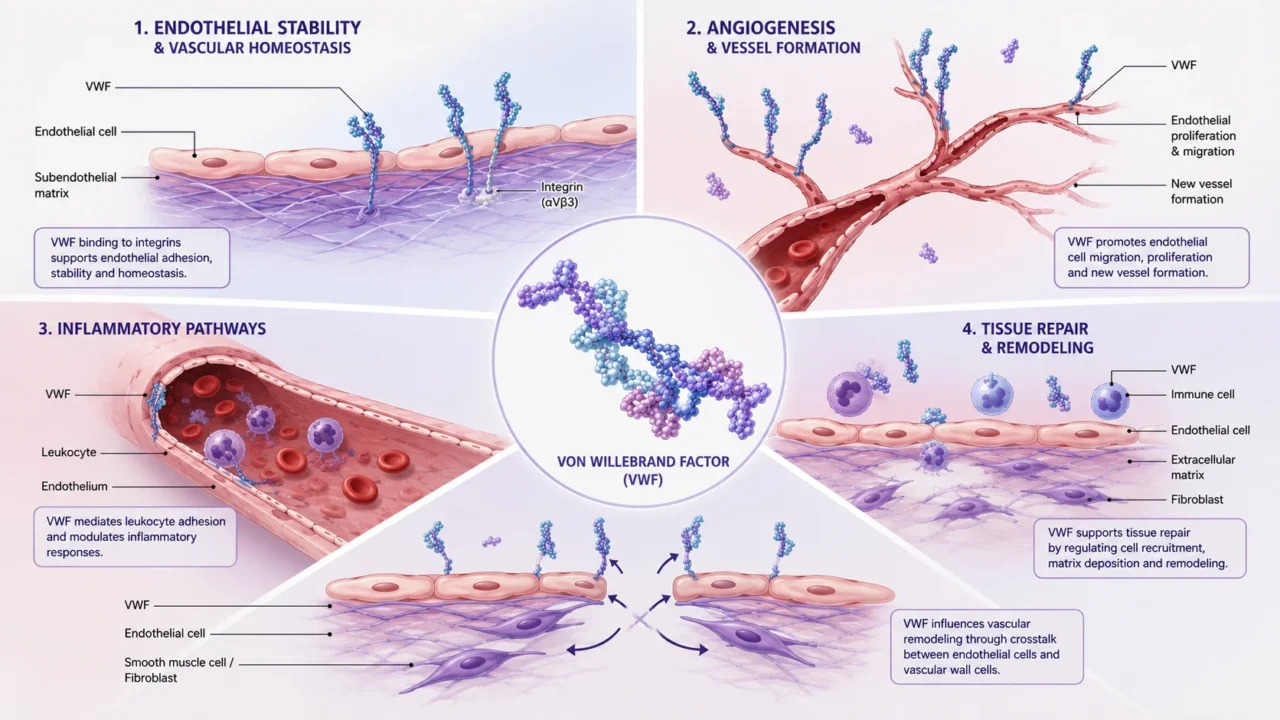
Traditionally recognized as a protein responsible for platelet adhesion and protection of factor VIII, VWF is now emerging as a multifunctional regulator of vascular biology.
Growing evidence demonstrates that VWF contributes to:
- endothelial stability and vascular homeostasis,
- angiogenesis and vessel formation,
- inflammatory pathways,
- tissue repair and vascular remodeling.
This broader perspective changes the way VWD is viewed—not only as a bleeding disorder, but as a disease involving complex vascular regulation.
The Ang2 Pathway A New Explanation for Gastrointestinal Angiodysplasia
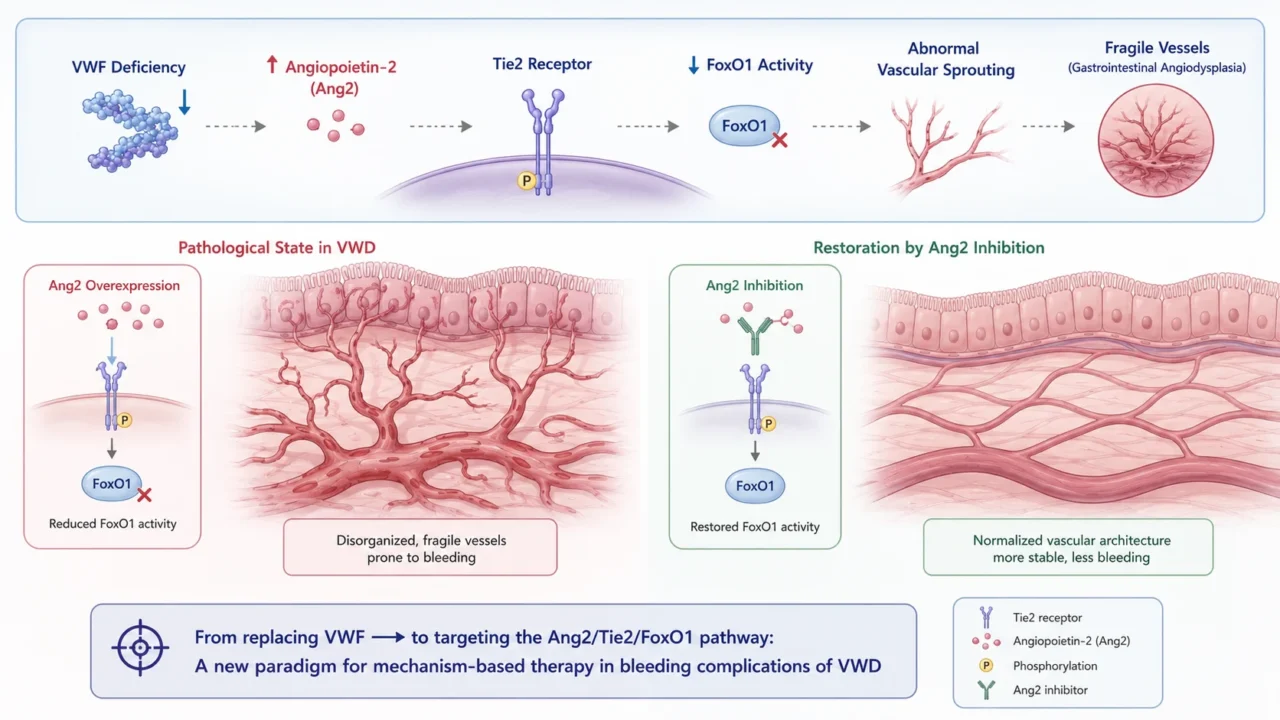
One of the most compelling insights discussed was the biological mechanism behind gastrointestinal angiodysplasia, a major cause of recurrent bleeding in patients with severe VWD.
Recent studies have shown that VWF deficiency disrupts the Angiopoietin-2 (Ang2)/Tie2/FoxO1 signaling pathway, leading to abnormal vascular sprouting and the formation of fragile blood vessels.
Importantly, experimental inhibition of Ang2 has demonstrated the potential to restore more normal vascular architecture.
This finding represents a major conceptual shift – from replacing missing VWF toward directly targeting the biological pathways responsible for disease complications.
Such approaches may open the door to mechanism-based therapies for patients with difficult-to-control bleeding.
The Next Generation of VWD Therapies
The future of VWD treatment may extend far beyond traditional replacement strategies.
Emerging therapeutic concepts include the potential use of emicizumab in selected patients with severe VWD and reduced factor VIII levels, antibodies targeting natural anticoagulant pathways such as protein S, therapies designed to reduce VWF clearance, and engineered molecules aimed at extending VWF survival in circulation.
Another promising area involves approaches targeting plasminogen regulation to reduce heavy menstrual bleeding, addressing one of the most significant clinical burdens experienced by many women with VWD.
Together, these strategies suggest that VWD may be approaching a therapeutic transformation similar to that seen in hemophilia.
The Hidden Function of the VWF Propeptide
The lecture concluded with intriguing new findings regarding the role of the VWF propeptide.
Traditionally considered mainly a biosynthetic component required for VWF production and storage, emerging data suggest that the propeptide may have additional biological activity during early platelet thrombus formation under flow conditions.
Preliminary findings indicate that specific N-glycan sites may influence extracellular interactions that enhance initial platelet recruitment.
Although further validation is required, this discovery highlights how even well-known components of the hemostatic system may contain previously unrecognized functions.
The Future of von Willebrand Disease Research
The centennial reflection on VWD at ISTH 2026 demonstrated that this disease remains one of the most informative models in modern hematology.
The next century of VWD research will likely be shaped not only by improved replacement therapies, but by deeper understanding of vascular signaling, angiogenesis, immune regulation and the non-hemostatic functions of VWF.
One hundred years after Erik von Willebrand’s original description, VWD continues to challenge traditional concepts of bleeding disorders – and continues to reveal fundamental principles that shape the future of thrombosis and hemostasis research.
Written by Heghine Khachatryan, MD, PhD, Editor-in-Chief at Hemostasis Today.
-
Sep 20, 2026, 11:27Edward Lee Carter: Prasugrel Dosing Matters in P2Y12 Inhibitor Comparisons After PCI
-
Sep 20, 2026, 09:51Ceasovschih Alexandr: A Closer Look at Lipid Disorders in CKM Syndrome
-
Sep 20, 2026, 09:05World Stroke Academy: Can Adjunct IAT Improve Tissue Reperfusion?
-
Sep 20, 2026, 06:46Neeraj Songara: From Donated Blood to Engineered Therapeutics
-
Sep 20, 2026, 06:24Louise St. Germain Bannon: Improving Awareness and Care for Women Across the Lifespan
-
Sep 20, 2026, 05:17Maxime Dely: When ABO Compatibility Isn’t Enough for Safe Transfusion
-
Sep 20, 2026, 04:54William Aird: What Does a Complete History and Physical Really Mean?
-
Sep 20, 2026, 04:34Hons Saurabh Kaushik: Why Uncontrolled LDL Can Be Harmful
-
Sep 20, 2026, 03:58Salih Ehsan: The Complexities of HbF and HbA2