

Thrombin-Trained Immunity and the Biology of Recurrent VTE
Recurrent venous thromboembolism (VTE) is usually approached as a problem of persistent risk factors, insufficient anticoagulation, or inherited and acquired thrombophilia.
An expanding body of research adds another possibility: a previous inflammatory or thrombotic episode may leave innate immune cells in a persistently procoagulant state.
This concept, known as trained immunity, may help explain why some patients remain susceptible to deep-vein thrombosis (DVT) or pulmonary embolism (PE) after an apparent recovery.
The hypothesis is biologically persuasive, but it is not yet a clinical diagnosis and does not currently change standard anticoagulant treatment.
Thrombin at the crossroads
Thrombin is central to clot formation.
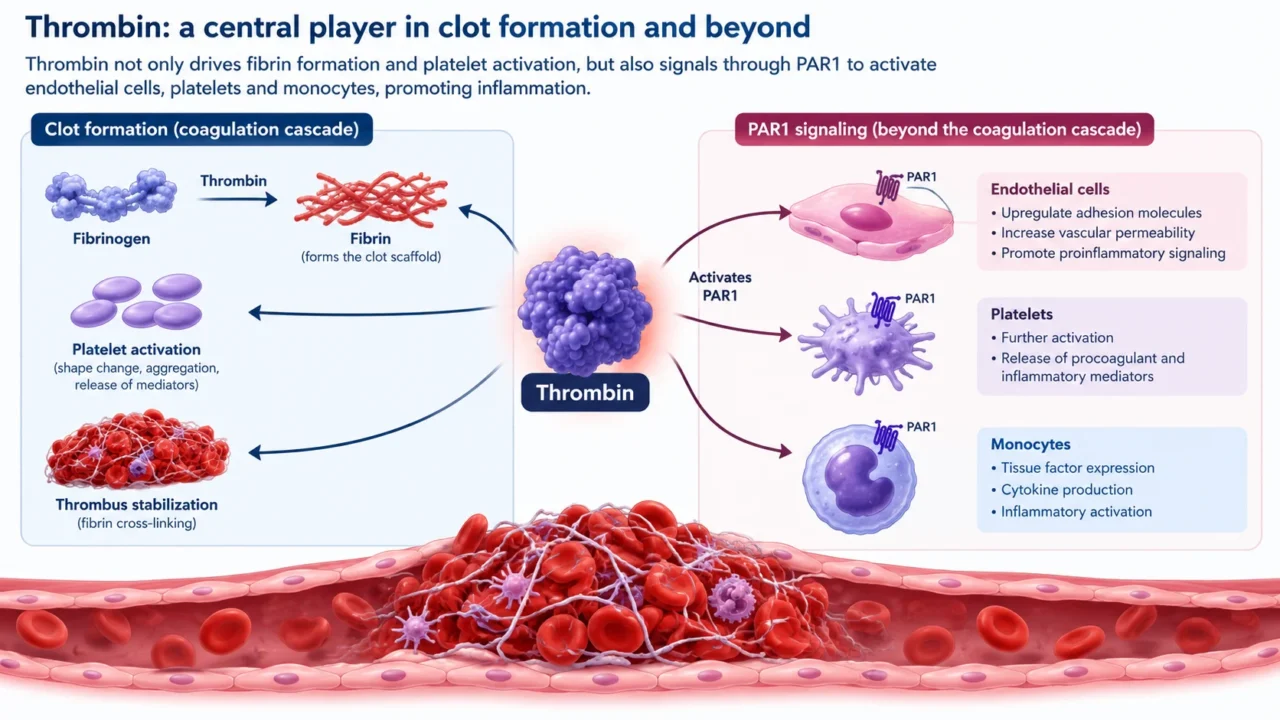
It converts fibrinogen into fibrin, activates platelets, and helps stabilize the developing thrombus.
It also acts outside the traditional coagulation cascade.
Through protease-activated receptors, particularly PAR1, thrombin activates endothelial cells, platelets, and monocytes and promotes inflammatory signaling.
This matters because inflammation and coagulation are tightly linked.
In a venous thrombus, reduced flow, hypoxia, endothelial activation, platelets, neutrophils, monocytes, fibrin, and coagulation proteins operate as an integrated system.
Monocytes can express tissue factor, the principal initiator of coagulation in vivo.
Tissue factor drives factor Xa and thrombin generation; thrombin can in turn promote inflammatory and tissue-factor–related responses.
The system can become self-amplifying.
A thrombus, therefore, is not simply a mechanical obstruction. It is a local and systemic inflammatory event.
What trained immunity means
Trained immunity is a sustained functional change in the innate immune system after a prior inflammatory exposure.
It differs from conventional adaptive immune memory because it is not specific to one antigen and does not depend on B- or T-cell recognition.
After an initial stimulus, monocytes, macrophages, and bone-marrow progenitor cells may undergo metabolic and epigenetic reprogramming.
Metabolic pathways shift toward a higher-energy, inflammatory state.
At the same time, gene-regulatory changes make selected inflammatory and coagulation-related genes easier to activate during a later challenge.
The result is a stronger or faster response to a second, unrelated stimulus.
This response may persist after the original infection, inflammatory episode, or tissue injury has resolved.
Experimental studies indicate that reprogramming of bone-marrow progenitors can generate newly formed monocytes with a lasting proinflammatory phenotype.
In the setting of thrombosis, this raises an important possibility: the immune system may retain a procoagulant “memory” after an earlier inflammatory or thrombotic insult.
How trained immunity may promote VTE recurrence
A 2025 Science Advances study provided direct experimental support for the relationship between trained immunity and hypercoagulability.
Macrophages and monocytes exposed to training stimuli such as β-glucan or free heme developed a heightened procoagulant phenotype after later stimulation.
They accelerated thrombin generation, increased tissue-factor activity, released procoagulant extracellular vesicles, and showed impaired fibrinolytic capacity.
Several mechanisms are relevant to recurrent VTE.
Higher tissue-factor activity
Trained macrophages can express more active tissue factor.
Tissue factor is the principal physiological trigger for coagulation, and increased activity supports faster factor Xa and thrombin generation.
Experimental inhibition of tissue factor reduced the excess thrombin generation seen in trained cells.
Reduced fibrinolysis
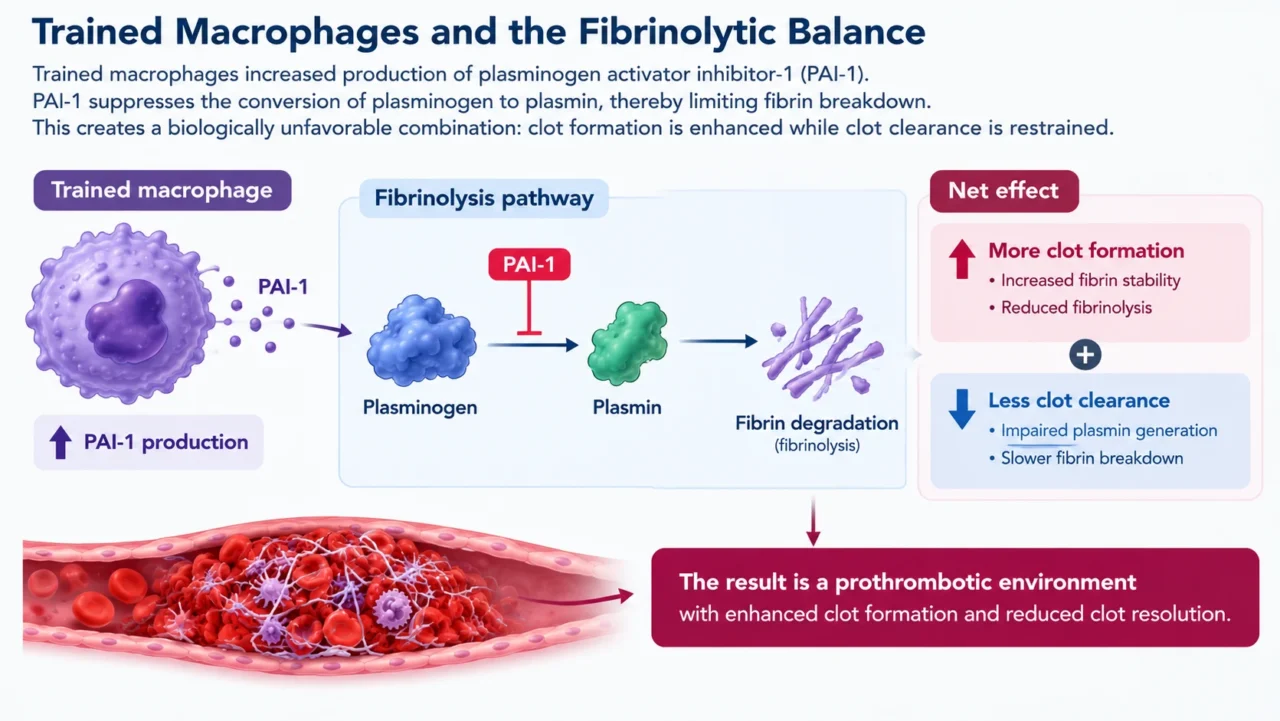
Trained macrophages increased production of plasminogen activator inhibitor-1, or PAI-1. PAI-1 suppresses the conversion of plasminogen to plasmin, thereby limiting fibrin breakdown.
This creates a biologically unfavorable combination: clot formation is enhanced while clot clearance is restrained.
Procoagulant extracellular vesicles
Activated myeloid cells can shed vesicles that carry tissue factor.
These vesicles provide circulating surfaces that can support coagulation away from the original inflammatory site.
Their presence may help connect persistent cellular activation with systemic thrombotic risk.
Longer-lived myeloid programming
A short-lived cytokine response is unlikely to explain thrombotic susceptibility months after an acute event.
Persistent epigenetic and metabolic changes in progenitor cells offer a more plausible mechanism.
New monocytes may enter circulation already primed for exaggerated inflammatory and procoagulant responses. The specific role of thrombin as a training stimulus remains less certain.
Thrombin clearly activates inflammatory pathways and monocytes, but direct proof that thrombin alone produces durable trained immunity leading to recurrent human VTE is still limited.
At present, “thrombin-trained immunity” should be viewed as a useful mechanistic framework, not as an established cause of recurrence in an individual patient.
Clinical relevance
This biology reinforces the need to look beyond a routine thrombophilia panel when VTE recurs.
Active cancer, chronic inflammatory disease, autoimmune disease, obesity and metabolic dysfunction, hemolytic disorders, infection, and persistent venous obstruction may all contribute to an inflammatory prothrombotic milieu.
A confirmed recurrence during anticoagulation deserves a systematic evaluation. The first priority is to establish that the event is new.
Residual thrombosis, chronic venous symptoms, and post-thrombotic syndrome can mimic recurrent DVT. Prior imaging should be reviewed whenever possible.
The next step is to assess anticoagulant exposure.
Incorrect dosing, missed doses, drug interactions, impaired absorption, kidney or liver dysfunction, and temporary treatment interruption can all reduce protection.
If anticoagulation is appropriate and therapeutic, clinicians should evaluate for active cancer, antiphospholipid syndrome, major inflammatory conditions, and anatomical causes such as venous compression.
Expert reviews emphasize that apparent “breakthrough” VTE often has an identifiable explanation before true pharmacologic failure is concluded.
Anticoagulation remains the foundation of secondary prevention.
For recurrent unprovoked DVT or PE, long-term or indefinite anticoagulation is generally recommended when the bleeding risk is acceptable.
Decisions should be reassessed periodically because both recurrence risk and bleeding risk change with age, comorbidity, kidney function, concurrent medications, and new clinical events.
Routine thrombophilia testing is not recommended for every patient with VTE.
The 2023 ASH guidance generally advises against testing after unprovoked VTE or VTE provoked by a major surgical trigger because results usually do not alter the treatment strategy.
Testing may be more useful after VTE associated with a major nonsurgical transient trigger or hormonal exposure, in selected unusual-site thromboses, or when a strong family history raises a specific management question.
Takeaway messages
Recurrent VTE is not solely a disorder of coagulation; persistent thromboinflammation may also contribute.
Thrombin links coagulation with endothelial, platelet, and innate immune activation. Trained immunity describes durable metabolic and epigenetic reprogramming of innate immune cells after an inflammatory exposure.
Experimental evidence shows that trained monocytes and macrophages can promote tissue-factor activity, thrombin generation, procoagulant vesicle release, and impaired fibrinolysis. Thrombin-trained immunity is a credible research hypothesis, but it is not yet a validated clinical diagnosis or an indication for immune-directed treatment.
A recurrent event during anticoagulation should trigger confirmation of recurrence, assessment of adherence and drug exposure, and investigation for cancer, antiphospholipid syndrome, inflammatory disease, or anatomical factors.
Indefinite anticoagulation is commonly appropriate after recurrent unprovoked VTE if bleeding risk is not prohibitive.
Thrombophilia testing should be selective and should only be ordered when the result is likely to change management.
FAQ
1. What is recurrent VTE?
Recurrent VTE means a new episode of DVT, PE, or another venous thrombosis after a previous confirmed event. It may occur after anticoagulation has stopped or, less commonly, while treatment is ongoing.
2. Does a recurrent clot mean anticoagulation has failed?
Not necessarily. A new clot should first be confirmed with imaging and compared with prior studies. Clinicians should also assess missed doses, dosing errors, interactions, absorption problems, and new provoking conditions before concluding that treatment has failed.
3. What is trained immunity?
It is a persistent change in innate immune-cell behavior after an earlier inflammatory exposure. Cells such as monocytes and macrophages become more responsive to later triggers through metabolic and epigenetic reprogramming.
4. Is trained immunity the same as autoimmune disease?
No. Autoimmunity involves immune responses directed against the body’s own tissues, often with adaptive immune mechanisms. Trained immunity is an altered, nonspecific response of innate immune cells and does not require self-reactive antibodies or lymphocytes.
5. Can thrombin train immune cells?
Thrombin clearly activates inflammatory and procoagulant signaling in monocytes and vascular cells. Whether thrombin itself can produce durable trained immunity that causes recurrent VTE in humans remains unproven. This is an active research question.
6. Why are monocytes important in thrombosis?
Monocytes can express tissue factor, which initiates coagulation. When activated, they may also release inflammatory mediators and procoagulant extracellular vesicles that enhance thrombin generation.
7. Does inflammation increase the risk of recurrent VTE?
Yes. Persistent inflammatory conditions, active cancer, autoimmune disease, infection, obesity-related metabolic dysfunction, and hemolysis can contribute to a sustained prothrombotic state. Trained immunity may be one mechanism linking inflammation to thrombosis.
8. Should every patient with recurrent VTE have thrombophilia testing?
No. Testing should be individualized. ASH guidance advises against routine testing after unprovoked VTE or surgery-provoked VTE when the result is unlikely to change management.
9. Will treatment for trained immunity soon replace anticoagulants?
No. Anticoagulation remains the proven treatment for VTE prevention and recurrence reduction. Targets such as tissue factor, PAI-1, cellular metabolism, and inflammatory signaling remain experimental and require clinical trials.
10. When is lifelong anticoagulation considered?
Long-term therapy is often favored after recurrent unprovoked VTE, persistent major risk factors, active cancer, or certain acquired thrombophilias, provided the expected benefit outweighs bleeding risk. Treatment should be individualized and reviewed regularly.
Written by Ani Gabrielyan.
Stay updated with Hemostasis Today.
-
Sep 27, 2026, 15:49Rana Al-Hrout: Iron Deficency – Is Ferritin 15ng/mL or Less Still the Cutoff?
-
Sep 27, 2026, 15:49Ayushi Sharma: What I Thought Transfusion Medicine Would Be vs What It Actually Is
-
Sep 27, 2026, 15:48William Wallace: How Much Human Research Is Behind the Supplements We Take?
-
Sep 27, 2026, 15:46Franck Perraudin: Lp(a) Lowering Alone May Not Be Enough
-
Sep 27, 2026, 15:41Ahmed Hamandi: Sharing Real-World HSCT Experience at the Iraqi Society of Haematology Conference
-
Sep 27, 2026, 15:39Co-creating Digital Support With Young Stroke Survivors – European Stroke Organisation
-
Sep 27, 2026, 15:39Eleri Schiavone: Celebrating 80 Years of the Welsh Blood Service
-
Sep 27, 2026, 15:38Jessica Garcia: Standing Where VWD Was First Recognized 100 Years Later
-
Sep 27, 2026, 15:37Heghine Khachatryan: A Meaningful Step Forward for Inherited Blood Disorders in Africa