


Smitirupa Mishra: A Practical Guide to Coagulation Pathway Assessment and Laboratory Interpretation
Smitirupa Mishra, Consultant Pathologist at Sparsh Hospitals and Lab Head at Pathkind Labs, shared a post on LinkedIn:
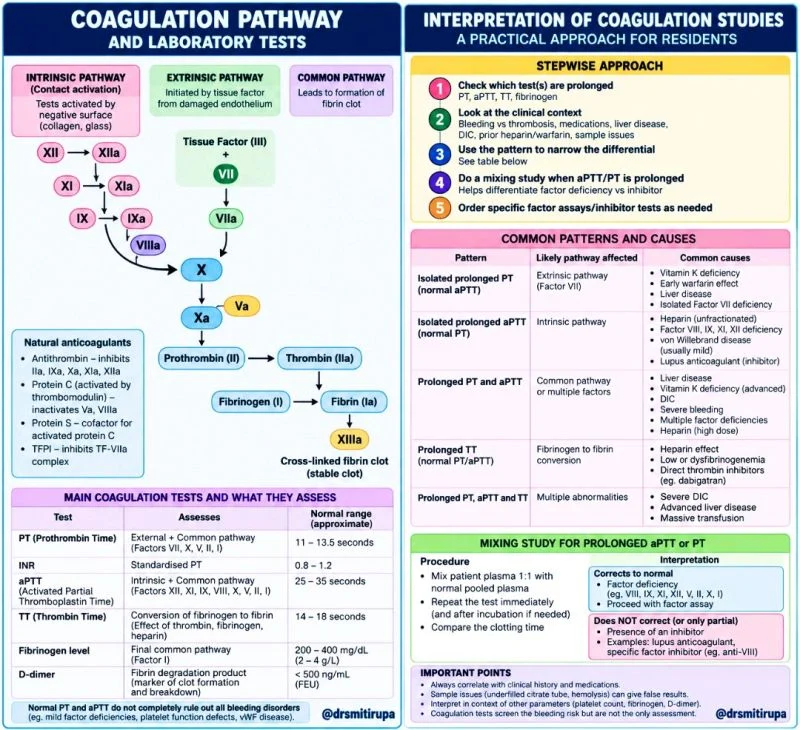
“Coagulation studies are more than just numbers on a laboratory report. Understanding the coagulation pathway is the key to interpreting them accurately.
For pathology residents and laboratory professionals, a systematic approach to coagulation testing is essential.
A few important points to remember:
- PT and INR – Primarily evaluates the extrinsic and common pathways.
- aPTT – Evaluates the intrinsic and common pathways.
- Thrombin Time (TT) – Assesses the conversion of fibrinogen to fibrin.
- Fibrinogen – Reflects the availability of the essential substrate for clot formation.
- D-dimer – Indicates fibrin breakdown and must always be interpreted in the appropriate clinical context.
When interpreting abnormal results, always consider:
- Isolated prolongation of PT or aPTT.
- Prolongation of both PT and aPTT.
- The role of mixing studies in differentiating factor deficiency from inhibitors.
- Medication history, particularly anticoagulants.
- Clinical conditions such as liver disease and DIC.
One important reminder: A prolonged PT or aPTT is not a diagnosis by itself. It is an indication to investigate further.
The aim of this educational poster is to simplify the coagulation cascade and provide a practical, stepwise approach to interpreting coagulation profiles.
Because accurate laboratory interpretation is the first step towards better clinical decisions.
Sharing this as a quick learning resource for pathology residents, postgraduate students and laboratory professionals.”
More posts featuring Smitirupa Mishra on Hemostasis Today.
-
Nov 4, 2026, 18:57Connecting Haemophilia Centres, Certifying Treaters, and Improving National Data in Romania – EHC
-
Nov 4, 2026, 15:59Alessandra Bosch: A Successful Patient Day for the Bleeding Disorders Community in Zürich
-
Nov 4, 2026, 15:47Wolfgang Miesbach: Targeting Hepatic Endothelial Cells for Lentiviral Gene Therapy in Haemophilia A
-
Nov 4, 2026, 15:20Augustina Isioma Ikusemoro: Before You Transfuse, Think PBM
-
Nov 4, 2026, 14:23Advancing Hemophilia Care Through Global Research – WFH
-
Nov 4, 2026, 14:12Jean-Jacques Kiladjian: From JAK Inhibitor-Associated Skin Cancers to Laboratory Discovery
-
Nov 4, 2026, 13:59Rita Li: ASH 2026 Abstract Achievement Award for Gut Microbiome Research
-
Nov 4, 2026, 13:38Omid Seidizadeh: Improving Access to von Willebrand Disease Diagnosis and Treatment Across Europe
-
Nov 4, 2026, 13:38Fiona Robinson: NBDF Webinar Explores the Practical Challenges of Hemophilia Gene Therapy