


David McIntosh: Cybersecurity Matters, but Blood Availability Remains the Bigger Challenge
David McIntosh, Founder and Chair of United Plasma Action, shared Kalyan Roy’s post on LinkedIn, adding:
“We must surely all identify with Dr Roy‘s concerns about this – but –
Isn’t it interesting that it takes one minor hacking event to draw the World’s attention to its blood stocks ….
Q; What’s the most noticeable and important thing about blood fridges, globally?
A: 80% of them are empty most of the time.
Q: Why is everyone so excited about the cybersecurity of blood stocks when the real problem is the lack of blood stocks?
A: Because Humankind, like Magpies and Jays, is always more attracted to the new and shiny than to simple essential tasks.
Maybe we’ll finally achieve an appropriate sense of proportion and priority some day soon …. we must certainly hope so ….
… for the sake of the thousands of patients who die every day – every day – for lack of a timely blood transfusion – fridge hacks not withstanding!”
Kalyan Roy, Specialist Transfusion Medicine Center at Square Hospitals LTD, shared a post on LinkedIn:
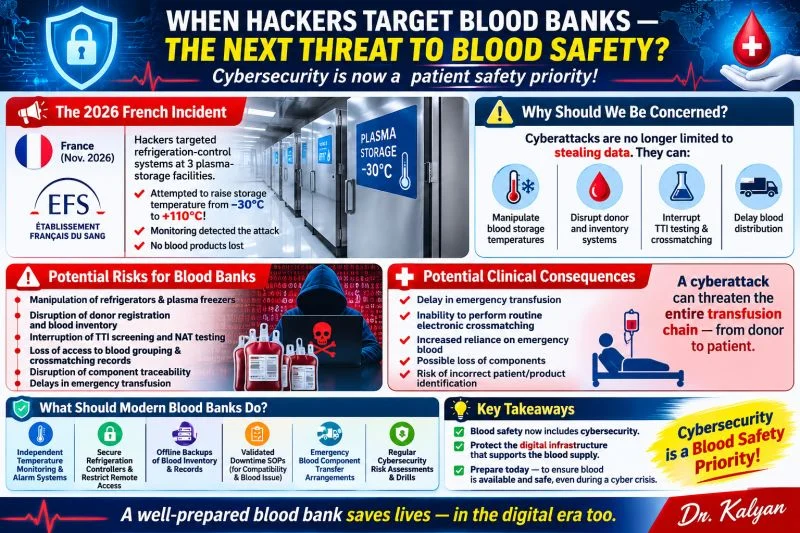
“When Hackers Target Blood Banks: Cybersecurity Is Now a Blood Safety Issue!
A disturbing cybersecurity incident reported in France in November 2026 has raised a serious concern for the global transfusion medicine community.
What happened?
Hackers reportedly targeted refrigeration-control systems associated with three plasma-storage facilities operated by Établissement français du sang (EFS), France’s national blood service.
- Temperature and defrost settings were reportedly manipulated remotely.
- The normal plasma storage temperature was approximately −30°C.
- Monitoring systems detected the abnormal settings.
- Staff intervened promptly, preventing product loss.
- Fortunately, no blood products or samples were compromised.
Why Should We Be Concerned?
Cyberattacks are no longer limited to stealing patient information or disrupting hospital software.
They can potentially threaten the physical integrity of blood components and the continuity of transfusion services.
Potential Risks for Blood Banks:
- Manipulation of blood storage refrigerators and plasma freezers.
- Disruption of donor registration and blood inventory systems.
- Interruption of TTI screening and NAT testing workflows.
- Loss of access to blood grouping and crossmatching records.
- Disruption of component traceability and blood distribution.
- Delays in emergency transfusion support.
What Should Modern Blood Banks Do?
- Independent temperature monitoring and alarm systems.
- Secure refrigeration controllers and restricted vendor remote access.
- Offline backups of essential blood inventory and transfusion records.
- Validated downtime SOPs for compatibility testing and blood issue.
- Emergency blood component transfer arrangements.
- Regular cybersecurity risk assessments and simulation exercises.
A Lesson for the Global Transfusion Community:
Blood safety is not just about preventing transfusion-transmitted infections, ensuring compatibility or maintaining component quality.
It is also about protecting the digital infrastructure that supports every step of the transfusion chain.
Cybersecurity Is Now a Patient Safety Priority.
Are our blood banks adequately prepared for a cyberattack that could compromise the blood cold chain?”
Find more posts featuring Kalyan Roy and David McIntosh on Hemostasis Today.
-
Nov 8, 2026, 19:31Anna Kajaste-Rudnitski: Presenting AAV-Induced p53 Signalling in Human CNS Cells at ESGCT 26
-
Nov 8, 2026, 19:26Wenxue Ma: An Integrative Framework for Macrophage-Mediated Therapeutic Resistance in Cancer
-
Nov 8, 2026, 19:25Yildiz Yigit: Presenting a Polycythemia Vera Case at the MPN Subcommittee Session
-
Nov 8, 2026, 18:56Denis Oduor: Strengthening the Regulation and Delivery of Blood Transfusion and Transplantation Services
-
Nov 8, 2026, 18:28Raghavendra Rao: A Narrative Review on Chronic Venous Disease during Pregnancy
-
Nov 8, 2026, 17:57Dhiren Patel: PLD1-Derived Phospholipids Regulate NAD Kinase and ROS Production in Neutrophils
-
Nov 8, 2026, 17:48Andra T.: What Causes Antiphospholipid Syndrome? – Four Steps, not One Cause
-
Nov 8, 2026, 17:38Nasrin Samadi: Can a Normal Clotting Test Be Misleading?
-
Nov 8, 2026, 17:36Paschalis Evangelidis: The Multifactorial Nature of Cardiovascular Risk in People With Hemophilia