


Abdul Mannan: Managing Bleeding in Acquired Haemophilia A – Choosing the Right Haemostatic Strategy
Abdul Mannan, Consultant Haematologist at Betsi Cadwaladr University Health Board, shared a post on LinkedIn:
“In acquired haemophilia A, the best haemostatic agent depends on the patient in front of you.
Acquired haemophilia A is not the moment to admire a prolonged APTT from a distance.
If the patient is bleeding, act early and involve a haemophilia centre.
The new BSH/UKHCDO guideline keeps the message practical:
- Control bleeding first
- Avoid trauma and procedures where possible
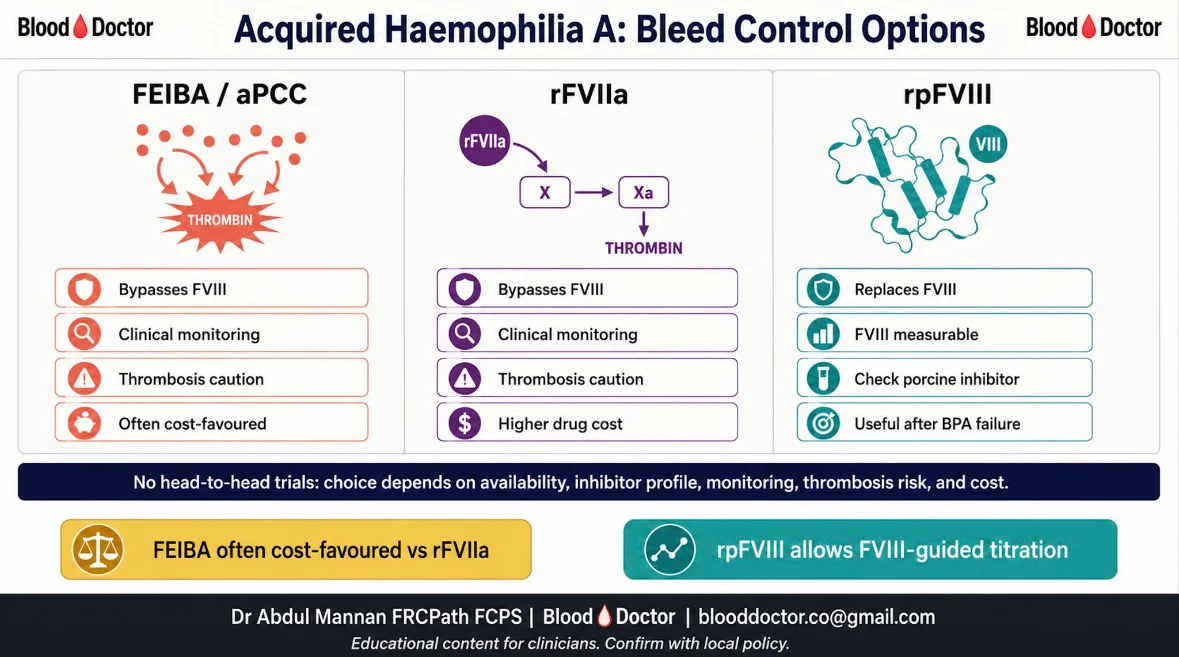
- Use rFVIIa, aPCC/FEIBA, or rpFVIII for bleeding patients
- Monitor bypassing agents clinically, not by routine clotting tests
- Use rpFVIII when FVIII measurement can guide treatment
- Start inhibitor eradication with immunosuppression, tailored to risk
The key point?
BSH does not crown one universal winner between FEIBA, rFVIIa, and rpFVIII.
The right choice depends on the bleed, thrombotic risk, anti-porcine FVIII inhibitor status, lab support, access, and local haemophilia centre practice.
FEIBA/aPCC and rFVIIa remain trusted bypassing options. rpFVIII has the practical advantage of measurable FVIII levels, which can be very helpful when the bleeding is severe or the response is unclear.
AHA is rare, but when it appears, it tends to theatre. The platelet count sits there innocently while the APTT does all the shouting.
What drives your first choice in AHA bleeding: thrombosis risk, lab monitoring, local access, or centre protocol?”
Find more posts from Abdul Mannan on Hemostasis Today.
-
Oct 19, 2026, 19:44Where You Live Should not Determine Whether You Receive Care – World Federation of Hemophilia
-
Oct 19, 2026, 19:42Belen Bianco: Prevention, Early Suspicion and an Interdisciplinary Approach Save Lives
-
Oct 19, 2026, 19:40Christina Chrysohoou: Catheter-Based LAAC vs OAC for Stroke Prevention in Atrial Fibrillation
-
Oct 19, 2026, 19:38Matthew Flick: A Two-Day Research Meeting on Fibrinogen, Hemostasis and Thrombosis
-
Oct 19, 2026, 19:37Hayat Saeed: Excited to Share Our Publication on the FGL1–Hepcidin Axis in Iron Homeostasis and Disease
-
Oct 19, 2026, 19:08IPAW 2026 Comes to a Close, but the Work Continues – PPTA
-
Oct 19, 2026, 17:44Paul Riley: Moderating a Webinar on Anticoagulation Monitoring
-
Oct 19, 2026, 16:36Christopher Pittman: Blood Clot Prevention Cannot End at Hospital Discharge
-
Oct 19, 2026, 16:13Javier M. Floren: When Immune Cells Move With Their Environment