


Abdul Mannan: What if Our First Move in Acquired Haemophilia A is Costing Frail Patients Time?
Abdul Mannan, Consultant Haematologist at Betsi Cadwaladr University Health Board, shared a post on LinkedIn:
“What if our first move in acquired haemophilia A is costing frail patients time?
Acquired haemophilia A is one of those haematology emergencies where delay hurts twice.
The patient is bleeding.
And the treatment itself, particularly prolonged steroid-heavy immunosuppression, can also cause harm.
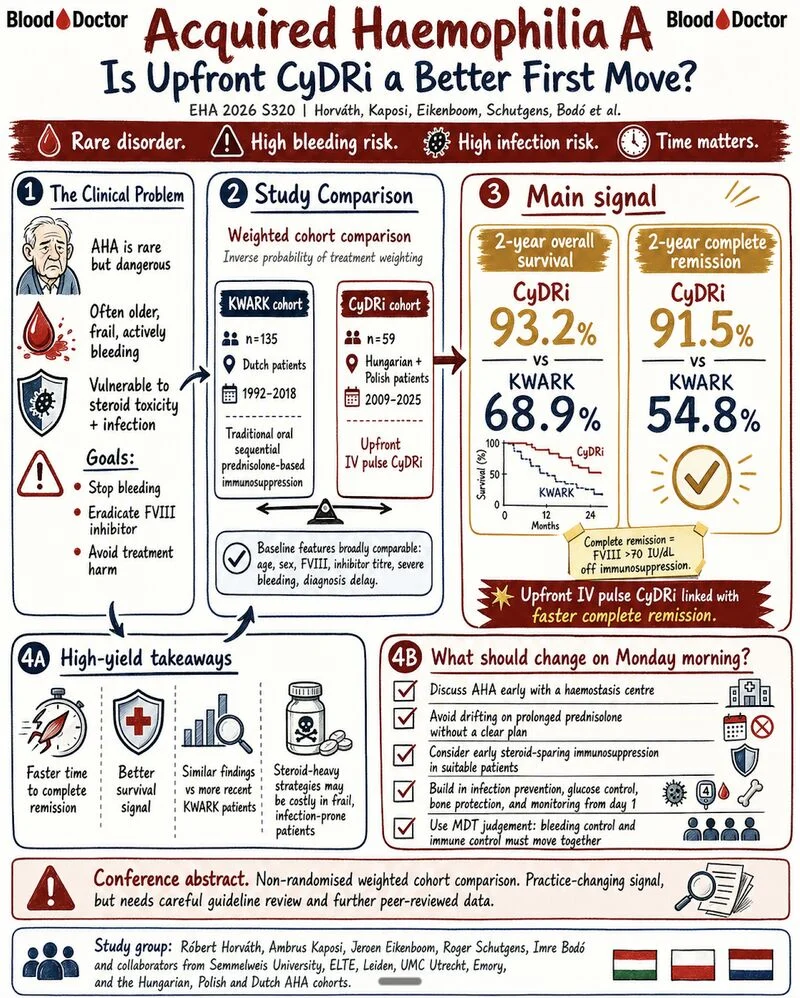
At EHA 2026, abstract S320 from Horváth, Kaposi, Eikenboom, Schutgens, Bodó and colleagues compared two real-world approaches in acquired haemophilia A using inverse probability of treatment weighting.
The comparison was between:
1. CyDRi cohort
This refers to patients treated with upfront intravenous pulse-dose CyDRi.
CyDRi is cyclophosphamide with dexamethasone and rituximab
This cohort included 59 Hungarian and Polish patients treated between 2009 and 2025.
2. KWARK cohort
This refers to the Dutch acquired haemophilia A cohort treated with traditional oral sequential prednisolone-based immunosuppression.
The KWARK cohort included 135 Dutch patients treated between 1992 and 2018.
Baseline features were reported as broadly comparable, including age, sex, factor VIII level, inhibitor titre, severe bleeding and diagnostic delay.
The signal was striking.
2-year overall survival
- CyDRi: 93.2%
- KWARK: 68.9%
2-year complete remission
- CyDRi: 91.5%
- KWARK: 54.8%
Complete remission was defined as factor VIII greater than 70 IU/dL off immunosuppression.
Why does this matter?
Because acquired haemophilia A is not just a bleeding disorder. It is a frailty, infection and treatment-toxicity problem as well. Many patients are older. Many are actively bleeding. Many are vulnerable to steroid complications, infection, hyperglycaemia, muscle loss and prolonged inpatient decline.
So the question is not simply:
‘How do we suppress the inhibitor?’
The better question may be:
‘How do we stop the bleeding, eradicate the inhibitor and minimise harm at the same time?’
My take:
This is a conference abstract, not a randomised trial. It is a non-randomised weighted cohort comparison, so we should avoid overclaiming.
But the clinical signal is hard to ignore.
It challenges the comfortable habit of starting with prolonged prednisolone and waiting to see what happens.
In suitable patients, earlier steroid-sparing combination immunosuppression may deserve serious discussion, especially within a haemostasis MDT.
Monday morning question:
Are we still drifting on prolonged prednisolone when a faster route to remission may exist?
Abbreviations used:
CyDRi – cyclophosphamide, dexamethasone and rituximab
KWARK – Dutch acquired haemophilia A cohort treated with traditional oral sequential prednisolone-based immunosuppression
Respect to Horváth, Kaposi, Eikenboom, Schutgens, Bodó and collaborators for raising a practical question that many haemostasis teams will recognise immediately.”
Other posts featuring Abdul Mannan on Hemostasis Today.
-
Sep 19, 2026, 18:03Manisha Madkaikar: Clinical, Hematological, and Molecular Features of Sickle β-Thalassemia
-
Sep 19, 2026, 17:24Jan Shawqi Goran: Understanding Beta Thalassemia Before Marriage Testing
-
Sep 19, 2026, 14:17Abdul Mannan: What Exactly Is a Platelet?
-
Sep 19, 2026, 13:39Keisuke Goda: Decoding Platelet Phenotypes in COVID-19 With Optofluidic Imaging
-
Sep 19, 2026, 13:30Targeted Thrombolysis Beyond tPA
-
Sep 19, 2026, 13:21Paul Armstrong: From Summer Studentship to Young Researcher
-
Sep 19, 2026, 13:06Rabiya Masood: Breaking the Cycle of Thalassemia Through Screening
-
Sep 19, 2026, 10:52Consuela A. Albright: The Critical Role of Black Blood Donors in Sickle Cell Treatment
-
Sep 19, 2026, 10:47Amber Yates: Inside Agios’ Partnership with the Sickle Cell Community