


Abdul Mannan: Pregnancy Changes Almost Every Coagulation Test
Abdul Mannan, Consultant Haematologist at Betsi Cadwaladr University Health Board, shared a post on LinkedIn:
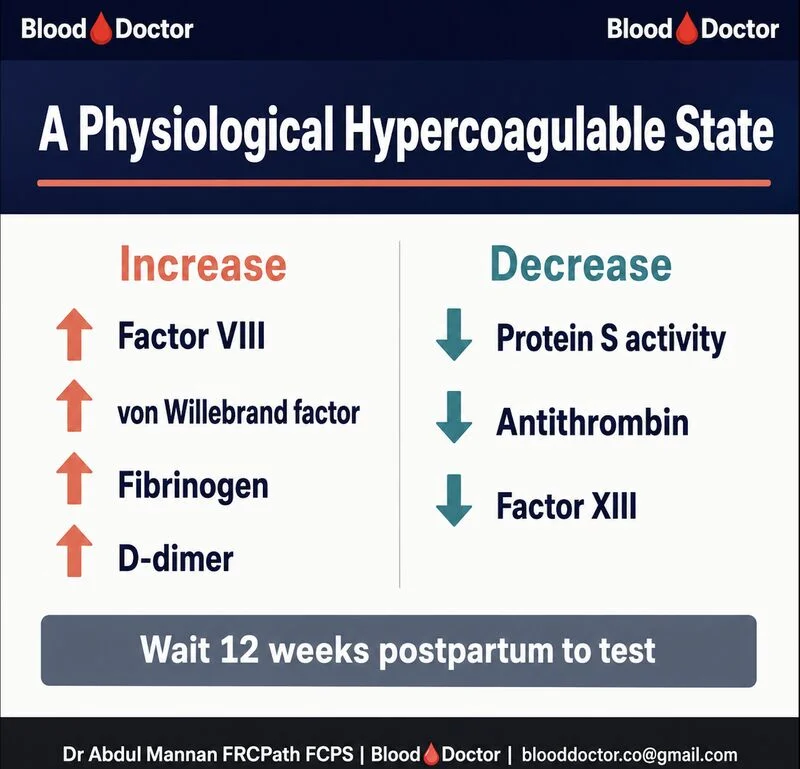
“Pregnancy Changes Almost Every Coagulation Test
Pregnancy is nature’s largest coagulation experiment.
As gestation progresses:
- High Factor VIII
- High Von Willebrand factor
- High Fibrinogen
- High D-dimer
- Low Protein S activity
- Low Antithrombin
- Low Factor XIII
The result is a physiological hypercoagulable state.
Why it matters at the bench and the bedside:
D-dimer rises through pregnancy, so it becomes unreliable for excluding VTE Protein S falls, so testing for protein S deficiency in pregnancy is not reliable
Thrombosis risk climbs
Mild bleeding disorders can look temporarily corrected
There is a practical consequence here.
Most of these changes take 6 to 7 weeks postpartum to settle, and some variables can take up to 12 weeks.
That is why haematologists usually wait at least 12 weeks postpartum before using lab tests to exclude conditions like von Willebrand disease.
Normal pregnancy is not normal haemostasis.”
More posts featuring Abdul Mannan on Hemostasis Today.
-
Sep 23, 2026, 07:28Isabelle Grenier-Pleau: Targeting Von Willebrand Disease to Transform Women’s Health
-
Sep 23, 2026, 07:07Wolfgang Miesbach: Mechanisms of Liver Injury After Hemophilia A Gene Therapy
-
Sep 23, 2026, 06:24Nicolas Gendron: Everolimus and Venous Thromboembolic Risk in Kidney Transplantation
-
Sep 23, 2026, 06:07Hoori Shahwar: Cerebral Venous Sinus Thrombosis Diagnosis and Management
-
Sep 23, 2026, 06:06Advancing Hemophilia Care and Patient Advocacy in Bangladesh – World Federation of Hemophilia
-
Sep 23, 2026, 05:54Bringing the Global Thrombosis and Haemostasis Community Together in 2027 – ISTH
-
Sep 23, 2026, 04:34David Akande: When Sickle Cell Crises Have No Clear Trigger
-
Sep 23, 2026, 04:13Jean Connors: Safety of Heparin Re-Exposure in Patients with Remote HIT
-
Sep 23, 2026, 04:09Beth Psaila: Applications Now Open for the Gordon Research Conference on Megakaryocytes and Platelets