


Abid Ur Rahman: Understanding the Coagulation Cascade and Hemostasis
Abid Ur Rahman, Laboratory Intern at Islamabad Diagnostic Centre, shared a post on LinkedIn:
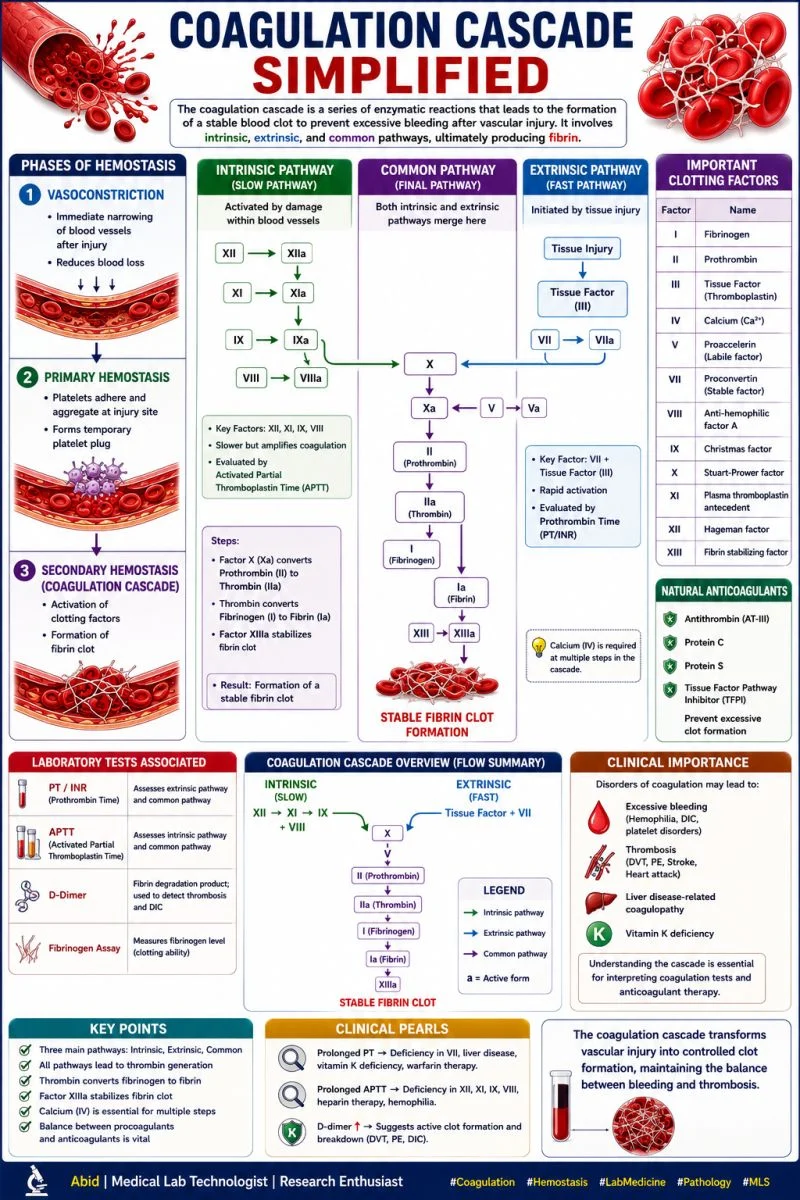
“Coagulation Cascade Simplified
The coagulation cascade is a complex series of enzymatic reactions that leads to the formation of a stable blood clot to prevent excessive bleeding after vascular injury.
It involves intrinsic, extrinsic, and common pathways, ultimately producing fibrin, which stabilizes the platelet plug.
Phases of Hemostasis
1.Vasoconstriction
- Immediate narrowing of blood vessels after injury
- Reduces blood loss
2.Primary Hemostasis
- Platelets adhere and aggregate at injury site
- Forms temporary platelet plug
3.Secondary Hemostasis (Coagulation Cascade)
- Activation of clotting factors
- Formation of fibrin clot
Extrinsic Pathway (Fast Pathway)
Initiated by tissue injury
Key Factor:
Factor VII (7) and Tissue Factor (Factor III)
Features:
- Rapid activation
- Evaluated by Prothrombin Time (PT/INR)
Pathway:
Tissue injury leads to Tissue Factor exposure, which activates Factor VII, resulting in Factor X activation.
Intrinsic Pathway (Slow Pathway)
Activated by damage within blood vessels
Key Factors:
Factor XII, Factor XI, Factor IX, and Factor VIII
Features:
- Slower but amplifies coagulation
- Evaluated by Activated Partial Thromboplastin Time (APTT)
Pathway:
Activation of Factor XII leads to activation of Factor XI, followed by activation of Factor IX together with Factor VIII, ultimately resulting in Factor X activation.
Common Pathway
Both intrinsic and extrinsic pathways merge here.
Key Factors:
Factor X, Factor V, Prothrombin, and Fibrinogen
Steps:
- Factor X converts Prothrombin into Thrombin
- Thrombin converts Fibrinogen into Fibrin
- Factor XIII stabilizes fibrin clot
Final Result:
Stable fibrin clot formation
Important Clotting Factors
Factor Name
- I Fibrinogen
- II Prothrombin
- III Tissue Factor
- IV Calcium
- VIII Anti-hemophilic factor A
- IX Christmas factor
- X Stuart-Prower factor
Natural Anticoagulants
- Antithrombin
- Protein C and Protein S
- Tissue Factor Pathway Inhibitor (TFPI)
Prevent excessive clot formation
Laboratory Tests Associated
- PT / INR evaluates Extrinsic pathway
- APTT evaluates Intrinsic pathway
- D-dimer reflects Fibrin degradation
- Fibrinogen assay assesses Clotting ability
Clinical Importance
Disorders of coagulation may lead to:
- Excessive bleeding (Hemophilia, DIC)
- Thrombosis (DVT, PE)
- Liver disease-related coagulopathy
- Vitamin K deficiency
Understanding the cascade is essential for interpreting coagulation tests and anticoagulant therapy.
The coagulation cascade transforms vascular injury into controlled clot formation, maintaining the balance between bleeding and thrombosis.”
Stay updated with Hemostasis Today.
-
Oct 10, 2026, 17:58Archo Farzana Batool: Exploring Medical Writing Through an Article on Iron Deficiency Anemia
-
Oct 10, 2026, 17:53Assessing Frailty in Adults With Hemophilia – JTH
-
Oct 10, 2026, 17:52Fatma Sadeghi: Reducing Maternal Health Inequalities Through Nursing Advocacy
-
Oct 10, 2026, 17:50Grzegorz Hensler: How Apheresis Transformed Blood Cell Separation and Collection
-
Oct 10, 2026, 17:47Hemant K Sharma: Japan’s Universal Artificial Blood Research – A Potential Breakthrough in Transfusion Medicine
-
Oct 10, 2026, 17:40John Strouse: Learning About Bleeding Disorders and Sickle Cell Disease at FWGBD
-
Oct 10, 2026, 17:34Mae Caime: Speaking at the Annual Women’s Retreat for the Hemophilia Community in Florida
-
Oct 10, 2026, 17:30Chokri Ben Lamine: PNH beyond the Textbook Triad
-
Oct 10, 2026, 17:29Ruah Alyamany: Thrombosis and Anticoagulation in Hematological Malignancies at SOHO KSA 2026