


Anu Thomas: ET vs IUT – Two Life-Saving Procedures, Different Stages of Care
Anu Thomas, Assistant Professor at Government Medical College, Kozhikode, shared a post on LinkedIn:
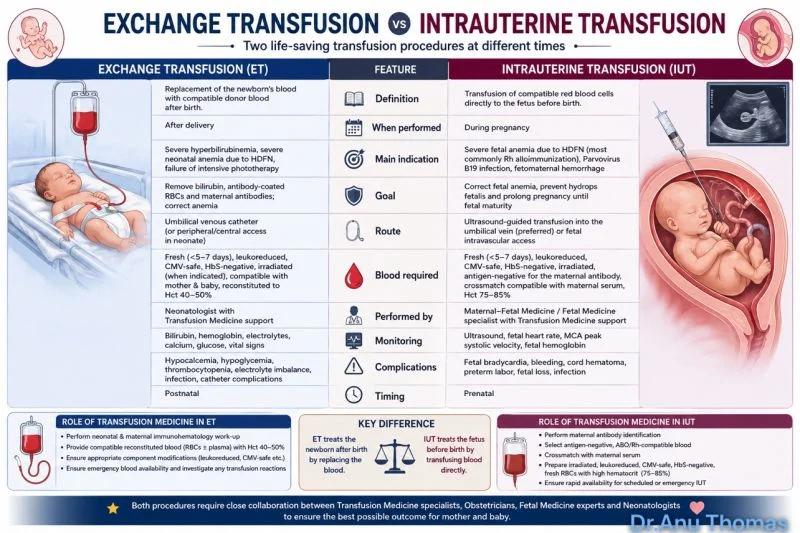
“Exchange Transfusion (ET) vs Intrauterine Transfusion (IUT): Two Life-Saving Procedures, Different Stages of Care
Although both procedures are used to manage severe fetal and neonatal anemia, they serve different purposes.
- Intrauterine Transfusion (IUT) is performed before birth to treat fetal anemia, most commonly due to red cell alloimmunization. It helps prevent hydrops fetalis, improves fetal well-being, and allows pregnancy to continue safely.
- Exchange Transfusion (ET) is performed after birth to rapidly reduce bilirubin levels, remove antibody-coated red cells, and correct severe anemia in newborns with hemolytic disease.
The Department of Transfusion Medicine plays a pivotal role in both procedures by ensuring accurate immunohematological evaluation, selection of compatible and appropriately modified blood components, and timely support to achieve the best possible outcomes for both mother and baby.
Together, multidisciplinary collaboration between Transfusion Medicine, Fetal Medicine, Obstetrics, and Neonatology makes these life-saving interventions possible.”
Stay updated with Hemostasis Today.
-
Sep 19, 2026, 18:03Manisha Madkaikar: Clinical, Hematological, and Molecular Features of Sickle β-Thalassemia
-
Sep 19, 2026, 17:24Jan Shawqi Goran: Understanding Beta Thalassemia Before Marriage Testing
-
Sep 19, 2026, 14:17Abdul Mannan: What Exactly Is a Platelet?
-
Sep 19, 2026, 13:39Keisuke Goda: Decoding Platelet Phenotypes in COVID-19 With Optofluidic Imaging
-
Sep 19, 2026, 13:30Targeted Thrombolysis Beyond tPA
-
Sep 19, 2026, 13:21Paul Armstrong: From Summer Studentship to Young Researcher
-
Sep 19, 2026, 13:06Rabiya Masood: Breaking the Cycle of Thalassemia Through Screening
-
Sep 19, 2026, 10:52Consuela A. Albright: The Critical Role of Black Blood Donors in Sickle Cell Treatment
-
Sep 19, 2026, 10:47Amber Yates: Inside Agios’ Partnership with the Sickle Cell Community