


Ayuka King-Percival: Understanding Platelet Aggregation Testing
Ayuka King-Percival, Senior Medical Technologist, Head of Hematology at LABORATORY, Adjunct Lecturer at College of Science, Technology and Applied Arts of Trinidad and Tobago-COSTAATT, shared a post on LinkedIn:
“Understanding Platelet Aggregation Testing: A Simple Analogy
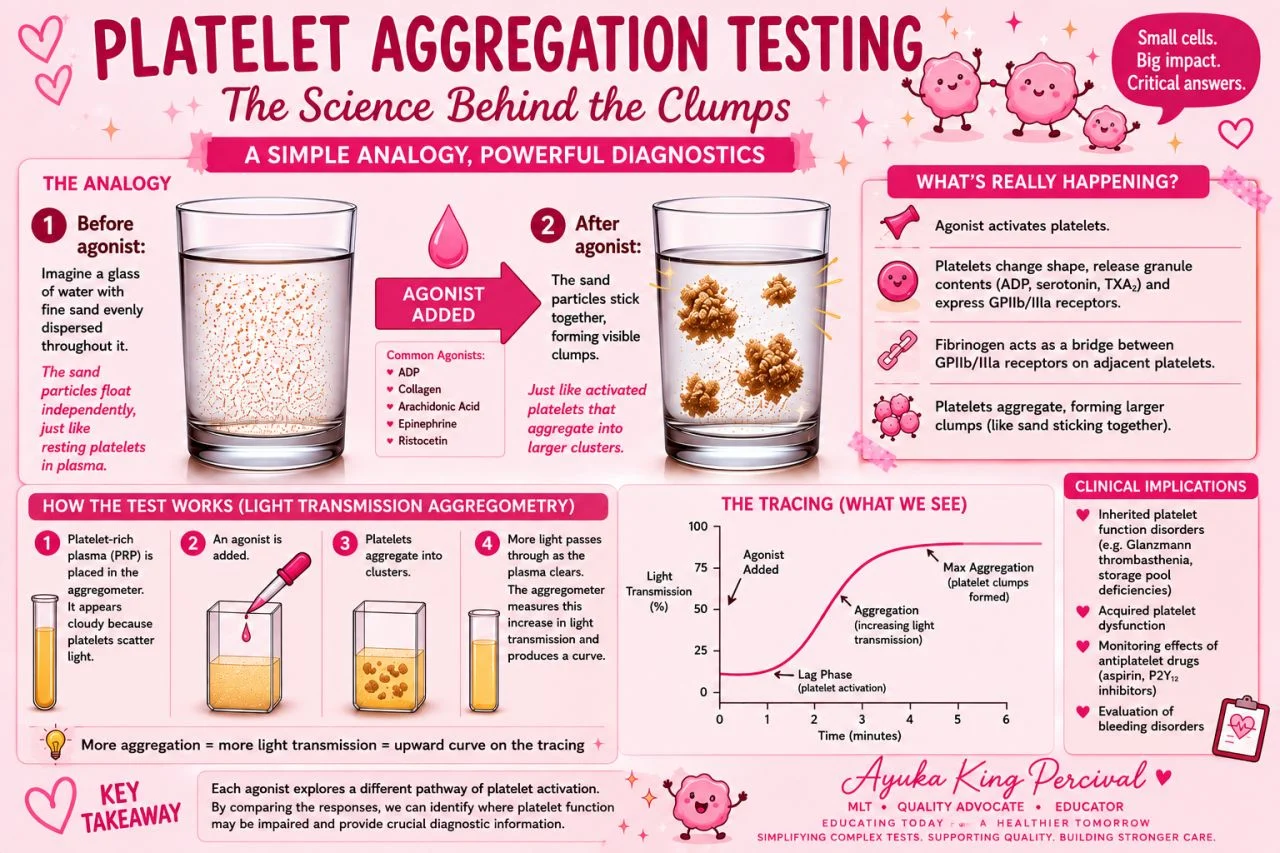
Platelet aggregation testing is one of the most fascinating investigations in haemostasis because it allows us to evaluate how well platelets respond to different activating agents (agonists). While the technology is sophisticated, I often explain the concept using a simple glass of water and sand.
Imagine a glass of water with fine sand evenly dispersed throughout it.
At first, the sand particles are floating independently, much like resting platelets circulating in our bloodstream.
Now imagine adding a special ingredient. Suddenly, the individual grains begin sticking together, forming visible clumps.
This is similar to what happens during platelet aggregation testing.
The ‘special ingredient’ represents an agonist such as ADP, collagen, arachidonic acid, epinephrine, or ristocetin. Rather than physically sticking platelets together, the agonist activates them. Activated platelets change shape, release the contents of their granules, and express GPIIb/IIIa receptors on their surface.
Fibrinogen then acts as a bridge between these receptors, allowing platelets to aggregate and form larger clumps.
In light transmission aggregometry (LTA), platelet-rich plasma initially appears cloudy because platelets scatter light. As platelets aggregate into larger clusters, the plasma becomes clearer, allowing more light to pass through. The aggregometer measures this increase in light transmission and generates characteristic curves for each agonist.
These patterns are invaluable in investigating:
- Inherited platelet function disorders
- Acquired platelet dysfunction
- The effects of antiplatelet medications such as aspirin or P2Y12 inhibitors
- Certain bleeding disorders
What makes platelet aggregometry so powerful is that each agonist explores a different activation pathway. By comparing the responses, the laboratory can identify where platelet function may be impaired and provide clinicians with crucial diagnostic information.
Complex science becomes much easier to understand when we can connect it to everyday experiences.
Sometimes, a simple glass of water and sand is all it takes to make platelet aggregation come to life.”
Stay updated with Hemostasis Today.
-
Sep 21, 2026, 15:56Anita Zaidi: Why Only 2% of Health Research and Development Goes to Women’s Conditions
-
Sep 21, 2026, 15:49Omid Khalafi: Gating Strategy and How Do We Decide Which Cells to Analyze
-
Sep 21, 2026, 15:44Levacetylleucine: A New Therapeutic Approach to Ataxia Telangiectasia
-
Sep 21, 2026, 15:40Andreas Tridimas: The Diagnostic Traps of Lipaemic Blood – Why a Normal Amylase Can Mislead You
-
Sep 21, 2026, 15:33Arsene Mekinian: Exploring Cardiac Involvement in Behçet’s Disease
-
Sep 21, 2026, 15:23Anis Mahjoubi: MRI Findings of Krukenberg Tumors
-
Sep 21, 2026, 15:08Fikreab Tesfaye Tefera: 10 Practical Take-Home Points for Diagnosing Iron Deficiency Anemia
-
Sep 21, 2026, 14:10Aswin K Mohan: Lessons from TRANSCON 2026 – Building Resilient Blood Supply Systems Before Crisis Hits
-
Sep 21, 2026, 14:00Vincent Lu: Beyond PT and aPTT – How Hemostasis Evolves Across a Lifetime