


Bastu Odoka: Same Blood Group Does Not Guarantee Compatibility
Bastu Odoka, Transfusion Scientist at Effia-Nkwanta Regional Hospital, shared a post on Linkedin:
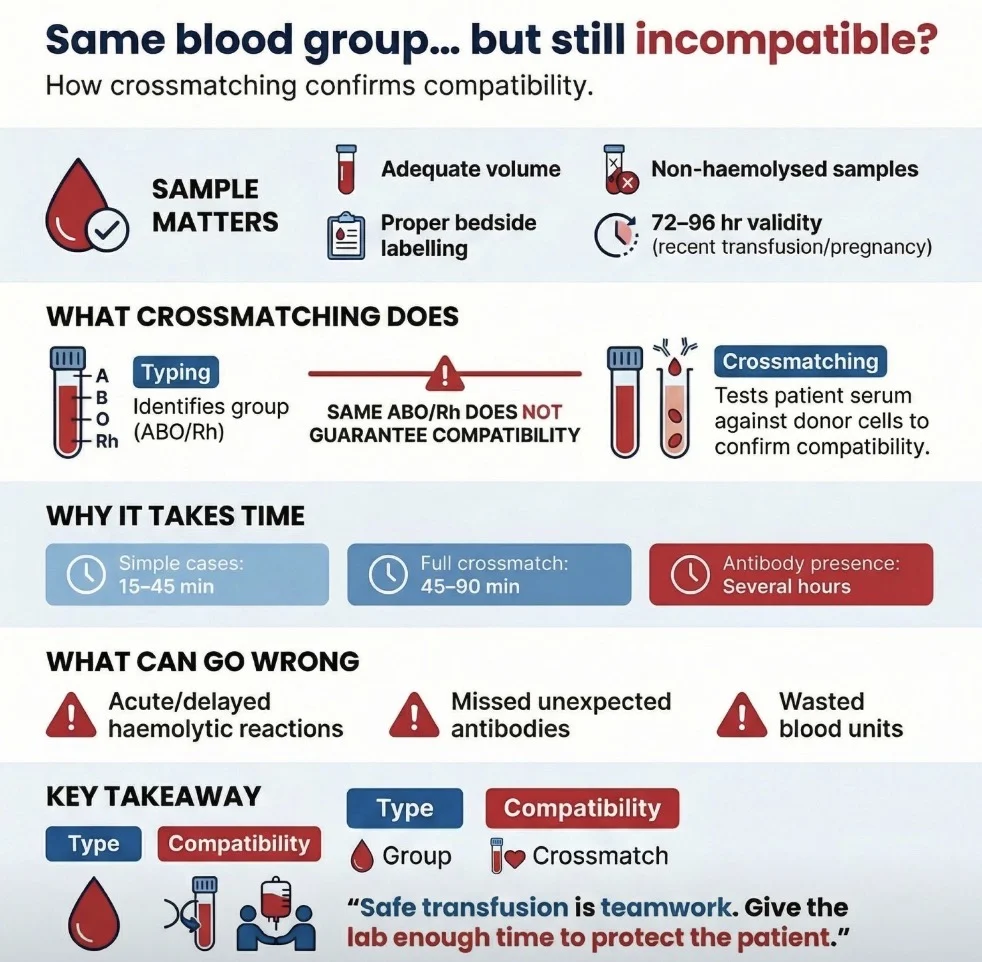
“Same blood group… but still incompatible?
A practical reminder for clinical teams.
Knowing the blood group (ABO and Rh) is only the first step.
Safe transfusion doesn’t stop there.
It requires proper compatibility testing, crossmatching.
Here’s what is often overlooked
1. Sample requirements matter
For safe crossmatching, the blood bank needs:
- Adequate sample volume
Based on your laboratory SOP (3-5mls) - Proper bedside labelling
- A non-haemolysed sample
Gross haemolysis can interfere with interpretation - A fresh sample, when required
If the patient has been recently transfused, pregnant within the last 3 months, or history is uncertain:
The sample should be within 72–96 hours
In stable patients with no recent transfusion or pregnancy:
Sample validity may be longer, depending on local policy
Why?
Because new antibodies can develop.
2. What crossmatching actually does
Crossmatching tests the patient’s serum against donor red cells to help detect incompatibility and confirm the unit is safe to use.
Same ABO and Rh does not always mean compatible blood.
3. How long does crossmatching take?
It depends on the situation, the method used, and the patient’s antibody history.
- Simple cases may be completed relatively quickly (~15-45 mins)
- Full (IAT/AHG) crossmatch takes longer (~45-90 mins).
If antibodies are present:
- It can take several hours or more
- Safe transfusion takes time.
Why this matters
Using an invalid sample or rushing compatibility testing increases the risk of:
- Acute haemolytic transfusion reactions
- Delayed reactions
- Missed antibodies (alloimmunisation)
- Wasted blood units
Key takeaway
- Blood group tells you the type
- Crossmatch confirms compatibility of the unit
- Fresh, properly collected samples protect patients
- Give the lab enough time to do it right
Safe transfusion is teamwork between the clinical team and the blood bank.
Bastu Odoka
Medical Laboratory Scientist
ENRH Blood Bank”
Other posts featuring Bastu Odoka on Hemostasis Today.
-
Oct 9, 2026, 16:23David Boone: Distinguishing Stroke Prevention from Rhythm Control in Atrial Fibrillation
-
Oct 9, 2026, 15:27Mohamed Hegazi: Geostatistical Modelling Maps Global β-Thalassaemia Carrier Prevalence
-
Oct 9, 2026, 15:15Maha Othman: Uncovering the Consensus on TXA in TBI – Call for Collaboration on a Landmark Umbrella Review
-
Oct 9, 2026, 15:07Daniel D. Han: How Inhalation Product Exposure Impairs Cardiac and Platelet Recovery After MI
-
Oct 9, 2026, 14:58William Toole: How Ultrasound-Guided PRP Therapy Relieves Joint and Tendon Pain
-
Oct 9, 2026, 14:50Shayan Mohammadmoradi: In Corpus Christi for the 20th Midwest Platelet Conference
-
Oct 9, 2026, 14:37Tariq Tramboo: High Platelet Concentrate for Osteoarthritis Knee – Recent Meta-Analyses
-
Oct 9, 2026, 14:26Yousma Khan: Hematology Series – Beyond RBCs, WBCs and Platelets
-
Oct 9, 2026, 14:13Jesus Ardila Novoa: Why the WHO’s Historic Essential Medicines List Decision Is Just the Beginning