

Bastu Odoka: Principles of Pediatric Transfusion Dosing
Bastu Odoka, Transfusion Scientist at Effia-Nkwanta Regional Hospital, shared a post on LinkedIn:
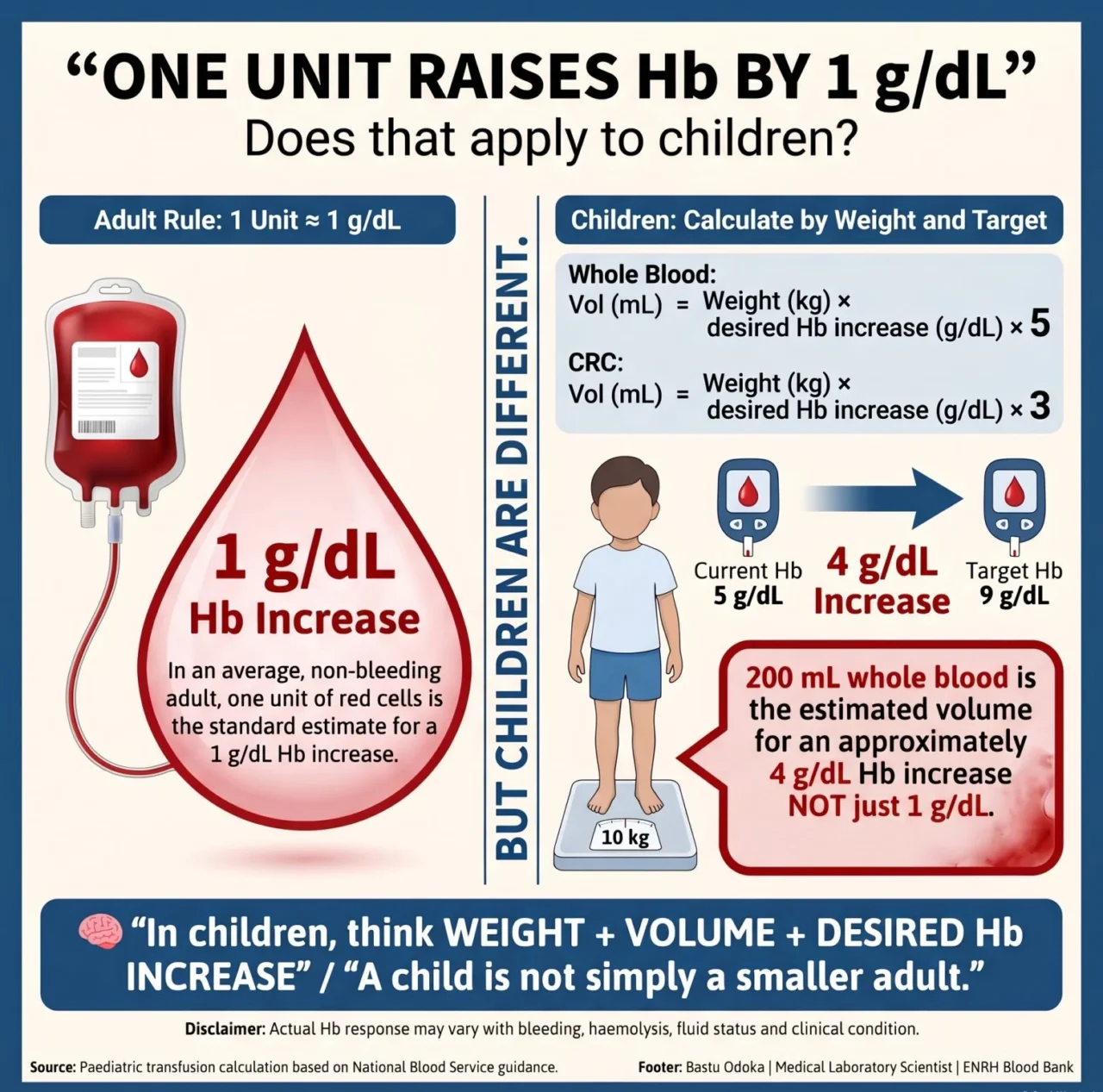
“One unit of blood raises Hb by about 1 g/dL.
But does that apply to children?
Last week, a clinician came to the blood bank to secure blood for a 10 kg child being prepared for surgery.
The request was:
- 200 mL whole blood × 2
The initial 200 mL wasn’t the problem. In our setting, 20 mL/kg of whole blood is commonly used for children, which gives:
- 10 kg × 20 mL/kg = 200 mL
The misunderstanding was about the expected rise in hemoglobin.
There was an assumption that the first 200 mL would raise the child’s Hb by about 1 g/dL, and another 200 mL would provide a further increase.
We discussed the calculation together, particularly the fact that the desired Hb rise is already factored into the calculated volume.
Based on the child’s weight and the desired Hb increase, we agreed that 200 mL of whole blood was appropriate.
According to the National Blood Service guidance we use:
- Whole blood (mL):
Weight (kg) × desired Hb increase (g/dL) × 5
- Concentrated red cells (mL):
Weight (kg) × desired Hb increase (g/dL) × 3
So, let’s take a 10 kg child with an Hb of 5 g/dL, and suppose the desired Hb is 9 g/dL.
Desired Hb increase = 4 g/dL
For whole blood:
10 × 4 × 5 = 200 mL
So that 200 mL is already the estimated volume required for an approximately 4 g/dL rise, not 1 g/dL.
This is where the familiar adult rule of thumb can cause confusion.
In an average, non-bleeding adult, one unit of red cells is commonly expected to raise Hb by approximately 1 g/dL.
In children, however, the volume and desired Hb increase are calculated together.
Of course, the actual Hb response may vary with ongoing bleeding, haemolysis, fluid status and the child’s clinical condition.
Key message:
The rule of thumb we use in adults does not apply the same way to children.
For children, think weight plus desired Hb increase plus volume.”
Other posts featuring Bastu Odoka on Hemostasis Today.
-
Sep 18, 2026, 12:54David McIntosh: Plasma Therapies and the Unfinished Global Access Mission
-
Sep 18, 2026, 11:10R. Stephani Hellwege: Beyond LVEF Echocardiographic Assessment of Undifferentiated Shock
-
Sep 18, 2026, 06:48Gopal Patidar: Honoured to Contribute to the ASFA 2026 Guidelines for Therapeutic Apheresis
-
Sep 18, 2026, 05:48Julie Taylor: Navigating Tech Glitches to Deliver Engaging BBTS Presentation
-
Sep 18, 2026, 05:42Emma Copperwaite: BBTS Conference Presentation Highlights Power of Peer Support and Pushing Past Fear
-
Sep 18, 2026, 05:34Suhasini Sil: RGSSH Joins Mega Blood Donation Camp at Thyagaraj Stadium
-
Sep 18, 2026, 05:25Lisa Laun: Spleen Clears Activated Platelets to Limit Thrombosis and Inflammation
-
Sep 18, 2026, 05:16Louise St. Germain Bannon: ISTH Advocates for Enhanced Patient Safety in Blood Disorder Care
-
Sep 18, 2026, 05:08Vikas Veer: Exploring Sickle Cell Anemia at the Molecular Level