


environment.uq.edu.au
Feb 23, 2026, 17:42
Bryan Fry: First Evidence That Bothrops atrox Venom Directly Activates Human Factor VII
Bryan Fry, Professor of Toxicology at the University of Queensland, shared a post on LinkedIn, about a recent article he and his colleagues co-authored, adding:
”Highlights
- Neonate Bothrops atrox venom is far more procoagulant than adult venom on plasma and fibrinogen.
- Neonate venom activates prothrombin and Factor VII via FVa-dependent pathways more strongly than adults.
- We provide the first evidence that Bothrops atrox venom directly activates human Factor VII.
- Clinically used antivenoms neutralise adult venom better than neonate venom; Butantan performs best.
- Findings indicate high coagulopathy risk after neonate bites and support adding neonate venom to antivenom immunizing mixture.”
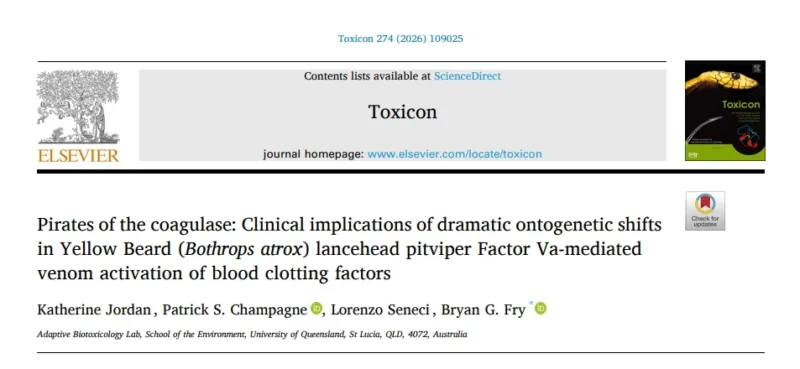
Title: Pirates of the coagulase: Clinical implications of dramatic ontogenetic shifts in Yellow Beard (Bothrops atrox) lancehead pitviper Factor Va-mediated venom activation of blood clotting factors
Authors: Katherine Jordan, Patrick S. Champagne, Lorenzo Seneci, Bryan G. Fry
Read the Full Article on Toxicon.
Stay updated with Hemostasis Today.
-
Oct 9, 2026, 12:03Heather Case: Bridging Awareness and Action in Women’s Hemophilia Care
-
Oct 9, 2026, 11:58Brandon Luu: Can Iron Deficiency Cause Fatigue Without Anemia?
-
Oct 9, 2026, 11:51Sumaiya Dickens: Marginal Zone B Cells in Transfusion Medicine and Hemophilia A Research
-
Oct 9, 2026, 11:44Ayyappan V Nair: PRP and Rehabilitation – Can It Help Athletes with Partial Rotator Cuff Tears?
-
Oct 9, 2026, 11:29Jigesha Dholakia: Supporting the Hemophilia Community Through the Unite Walk
-
Oct 9, 2026, 11:06Nobles Green: How siRNA Therapy Helps the Body Form Stronger Clots
-
Oct 9, 2026, 10:53Switching From Emicizumab to Denecimig in Hemophilia A – Rare Disease Advisor
-
Oct 9, 2026, 10:40What New U.S. Data Reveal About GT – Glanzmann’s Research Foundation
-
Oct 9, 2026, 10:32Anjali Pandey: The Morphologic Clues to MDS With del(5q)