


Dip Ghosh: How CPDA-1 Keeps Transfusions Safe and Effective
Dip Ghosh, Student at North South University, shared a post on LinkedIn:
“A single unit of blood can save multiple lives – but only if science preserves it effectively before transfusion.
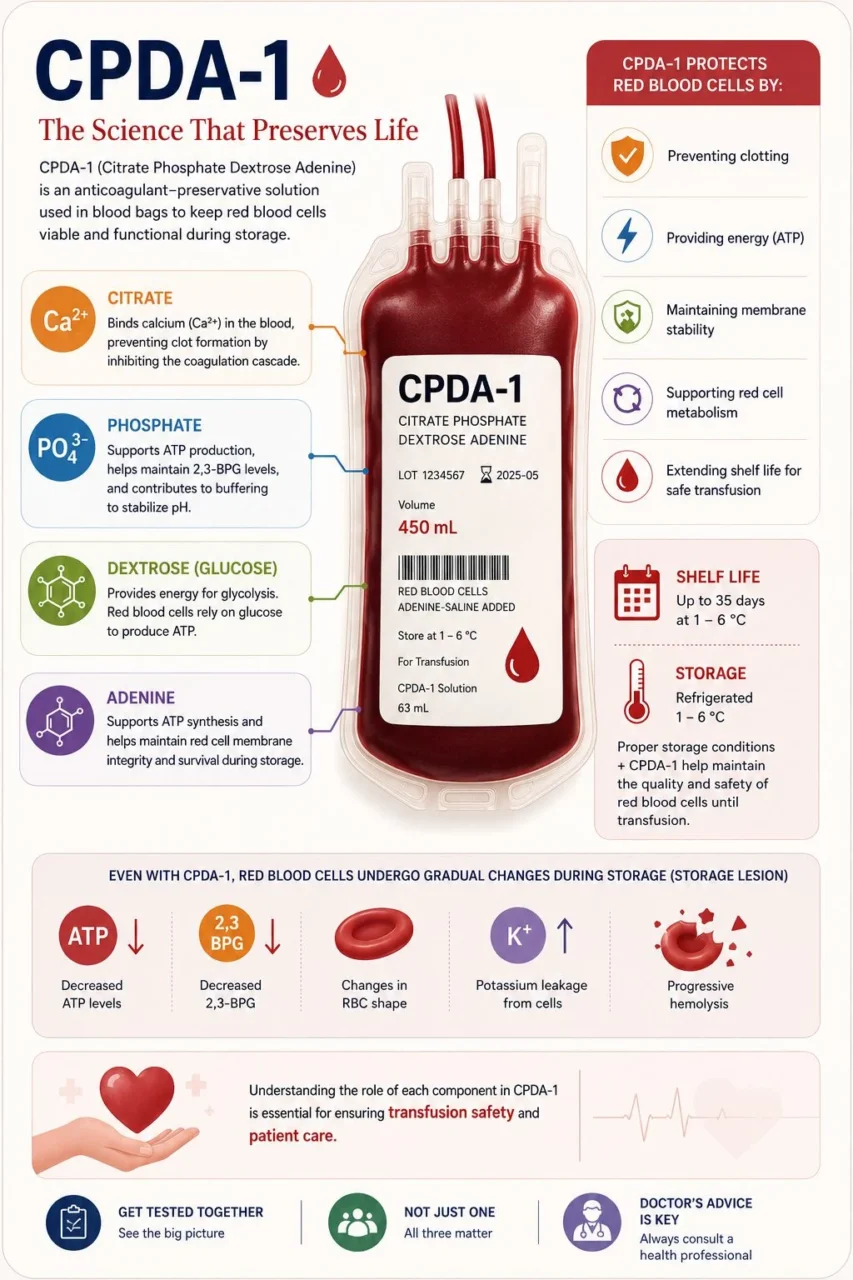
Behind every safe transfusion lies CPDA-1 (Citrate Phosphate Dextrose Adenine), a preservative-anticoagulant solution that revolutionized blood banking by extending red blood cell (RBC) storage while maintaining cellular viability and function.
Each component plays a unique role:
- Citrate – Prevents coagulation by binding calcium ions and interrupting the clotting cascade.
- Phosphate – Supports ATP production and stabilizes pH balance.
- Dextrose – Provides glucose for glycolysis, the main energy source for RBC survival.
- Adenine – Enhances ATP synthesis, helping preserve membrane integrity and post-transfusion survival.
With refrigeration at 1–6°C, CPDA-1 can preserve RBCs for up to 35 days, improving blood availability for trauma care, surgery, oncology, and emergency medicine.
According to the World Health Organization, more than 118 million blood donations are collected globally every year, making effective blood preservation essential for modern healthcare (World Health Organization [WHO], 2024).
Research shows that maintaining ATP levels is critical because red blood cells lack mitochondria and rely entirely on glycolysis for energy production (Hess, 2010).
ATP preservation helps maintain membrane flexibility, ion transport, and overall cell survival during storage.
However, even under optimal conditions, stored blood develops ‘storage lesions,’ including:
- Decreased ATP levels
- Reduced 2,3-BPG
- Potassium leakage
- Oxidative membrane damage
- Shape changes and progressive hemolysis
Studies suggest that reduced 2,3-BPG can impair oxygen release from hemoglobin, potentially affecting tissue oxygenation after transfusion (Yoshida et al., 2019). Potassium accumulation may also become clinically significant during massive or neonatal transfusions (Zimring, 2015).
International quality standards require stored RBCs to maintain approximately 75% survival 24 hours after transfusion, highlighting the importance of preservation science (Hess, 2010).
Modern transfusion medicine continues evolving through additive solutions, leukoreduction, pathogen reduction technology, and advanced storage research to improve patient outcomes.
For laboratory professionals, understanding CPDA-1 is more than theory – it directly supports:
- Patient safety
- Transfusion effectiveness
- Quality assurance
- Evidence-based laboratory practice
Every blood bag represents more than stored cells.
It represents science, donor generosity, and the silent precision of laboratory medicine working to save lives every day.
If this taught you something new, share it and help strengthen safety culture in science.”
 \
\
Stay updated with Hemostasis Today.
-
Oct 17, 2026, 09:33Robert Lookstein: Mechanical Thrombectomy Shows Functional Benefits in Intermediate-High-Risk PE
-
Oct 17, 2026, 09:18Sarra Hmidi: Tunisia Highlights Thrombosis Prevention on World Thrombosis Day
-
Oct 17, 2026, 09:05Addressing the Hidden Burden of Bleeding Disorders in Women – Hemophilia Society Mumbai Chapter
-
Oct 17, 2026, 08:49Maria Magnusson: Karolinska Experts Explore Gene Therapy in Sickle Cell Disease and Hemophilia
-
Oct 17, 2026, 04:07Weihao Li: Global HEPATIC Registry Findings on Post-Transplant Arterial Thrombosis
-
Oct 17, 2026, 03:56Ghaith Abu-Zeinah: ASH Publishes 2026 Guidelines for Myelofibrosis Management in Blood Advances
-
Oct 17, 2026, 03:48Tristan Siokos: Why Vascular Occlusion Is More Than Just Clots – Breakdown of the 8 Pathways
-
Oct 17, 2026, 02:36Archil Jaliashvili: Oxygen Transport in Capillaries
-
Oct 17, 2026, 02:35Carly Newton: Understanding Access to Red Blood Cell Exchange for People Living With SCD