

Farjah Algahtani: Stroke Incidence and Risk Factors in Saudi Patients with Sickle Cell Disease
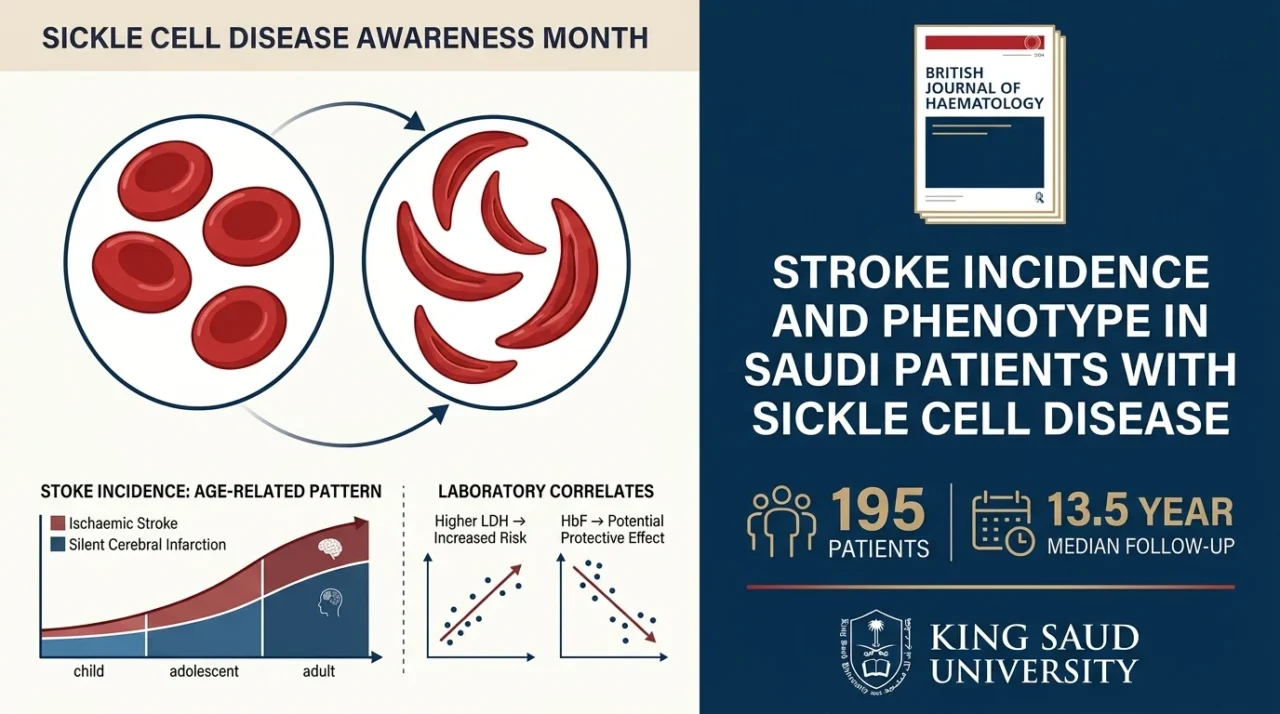
Farjah Algahtani, Director of Epidemiology and Public Health Research at King Saud University, Professor Of Hematology, shared a post on LinkedIn about a recent article he and his colleagues co-authored, published in British Journal of Haematology, adding:
“As we mark Sickle Cell Disease Awareness Month, I am especially proud to contribute to improving our understanding of this complex disease and its complications in our Saudi population.
There is still much to learn about the unique phenotypes, risk factors, and long-term outcomes of patients with SCD.
I am sharing the results of our longitudinal study, ‘Stroke Incidence and Phenotype in Saudi Patients with Sickle Cell Disease,’ published in the British Journal of Haematology.
In this study of 195 Saudi patients with SCD, followed for a median of 13.5 years, we explored the incidence, phenotype, and laboratory correlates of stroke. Our findings highlight an important age-related pattern of stroke and the significant burden of both overt stroke and silent cerebral infarction.
We also found that higher LDH was associated with increased ischaemic stroke risk, while HbF showed a potentially protective effect.
I would like to extend my sincere thanks and appreciation to all the authors and collaborators for their valuable contributions and dedication to this important work.
Most importantly, a special thank you to our patients and their families, whose participation and trust made this research possible.
I hope that through continued research, collaboration, and awareness, we can contribute more to improving the lives and outcomes of people living with sickle cell disease.
Proud to be part of this important work and to collaborate with my colleagues at King Saud University.”
Title: Stroke incidence and phenotype in Saudi patients with sickle cell disease: A longitudinal cohort study
Authors: Mohammed Al-Agha, Fahad Albadr, Aamer Aleem, Farjah H. Algahtani, Ali Al-Shehri, Fahad Bashiri, Abdulrahman Alsultan
Stay updated on all scientific advances with Hemostasis Today.
-
Sep 14, 2026, 20:53YoonHwa An: Rusfertide in Polycythemia Vera – From Clinical Benefit to Strategic Value
-
Sep 14, 2026, 20:52Andres Alberto Mercado Pompa: External Validation of Prognostic Risk Scores in Cerebral Venous Thrombosis
-
Sep 14, 2026, 20:50Balaji Kirushnan: Advancing Regional Citrate Anticoagulation in CRRT – From Experience to Implementation
-
Sep 14, 2026, 20:48Valerie Dehondt: Nutritional Anemia Is Associated With Increased Risk of Severe COPD Exacerbations
-
Sep 14, 2026, 20:46Nupur Choudhury: Exploring AI-Based Detection of Anemia Using Eye and Fingernail Images
-
Sep 14, 2026, 20:44Shamee Shastry: Chart Before You Chase – Diagnosing Drug-Induced Hemolytic Anemia
-
Sep 14, 2026, 20:43David Reiner: Blood Tests That Can Reveal Nutrition Clues
-
Sep 14, 2026, 20:40Giuseppe Biondi Zoccai: Balancing Thrombosis and Bleeding in Acute MI With Hemophilia A
-
Sep 14, 2026, 20:39Kemal Karaagac: Kounis Syndrome as a Possible Cause of Very Late Stent Thrombosis