


Hannah Omunakwe: When Blood Becomes the Limiting Treatment in Sickle Cell Disease
Hannah Omunakwe, Lecturer at Rivers State University, Consultant Haematologist at Rivers State University Teaching Hospital, shared a post on LinkedIn:
“What if the biggest challenge in sickle cell care isn’t the disease, but the blood bank?
A child with severe anaemia. A clear diagnosis. A life-saving treatment.
Then comes the call:
‘There’s no blood available.’
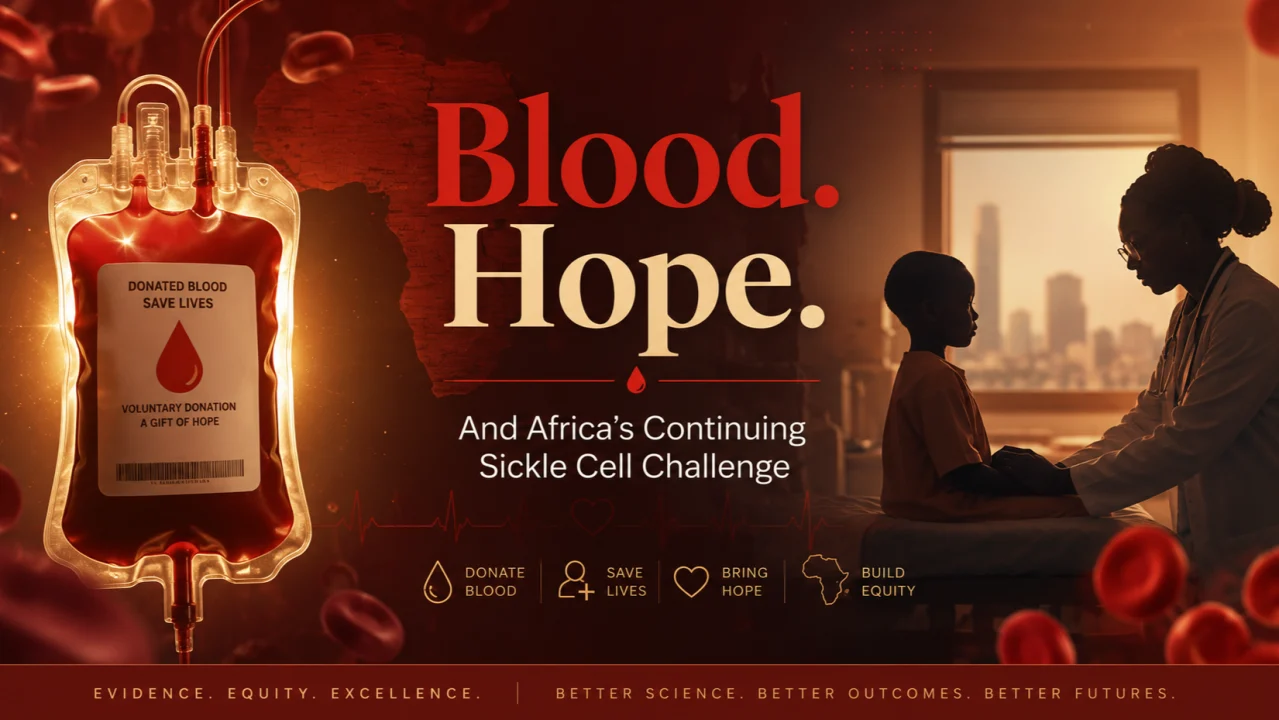
In this month’s Vital Signs, let’s think on why World Blood Donor Day and World Sickle Cell Day are really one conversation and why blood remains one of Africa’s greatest unmet needs in haematology.
June Left Us with Two Reminders We Shouldn’t Forget
June may be over, but it left behind an important reminder.
Within just five days, the world marked World Blood Donor Day (June 14) and World Sickle Cell Day (June 19). On paper, they’re separate awareness events. In African hospitals, they’re often the same story.
Picture a child with sickle cell disease arriving after days of severe pain and profound anaemia. The diagnosis is straightforward. The treatment is clear.
Then the blood bank calls back:
‘There’s no blood available.’
In that moment, years of medical training, clinical guidelines, and even tomorrow’s gene therapies become irrelevant.
Because without blood, nothing moves.
Blood: The Medicine We Often Forget
The theme for World Blood Donor Day 2025 was simple yet powerful: ‘Give Blood. Give Hope. Together We Save Lives.’
A single donation can save multiple lives. Yet while the WHO African Region is home to about 13% of the world’s population, it contributes only around 4% of global blood donations.
Blood remains the invisible foundation of healthcare. It saves mothers after postpartum haemorrhage, supports cancer treatment, rescues children with severe malaria, and for many people living with sickle cell disease, it can mean the difference between recovery and tragedy.
Africa’s Greatest Sickle Cell Burden
Five days later came World Sickle Cell Day, reminding us that more than 300,000 babies are born with sickle cell disease every year, with roughly half born in Nigeria.
Nigeria is not simply managing sickle cell disease; it sits at the centre of the global burden.
Yet newborn screening remains inconsistent, hydroxyurea is still underused despite strong evidence, and many children are diagnosed only after their first major complication. When those complications occur, the same question returns:
Is blood available?
That is why these two awareness days belong together.
Beyond Awareness
June also highlighted an uncomfortable reality. While headlines celebrated breakthroughs such as gene therapy, many hospitals across Africa were still grappling with a much more immediate challenge:
‘Can we find compatible blood today?’
Sometimes the greatest breakthrough isn’t futuristic.
Sometimes it’s a functioning blood bank.
The Vital Sign
Haematology continually reminds me that meaningful progress is never the work of one hero.
Researchers generate evidence. Clinicians diagnose and treat. Communities donate blood. Parents advocate. Health systems improve access.
Each part depends on the others.
Across Africa, encouraging progress is happening, from expanding newborn screening programmes to strengthening blood services and collaborative initiatives like the SickleInAfrica Consortium. The momentum is real, but so is the work ahead.
As we move through July, let’s carry June’s lessons with us. Donate blood if you’re eligible. Talk about sickle cell disease before the next crisis arrives. Keep generating African evidence for African patients.
Because sometimes the most important vital sign isn’t measured on a monitor. It’s measured by whether hope is available when a patient needs it most.
Looking Ahead
Next month, Vital Signs returns to the science, exploring another question at the intersection of haematology, evidence, and clinical practice. Until then, keep asking good questions, they’re often the first sign of better medicine.”
Stay updated with Hemostasis Today.
-
Oct 9, 2026, 16:23David Boone: Distinguishing Stroke Prevention from Rhythm Control in Atrial Fibrillation
-
Oct 9, 2026, 15:27Mohamed Hegazi: Geostatistical Modelling Maps Global β-Thalassaemia Carrier Prevalence
-
Oct 9, 2026, 15:15Maha Othman: Uncovering the Consensus on TXA in TBI – Call for Collaboration on a Landmark Umbrella Review
-
Oct 9, 2026, 15:07Daniel D. Han: How Inhalation Product Exposure Impairs Cardiac and Platelet Recovery After MI
-
Oct 9, 2026, 14:58William Toole: How Ultrasound-Guided PRP Therapy Relieves Joint and Tendon Pain
-
Oct 9, 2026, 14:50Shayan Mohammadmoradi: In Corpus Christi for the 20th Midwest Platelet Conference
-
Oct 9, 2026, 14:37Tariq Tramboo: High Platelet Concentrate for Osteoarthritis Knee – Recent Meta-Analyses
-
Oct 9, 2026, 14:26Yousma Khan: Hematology Series – Beyond RBCs, WBCs and Platelets
-
Oct 9, 2026, 14:13Jesus Ardila Novoa: Why the WHO’s Historic Essential Medicines List Decision Is Just the Beginning