


Ifeanyichukwu Ifechidere: Direct Oral Anticoagulants Broke Traditional Coag Testing
Ifeanyichukwu Ifechidere, Specialist Biomedical Scientist at Sheffield Teaching Hospitals NHS Foundation Trust, shared a post on LinkedIn:
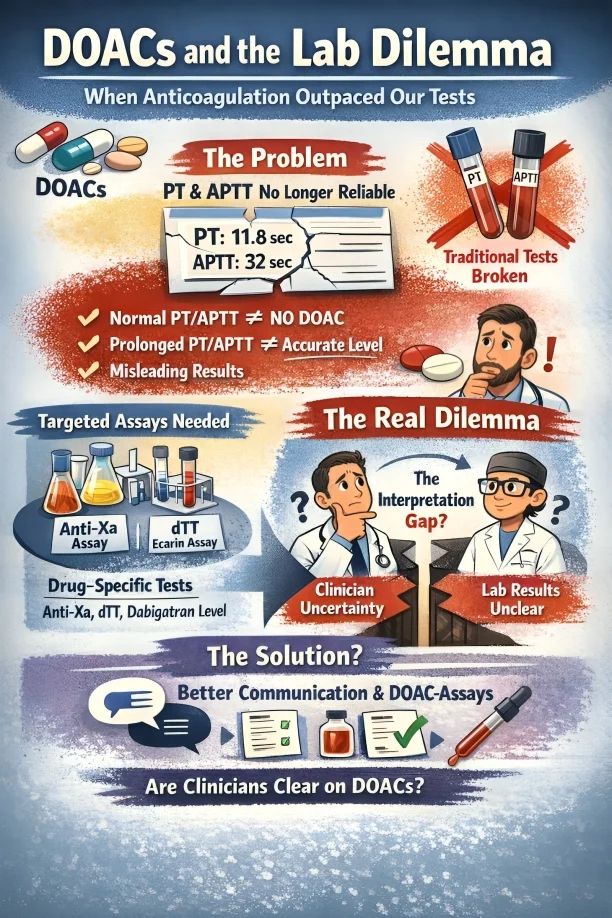
”DOACs and the Lab Dilemma: When Anticoagulation Outpaced Our Tests
‘Direct oral anticoagulants broke traditional coag testing.’
That may sound dramatic—but in many ways, it’s true.
For decades, laboratories and clinicians relied on PT and APTT as the backbone of coagulation assessment. They were predictable, interpretable, and clinically actionable. Then came DOACs… and the rules changed.
The Problem: Familiar Tests, Unfamiliar Behavior
Direct oral anticoagulants (DOACs)—including factor Xa inhibitors and direct thrombin inhibitors—interact with coagulation assays in ways that are:
- Variable (reagent-dependent)
- Drug-specific
- Often misleading
PT and APTT are no longer reliable indicators of anticoagulant effect
- A normal PT/APTT does NOT exclude clinically relevant DOAC levels
- A prolonged result does NOT quantify anticoagulation
In short: we’re using tools built for a different era.
The Shift: From Global Tests to Targeted Assays
To truly understand DOAC activity, we need drug-specific testing strategies:
- Anti-Xa assays (calibrated for specific DOACs) are used for rivaroxaban, apixaban, edoxaban
- Dilute thrombin time (dTT) or ecarin-based assays are used for dabigatran
These assays provide:
- Quantitative insight
- Drug-level estimation
- Clinical relevance in bleeding, thrombosis, or urgent procedures
But access remains inconsistent—and interpretation isn’t always straightforward.
The Real Dilemma Isn’t the Lab… It’s the Gap
We’re facing a critical disconnect:
- Clinicians may request PT/APTT expecting clarity
- Labs know these tests may mislead in DOAC-treated patients
- Results are reported… but not always understood
‘Are clinicians clear on DOAC lab interpretation?’
In many cases—not fully. And that’s not a criticism—it’s a system challenge.
Where Do We Go From Here?
- Stronger lab–clinician communication
- Clear interpretative comments on reports
- Wider access to DOAC-calibrated assays
- Ongoing education across disciplines
Because the question is no longer ‘What’s the PT?’
It’s ‘What does this result actually mean for this patient on a DOAC?’
Bottom Line
DOACs didn’t just change anticoagulation therapy—they exposed the limitations of our legacy testing systems.
As laboratory professionals, we’re not just reporting numbers anymore.
We’re guiding interpretation in a new and evolving landscape.”
More posts featuring Ifeanyichukwu Ifechidere on Hemostasis Today.
-
Sep 30, 2026, 01:52Javed Anees: DADA2 – When a Young Stroke Is More Than a Stroke
-
Sep 30, 2026, 01:51How a Venous Thrombus Becomes Revascularized – ISTH
-
Sep 29, 2026, 22:45Victor Agunyego: Paracetamol – The Most Common Drug We Underestimate
-
Sep 29, 2026, 22:42Nova Sinclair: Advancing the Future of Hematology – Meet Our 2027 Organizing Committee
-
Sep 29, 2026, 22:41Lorenz Räber: Intracoronary Imaging in PCI – Why, When, How, and Which Modality?
-
Sep 29, 2026, 22:31Selma Turkovic: Pleased to Deliver the Opening Presentation at Kingston Hospital
-
Sep 29, 2026, 22:31Miguel Teran: Ultrasound and Simulation in Arterial Blood Sampling
-
Sep 29, 2026, 22:28Mohammad Refaei: Navigating Your Career in Hematology From Training to Practice
-
Sep 29, 2026, 22:27Matteo Foschi: 10 Clinical Pearls for Antithrombotic Therapy in Secondary Stroke Prevention