


Ifeanyichukwu Ifechidere: Why Manual PT and APTT Testing Still Matters
Ifeanyichukwu Ifechidere, Specialist Biomedical Scientist at Sheffield Teaching Hospitals NHS Foundation Trust, shared a post on LinkedIn:
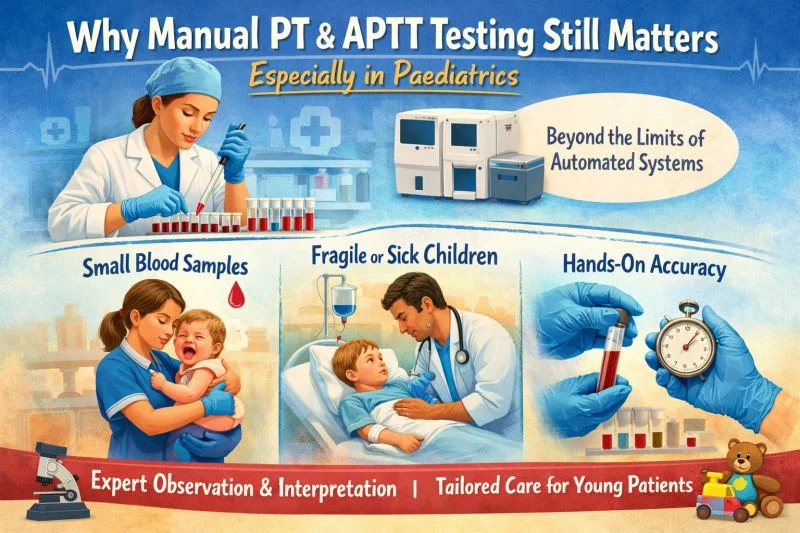
“Why Manual PT and APTT Testing Still Matters – Especially in Paediatrics
In an era of full automation, it’s easy to assume manual methods are outdated.
But in coagulation – particularly with paediatric samples – manual PT and APTT testing still holds real clinical value.
Here’s why:
1. Limited sample volume Paediatric samples are often:
- Minimal in volume
- Difficult to recollect
Automated analysers usually require dead volume plus repeat testing capacity – which isn’t always feasible.
Manual methods allow you to maximise every drop.
2. Sample integrity challenges In children, samples are more prone to:
- Underfilling (critical for citrate tubes)
- Clotting due to difficult draws
- Haemolysis
Automated systems may:
- Flag errors
- Reject results
Manual testing allows you to visually assess clot formation and determine if a result is still usable.
3. Critical troubleshooting tool When results don’t make sense:
- Unexpected prolonged APTT
- Analyzer flags or errors
- Suspected interference
Manual PT/APTT becomes a verification method, not just a backup.
It helps answer:
‘Is this a true result – or an analytical issue?’
4. Detection of subtle abnormalities Experienced scientists can identify:
- Weak clot formation
- Delayed fibrin strands
- Abnormal clot characteristics
These nuances are often missed by automated endpoints.
5. Maintaining core competency Automation is powerful – but over-reliance can weaken:
- Fundamental understanding
- Technical skill
- Interpretation confidence
Manual testing keeps you grounded in:
- The mechanism of coagulation – not just the number output.
Key takeaway:
Manual coagulation testing is not obsolete – it is a critical complementary skill, especially when working with challenging samples like paediatrics.
Want to strengthen your confidence in coagulation interpretation?
I’ve created a fundamental coagulation course built around 15 real-life case studies – designed for students, interns, and professionals who want to go beyond automation.
It’s focused on:
- Real lab scenarios
- Practical interpretation skills
- Avoiding common diagnostic pitfalls
True expertise isn’t just about running samples – it’s about knowing when to question the result.”
More posts featuring Ifeanyichukwu Ifechidere on Hemostasis Today.
-
Oct 4, 2026, 15:06Vasiliki Gkalea: Journal of Clinical Medicine Launches Special Issue on Hematologic Thrombosis and Bleeding
-
Oct 4, 2026, 14:55Quentin Brebant: What Defines a High-Quality Red Blood Cell Concentrate?
-
Oct 4, 2026, 14:47Rana Al-Hrout: Recognizing Non-Anemic Iron Deficiency – Why Iron Matters Beyond Hemoglobin
-
Oct 4, 2026, 14:41David McIntosh: International Plasma Awareness Week 2026 – Closing the Global Plasma Gap
-
Oct 4, 2026, 14:33Pete Stibbs: CleanerVac Real-World Study Presented at VIVA and The VEINS 2026
-
Oct 4, 2026, 13:56Maria Elisa Mancuso: EHC 2026 Highlights the Unmet Needs of Women with Bleeding Disorders
-
Oct 4, 2026, 13:53Nirmal Shaji George: Individualizing Anticoagulation in Complex APS and Thrombocytopenia
-
Oct 4, 2026, 13:5210 Posts Not to Miss This Week
-
Oct 4, 2026, 13:45Suswapna Singh Rawat: The Clinical Significance of Coronary Plaque Stability