


Ifeanyichukwu Ifechidere: The Most Misunderstood Cause of a Prolonged APTT in the Laboratory
Ifeanyichukwu Ifechidere, Specialist Biomedical Scientist at Sheffield Teaching Hospitals NHS Foundation Trust, shared a post on LinkedIn:
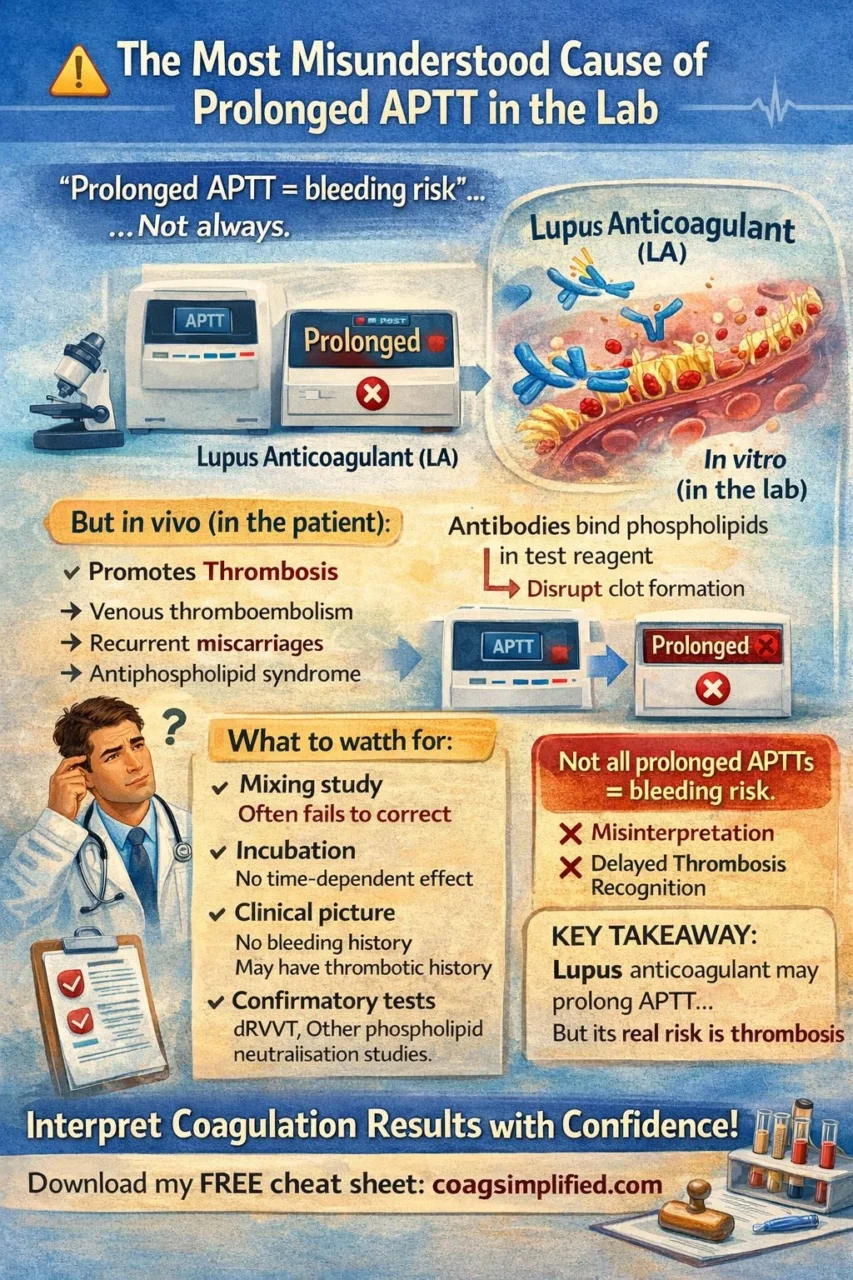
” ‘Prolonged APTT: bleeding risk’… right?
This is one of the most misunderstood assumptions in coagulation.
Because one of the commonest causes of prolonged APTT in the lab…
- does NOT cause bleeding at all.
In fact — it’s often associated with the opposite.
Let’s talk about Lupus Anticoagulant (LA)
Despite the name, it is: Not necessarily linked to lupus
Not an anticoagulant in the body
It is a prothrombotic antibody
So why does it prolong APTT?
Lupus anticoagulant interferes with: Phospholipid-dependent clotting assays
In vitro (in the lab):
It binds phospholipids in the test reagent
Disrupts clot formation
- Leads to prolonged APTT
But in vivo (in the patient):
It promotes thrombosis, not bleeding
Associated with:
- Venous thromboembolism
- Recurrent miscarriages
- Antiphospholipid syndrome
Why it confuses so many:
Because the pattern looks like a bleeding disorder:
Prolonged APTT
Sometimes no correction in mixing study
Easily mistaken for:
- Factor deficiency
- Factor inhibitor
Key distinguishing features:
- Mixing study
Often fails to correct (inhibitor pattern)
- Incubation
No time-dependent effect (unlike factor VIII inhibitors)
- Clinical picture
No bleeding history
May have thrombotic history
Confirmatory tests
- Dilute Russell Viper Venom Test (dRVVT)
- Phospholipid neutralisation studies
The critical takeaway:
Not all prolonged APTTs indicate bleeding risk.
And missing lupus anticoagulant can lead to:
- Misinterpretation
- Delayed thrombosis risk recognition
- Incorrect clinical decisions
Want a simple way to interpret coagulation results with confidence?
I’ve created a free cheat sheet that breaks down patterns like this — clearly and practically.
Because in coagulation, confidence doesn’t come from memorising — it comes from understanding what the result is really telling you..”
Other posts featuring Ifeanyichukwu Ifechidere on Hemostasis Today.
-
Oct 17, 2026, 17:27John Strouse: Building Standards for Whole-Person Sickle Cell Care Through Collaboration
-
Oct 17, 2026, 17:20Jean-Jacques Kiladjian: Exploring the Future of Polycythemia Vera Treatment at MPN Horizons 2026
-
Oct 17, 2026, 17:10Habib Bennaceur: Strengthening Collaboration in Haemophilia, Sickle Cell Disease and Thalassaemia in India
-
Oct 17, 2026, 16:58Danny Hsu: Building Connections at the AUSNBled Collaborative Dinner in Auckland
-
Oct 17, 2026, 16:48Kalyan Roy: Enhancing Patient Experience Through Learning and Collaboration
-
Oct 17, 2026, 16:43Wilfried Dinh: Antiplatelet Therapy in 2026: Duration is Becoming a Dynamic Decision
-
Oct 17, 2026, 16:37Ian Setchfield: Dr. Evans Presents on Safe Anticoagulation Prescribing at East Kent Hospitals
-
Oct 17, 2026, 16:33Lewis Thomas: Connecting Through Shared Experiences at ASCAT 2026
-
Oct 17, 2026, 16:29Nilesh Jethwa: Yasmin Adverse Event Reports Exceed 23,000 Over Two-Year Period