


Jeff June: The Stroke That Wasn’t New – Why ‘Cryptogenic’ Often Means Undetected
Jeff June, Innovation Advisor at Early Stage Digital Health, MedTech, Venture Capital, and Accelerator Programs, posted on LinkedIn:
‘The Stroke That Wasn’t New
Recurrent stroke is rarely mysterious. What’s mysterious is how often it happens — and how often the cause is never clearly identified.
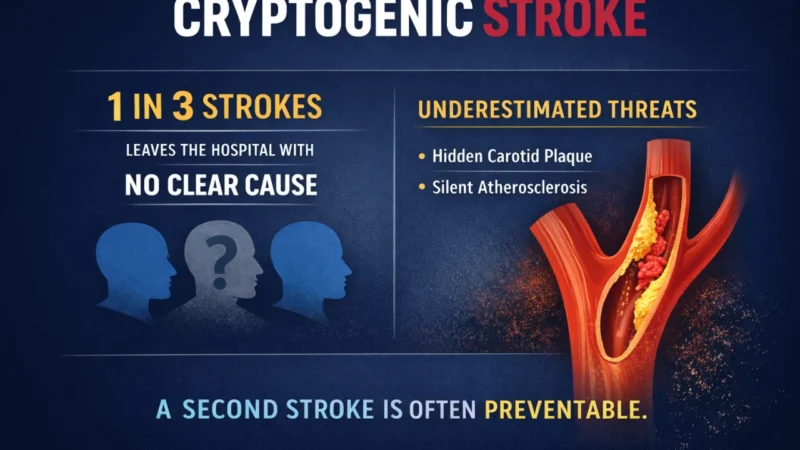
A 2026 review published in the Journal of the American Heart Association underscores a growing reality in stroke care: symptomatic carotid plaques with less than 50% stenosis — often considered ‘non-actionable’ in routine workups — can still cause ischemic stroke. These non-stenotic, high-risk plaques are increasingly linked to strokes labeled cryptogenic.
In other words, the mechanism is often present. It’s just below our detection threshold.
Cryptogenic stroke is not rare. It is routine.
In the United States:
- 20–35% of all ischemic strokes are classified as cryptogenic after standard evaluation
- That translates to ~160,000–240,000 patients every year discharged without a clear mechanism
- Nearly 1 in 3 ischemic stroke patients leaves the hospital with an unanswered ‘why’
Cryptogenic stroke is not an edge case.
It is one of the largest stroke populations we manage.
‘Cryptogenic’ often means ‘not yet detected’
Large-artery atherosclerosis is a prime example.
Multiple studies now show that:
- Non-stenotic carotid plaques (<50%) can be embolic
- Plaque composition and inflammation matter more than lumen narrowing alone
- Many embolic strokes occur before stenosis reaches surgical or interventional thresholds
Yet in U.S. imaging-based workflows, carotid disease often becomes ‘real’ only after:
- ≥50–70% narrowing
- Recurrent symptoms
- Or a second stroke
By then, biology has already been active for years.
Undetected carotid disease is common in the U.S.
Population data suggest that:
- 30–40% of adults over age 60 have measurable carotid atherosclerosis
- A significant fraction have moderate disease without symptoms
- Among patients with vascular risk factors, carotid plaque is common even when imaging is not pursued aggressively
Despite this, carotid imaging is not routine after many cryptogenic strokes, particularly when initial CTA or ultrasound appears ‘non-actionable.’
The result is a large population of patients with real vascular disease — and no mechanistic label.
Cryptogenic stroke is not benign
Patients labeled cryptogenic do not ‘reset’ their risk.
Evidence shows that:
- Recurrent stroke risk in cryptogenic patients approaches that of known subtypes over time
- Many recurrences later reveal a mechanism, including carotid disease or cardioembolism
- The second stroke is often when the diagnosis finally becomes obvious
What appears to be a new event is often the completion of an earlier diagnostic delay.
This is not a failure of care. It’s a failure of timing.
U.S. stroke systems excel at:
- Acute imaging
- Rapid intervention
- Post-event classification
They struggle with:
- Detecting active biology before anatomy declares itself
- Identifying which cryptogenic patients are on a predictable path to recurrence
- Escalating surveillance based on biologic risk rather than imaging thresholds alone
Cryptogenic stroke is where these limitations converge.
Atherosclerosis is a complex problem, beyond an arbitrary standard
Atherosclerosis is:
- Inflammatory
- Metabolically driven
- Biologically active long before it becomes anatomically severe
Two patients with the same ‘mild’ carotid stenosis do not share the same embolic risk.
Yet our classifications treat them as interchangeable.
That gap is where cryptogenic stroke lives.
Why this matters for prevention
If one in three ischemic strokes lacks a clear cause at discharge, prevention cannot rely solely on:
- Waiting for stenosis to worsen
- Waiting for recurrence
- Waiting for anatomy to explain biology
In my work as a stroke researcher, investor, and company founder at Ischemia Care , I would suggest thinking of cryptogenic stroke as:
- A high-risk category, not a neutral one
- A prompt for deeper biologic investigation
- A population where earlier mechanistic insight can change trajectories
Because preventing a second stroke is not only about faster response once a stroke occurs. It’s about earlier recognition.
Recurrent stroke is rarely a surprise to biology
By the time carotid disease causes a second stroke, the signals have been present for years.
The tragedy is not just that recurrence happens. It’s that we often quantify the risk only after the damage is done. Cryptogenic stroke is not just a diagnosis. It is a warning.’
More posts featuring Jeff June.
-
Sep 30, 2026, 14:13Ashok Choudhury: Portal Vein Thrombosis and Outcomes in Cirrhosis
-
Sep 30, 2026, 13:57Leslye Conde Bazán: When Conventional Imaging Is Not Enough – The Role of IVUS
-
Sep 30, 2026, 13:41Huda Salah Eldin: The Challenge of Balancing Antithrombotic Therapy After PCI
-
Sep 30, 2026, 13:29Abdus Salam: What Can CT Venography Reveal About the Veins?
-
Sep 30, 2026, 13:03Amira Mohy: Diagnostic Flow Cytometry Panels for Hematological Malignancies
-
Sep 30, 2026, 12:52Paul Watton: Could Repetitive Head Impacts Leave a Molecular Memory?
-
Sep 30, 2026, 12:41The Journey to ISTH 2027 Starts in Vancouver
-
Sep 30, 2026, 11:36Basit Ali: A Closer Look at CT Venography
-
Sep 30, 2026, 11:16Christina Pohlman: Could aPL Levels Help Predict Stroke Recurrence?