


Jonathan Douxfils: Are All Progestin-Only Contraceptives Truly ‘Neutral’ for VTE Risk?
Jonathan Douxfils, Director of the Clinical Pharmacology and Toxicology Research Unit at University of Namur, Board Member of Belgian Society on Thrombosis and Haemostasis, shared a post on LinkedIn about a recent article by Anna L. Eriksson et al, adding:
“New evidence in The Lancet Obstetrics, Gynaecology, and Women’s Health, adds much-needed granularity to a question clinicians face daily: is venous thromboembolism (VTE) risk truly ‘neutral’ across all progestin-only contraceptives (POC)?
Using a nationwide Swedish register-based, nested matched case–control design, Eriksson and colleagues analysed 7,597 first-time VTE cases matched to 37,985 controls.
The key message is that POC is not a single risk category: the study shows a dose-dependent pattern. Compared with non-use of hormonal contraception, the odds of VTE were markedly increased with high-dose POC (injectable depot medroxyprogesterone acetate; adjusted OR 3.05), slightly increased with intermediate-dose POC (oral desogestrel or etonogestrel implant; adjusted OR 1.24), not increased with low-dose oral POC (adjusted OR ~1.02), and lowest with the levonorgestrel intrauterine device (LNG-IUD; adjusted OR 0.81).
Why this matters: for years, ‘progestin-only’ has often been communicated as broadly safer than combined estrogen–progestin contraception for VTE (all data claiming that compared with ethinylestradiol containing pills). This study supports that overall direction, but also reminds us that systemic exposure and formulation matter, and that risk counselling can be more precise: DMPA stands out as the least favourable option from a VTE perspective, while LNG-IUD appears among the most favourable.
Information is missing for newer oral POC like drospirenone 4 mg for which previous PhV analyses revealed a reporting ratio of VTE events similar to that of E4/DRSP, a COC contaning a body-identical estrogen.
A practical take-away for shared decision-making: when VTE risk is a concern, it’s worth moving from the binary message (‘POC is safe’) to a more nuanced one. All POC are not safe and in light of this evidence, the results of previous disproportionnality analysis in spontaneous PhV database are not surprising in showing that COC containing body-identical estrogens may not be so different from some oral POC when it comes to VTE risk.”
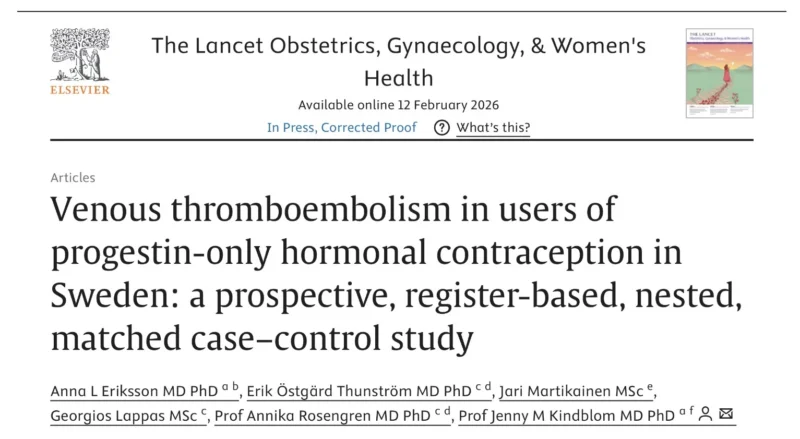
Title: Venous thromboembolism in users of progestin-only hormonal contraception in Sweden: a prospective, register-based, nested, matched case–control study
Autors: Anna L. Eriksson, Erik Östgärd Thunström, Jari Martikainen, Georgios Lappas, Annika Rosengren, Jenny M. Kindblom
Read the Full Article on The Lancet Obstetrics, Gynaecology, and Women’s Health.
Stay updated on all scientific advances with Hemostasis Today.
-
Oct 13, 2026, 21:05Francisco Chacón-Lozsán: Heparin-Induced Thrombocytopenia – When an Anticoagulant Triggers Thrombosis
-
Oct 13, 2026, 21:04Aref Zribi: Isolated Tumor Thrombus and the Role of Prophylactic Anticoagulation
-
Oct 13, 2026, 21:01Alex Larson: Why Normal Bloodwork Does Not Always Tell the Whole Story
-
Oct 13, 2026, 20:58Juan Jauregui-Lozano: How Replication Stress Impairs Red Blood Cell Maturation
-
Oct 13, 2026, 20:55Caitlin Raymond: Understanding Platelet Refractoriness Before Ordering More Platelets
-
Oct 13, 2026, 20:54Sanja Seratlic: How Cow Feeding Systems Influence the Anti-Platelet Properties of Cheddar Cheese
-
Oct 13, 2026, 20:50Ruchika Goel: Cord Blood Red Blood Cells as a Physiologically Aligned Transfusion Strategy
-
Oct 13, 2026, 20:47Sophia Delicou: Strengthening Transfusion Safety Through Advanced Screening and Haemovigilance
-
Oct 13, 2026, 20:45Lydia Pecker: Alloimmunization and Transfusion Indications in Sickle Cell Disease Pregnancy