


Jordan Agay: Why We Need to Track the Neurological Costs of Anemia
Jordan Agay, Public Health and Bioinformatics Student at The George Washington University and Clinical Product Strategy and Feedback Intern at hc1, shared a post on LinkedIn:
“Anemia’s most visible effects are physical. Its least visible may be neurological.
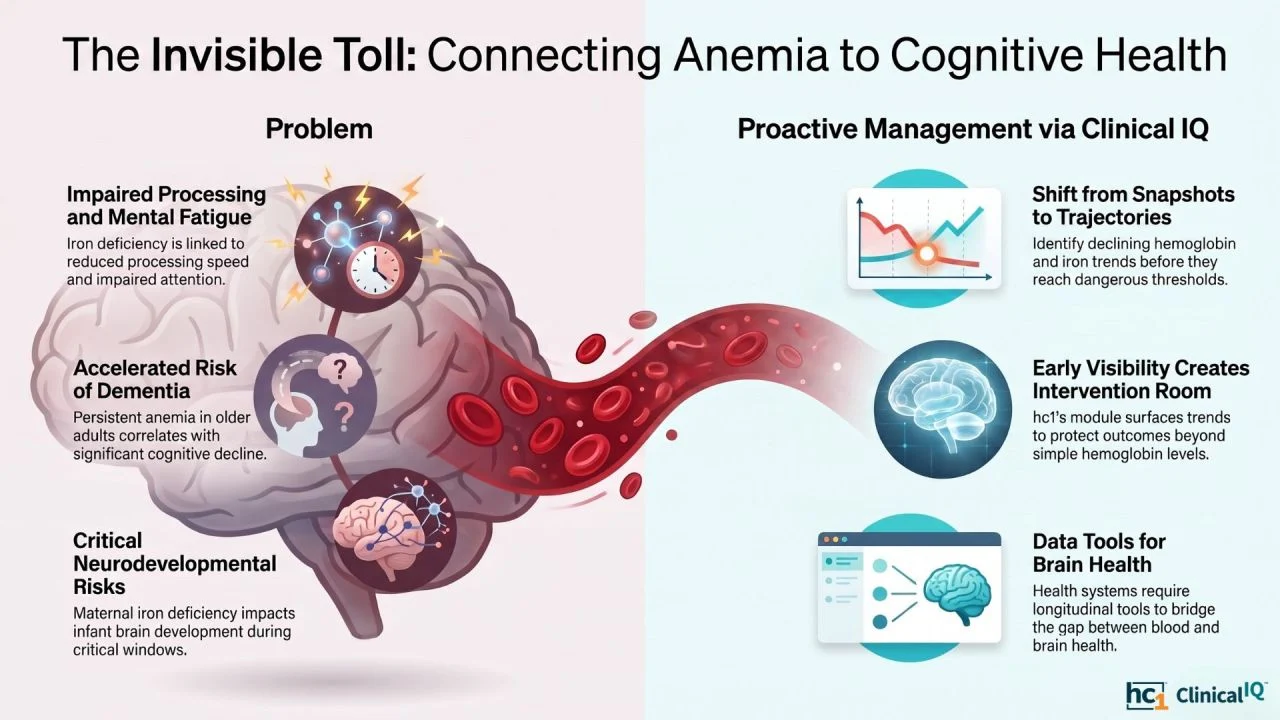
Iron deficiency, with or without anemia, is associated with impaired attention, reduced processing speed, and cognitive fatigue.
In older adults, persistent anemia correlates with accelerated cognitive decline and increased dementia risk.
In pregnant women, iron deficiency during pregnancy is associated with measurable neurodevelopmental impacts in the infant.
These are not rare outcomes.
They are poorly tracked and underrecognized effects of a condition that often goes unmanaged for months.
The challenge is that cognitive effects do not appear on a lab panel.
But the lab trends that predict them do, if someone is looking at the trajectory rather than the snapshot.
hc1’s Clinical IQ Anemia Management Module tracks hemoglobin and iron status longitudinally across patient encounters, surfacing declining trends before they reach thresholds that already signal significant physiological impact.
That earlier visibility is what creates room to intervene and potentially protect outcomes that extend well beyond hemoglobin levels.”
Stay updated with Hemostasis Today.
-
Sep 17, 2026, 07:50Applications Are Now Open for the 2026 WFH IHTC Fellowships
-
Sep 17, 2026, 07:37Jim Hoffman: Could NET Removal Help Restore Vascular Homeostasis?
-
Sep 17, 2026, 04:43Tom Tang: Preventing Post Thrombotic Syndrome Starts With Early DVT Prevention
-
Sep 17, 2026, 04:35Veronica Sanchez: Menopause as a Risk for Heart Disaese
-
Sep 17, 2026, 03:20Jessica Frye: Understanding VTE in Pregnancy and the Postpartum Period
-
Sep 17, 2026, 03:04Leonardo Roever: Exploring the Role of Glutamine Metabolism in Atherosclerosis
-
Sep 17, 2026, 02:36Wolfgang Miesbach: Effectiveness of Avatrombopag in ITP Treatment
-
Sep 17, 2026, 02:34Aleksandar Sič: The Endothelium and Cardiovascular Toxicity in Blood Cancers
-
Sep 16, 2026, 15:45Matthew Hazell: A Brilliant Explanation of Phenotype vs Genotype Using a LEGO House