


Melissa Hollo: The Hidden Burden of Anemia in Cardiovascular Disease
Melissa Hollo, Director of Project Management at hc1 and Licensed Independent Clinical Social Worker, shared Jordan Agay‘s post on LinkedIn, adding:
“Excellent post by Jordan Agay highlighting an often-overlooked clinical reality: Anemia and heart failure are not separate conditions they frequently fuel one another.
Too often, anemia is treated as a standalone lab value rather than a significant contributor to worsening cardiovascular outcomes.
Reduced oxygen-carrying capacity increases cardiac workload, accelerates disease progression, and can negatively impact quality of life, hospitalizations, and mortality.
The challenge is that anemia often develops gradually and can be missed until patients are already experiencing significant symptoms or decompensation.
This is why I appreciate Jordan Agay continuing to raise awareness around the importance of blood health in chronic disease management. Managing heart failure effectively requires looking beyond the heart itself and understanding the whole patient.
Early identification of anemia and iron deficiency provides an opportunity to intervene sooner, improve outcomes, and potentially reduce avoidable complications.
Thank you, Jordan Agay, for keeping the spotlight on this important intersection of cardiovascular care and blood health. These conversations help move healthcare from reactive treatment toward proactive patient management.”
Jordan Agay, Public Health and Bioinformatics Student at The George Washington University and Clinical Product Strategy and Feedback Intern at hc1, shared a post on LinkedIn:
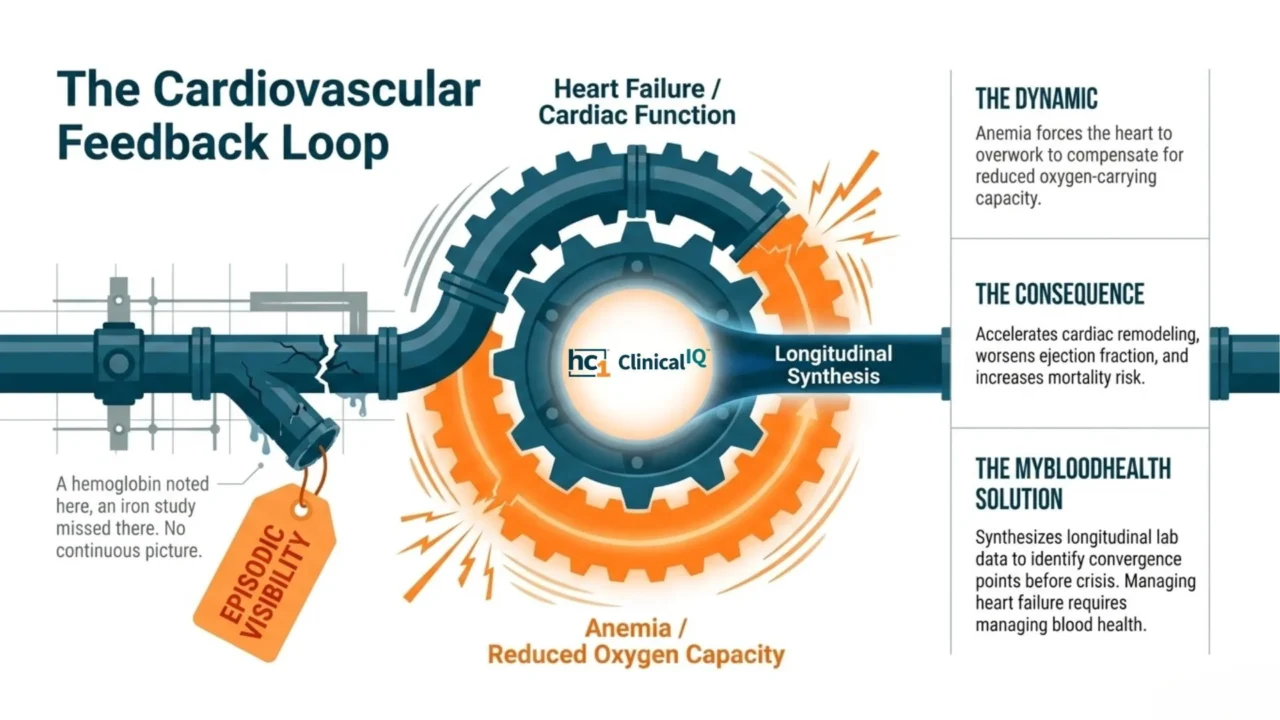
“Heart failure and anemia share more than a patient population. They share a feedback loop. Anemia forces the heart to work harder to compensate for reduced oxygen-carrying capacity.
Over time, that compensatory strain accelerates cardiac remodeling, worsens ejection fraction, and increases heart failure mortality risk. Because both conditions often develop gradually, the convergence point is frequently missed until the patient is already in crisis.
Managing heart failure well requires managing the whole patient. That includes blood health.
In most health systems, anemia in cardiac patients is addressed episodically. A hemoglobin noted here, an iron study missed there. There is no continuous picture of how a patient’s hematologic status is trending alongside their cardiac trajectory.
I’ve had the opportunity to see how hc1‘s Clinical IQ Anemia Management Module changes that.
By synthesizing longitudinal lab data including hemoglobin and iron levels, it gives care teams the visibility to identify and address anemia before it compounds an already complex cardiac problem.”
Stay updated with Hemostasis Today.
-
Sep 19, 2026, 14:17Abdul Mannan: What Exactly Is a Platelet?
-
Sep 19, 2026, 13:39Keisuke Goda: Decoding Platelet Phenotypes in COVID-19 With Optofluidic Imaging
-
Sep 19, 2026, 13:30Targeted Thrombolysis Beyond tPA
-
Sep 19, 2026, 13:21Paul Armstrong: From Summer Studentship to Young Researcher
-
Sep 19, 2026, 13:06Rabiya Masood: Breaking the Cycle of Thalassemia Through Screening
-
Sep 19, 2026, 10:52Consuela A. Albright: The Critical Role of Black Blood Donors in Sickle Cell Treatment
-
Sep 19, 2026, 10:47Amber Yates: Inside Agios’ Partnership with the Sickle Cell Community
-
Sep 19, 2026, 10:46Anton Farkas: Mechanical Thrombectomy for Acute PE in Early Pregnancy
-
Sep 19, 2026, 10:40Marjolein Smidt: ASH Raises Ferritin Thresholds for Iron Deficiency