


Pall T. Onundarson: DOACs Are No ‘Ninjas’ – Warfarin and Other VKAs Effectively Filled That Role for Decades
Pall T. Onundarson, Professor Emeritus at Landspitali University Hospital, shared a post on LinkedIn:
“Mockery is one subtle way used to strategically sideline warfarin.
It subtly makes patients needing warfarin and their prescribing physicians psychologically insecure.
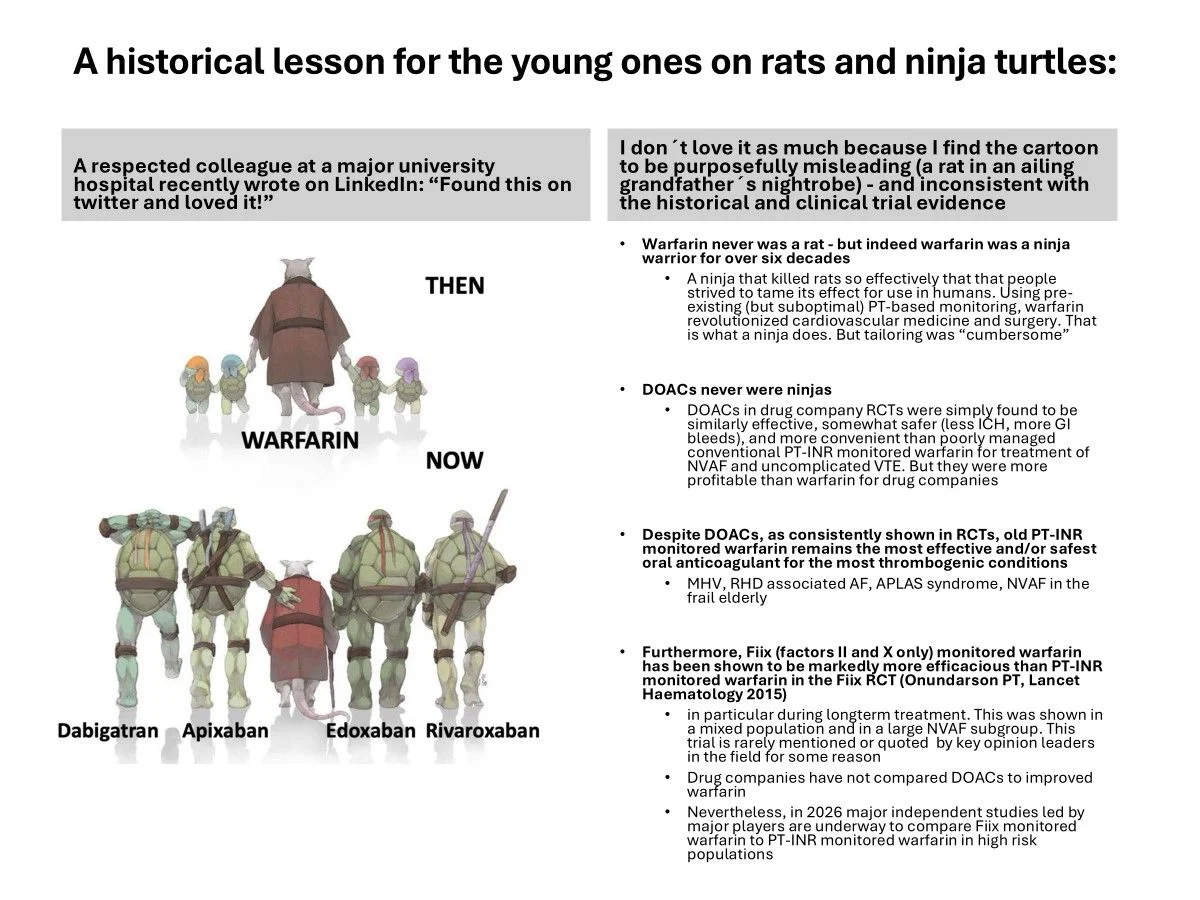
A few days ago, I saw a LinkedIn post written by a prominent physician at a respected teaching hospital referring to a cartoon depicting warfarin as an ailing old rat and DOACs to ‘ninja turtles’ that were popular during his childhood.
This analogy is misleading.
While DOACs are a commercial success, they are no ‘ninjas’; for decades, warfarin and other VKAs effectively filled that role (see figure).
Better outcomes with warfarin are achievable.
A key issue is that the traditional Quick or Owren-type PT-INR test is an underrecognized insidious source of variability and thus suboptimal VKA anticoagulation.
Variability arises not only from diet and drug interactions but also from limitations of the testing reagent itself.
AI cannot fix a flawed reagent.
A better alternative exists: the Fiix test.
Yet many physicians seem unaware of this, don’t understand the difference – or are unwilling to engage with it, some even seemingly being opponents of the test.
I could write about that later.
As a result, 75 years after its introduction and 14 years after the first Fiix publication, warfarin is still monitored worldwide using suboptimal PT-INR methods in both laboratories and point-of-care devices, except at our center in Reykjavik where we replaced INR with Fiix-NR in 2016.
However, as of 2026, the Fiix test has been implemented at major centers in the UK and Canada for research purposes.
Why hasn’t the Fiix test been widely adopted?
Answer is: Money.
The answer appears to lie more in marketing than medicine.
As one head of business development at a leading coagulation IVD company wrote to me in personal correspondence:
‘I’m fully convinced the Fiix test [is] a better test than INR for VKA monitoring – even though convincing the world to switch from a routine test [PT/INR] with wide clinical indications and extremely low price toward a specialized test for VKA follow-up will be challenging from a commercial stand-point’.
In short, the Fiix test is not currently attractive from a profitability standpoint but patients´ interests don´t come into the equation.”
Stay updated with Hemostasis Today.
-
Sep 20, 2026, 04:54William Aird: What Does a Complete History and Physical Really Mean?
-
Sep 20, 2026, 04:34Hons Saurabh Kaushik: Why Uncontrolled LDL Can Be Harmful
-
Sep 20, 2026, 03:58Salih Ehsan: The Complexities of HbF and HbA2
-
Sep 20, 2026, 03:22The Voices of People Living With Bleeding Disorders – EHC
-
Sep 20, 2026, 01:18Sebastian Mafeld: Has 2026 Changed How We Treat Pulmonary Embolism?
-
Sep 20, 2026, 01:16Pall T. Onundarson: DOACs – Monitoring, Tailoring Dose and Identifying Problems
-
Sep 20, 2026, 01:15Thierry Fumeaux: From Efficacy to Effectiveness – The Value of Real-World Evidence
-
Sep 20, 2026, 01:14Said El Shamieh: VEGFA Genetic Variants and Bleeding Risk During Warfarin Therapy
-
Sep 20, 2026, 01:04Omar Danoun: Levetiracetam May Increase Thromboembolic Risk With DOACs