


Priya Prasad: In Massive Hemorrhage, Fibrinogen Is Often the First Clotting Factor to Fall
Priya Prasad, Senior Specialist at Caritas Hospital, shared a post on LinkedIn:
“When a patient is bleeding out, one link is too often forgotten.
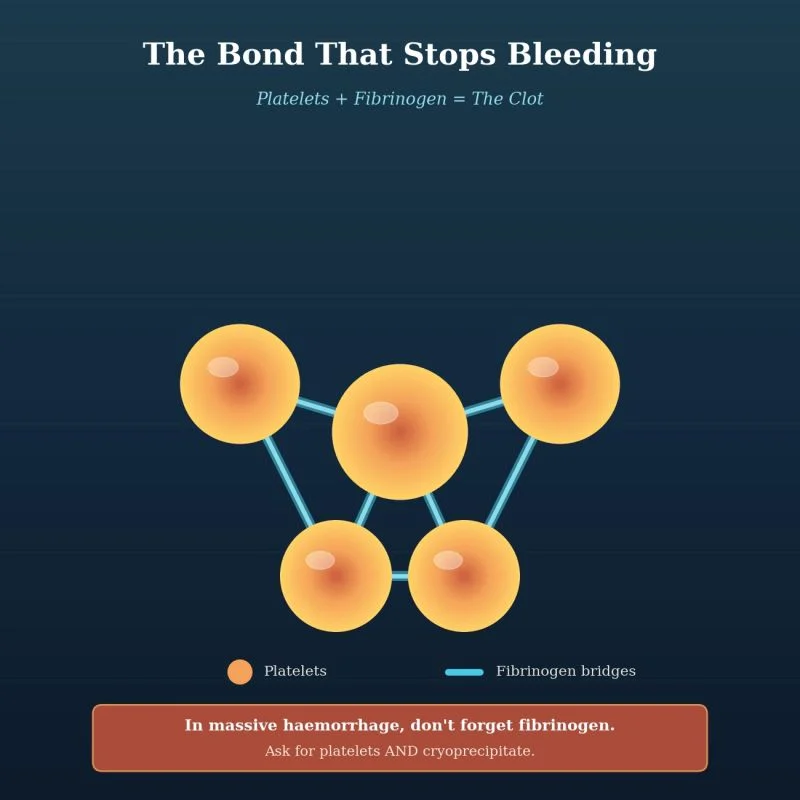
Platelets and fibrinogen work together.
The part that gets missed:
In massive haemorrhage, fibrinogen is often the first clotting factor to fall — sometimes before the platelet count even drops.
Focus only on platelets or the INR, and you can miss the very thing holding the clot together. Activated platelets can’t form a stable plug on their own!
Fibrinogen is the bridge that binds them, linking platelet to platelet through their GPIIb/IIIa receptors. Thrombin then converts that fibrinogen into fibrin – the mesh that locks the whole clot in place.
So don’t stop at platelets!
Ask for platelets and cryoprecipitate. Let that bond do what it’s designed to do — form a clot.”
More posts featuring Priya Prasad on Hemostasis Today.
-
Sep 16, 2026, 16:06Katrina Louise Manalaysay: A Few Minutes of Giving Can Mean a Lifetime
-
Sep 16, 2026, 15:45Matthew Hazell: A Brilliant Explanation of Phenotype vs Genotype Using a LEGO House
-
Sep 16, 2026, 15:23Ahmad Al-Ramahi: Presenting the Military Pharmacists Blood Training Course at the FIP World Congress
-
Sep 16, 2026, 15:21HIT Reimagined: Can 12-Lipoxygenase Inhibition Stop Immune Thrombosis?
-
Sep 16, 2026, 14:42Ruchi Punamia: Beyond the Blood Bank and The Clinical Impact of Apheresis
-
Sep 16, 2026, 14:06Kalyan Roy: Celebrating Apheresis, Advancing Care, Saving Lives
-
Sep 16, 2026, 13:38Andrew Zapfel: Advancing Sickle Cell Disease Care and Research
-
Sep 16, 2026, 13:30Thirunavukkarasu Angappan: Why Plasma-Derived Factor VIII Still Matters for Inhibitor Patients
-
Sep 16, 2026, 13:22Matthew Hazell: New BSH Guidance for Fetal, Neonatal and Paediatric Transfusion