

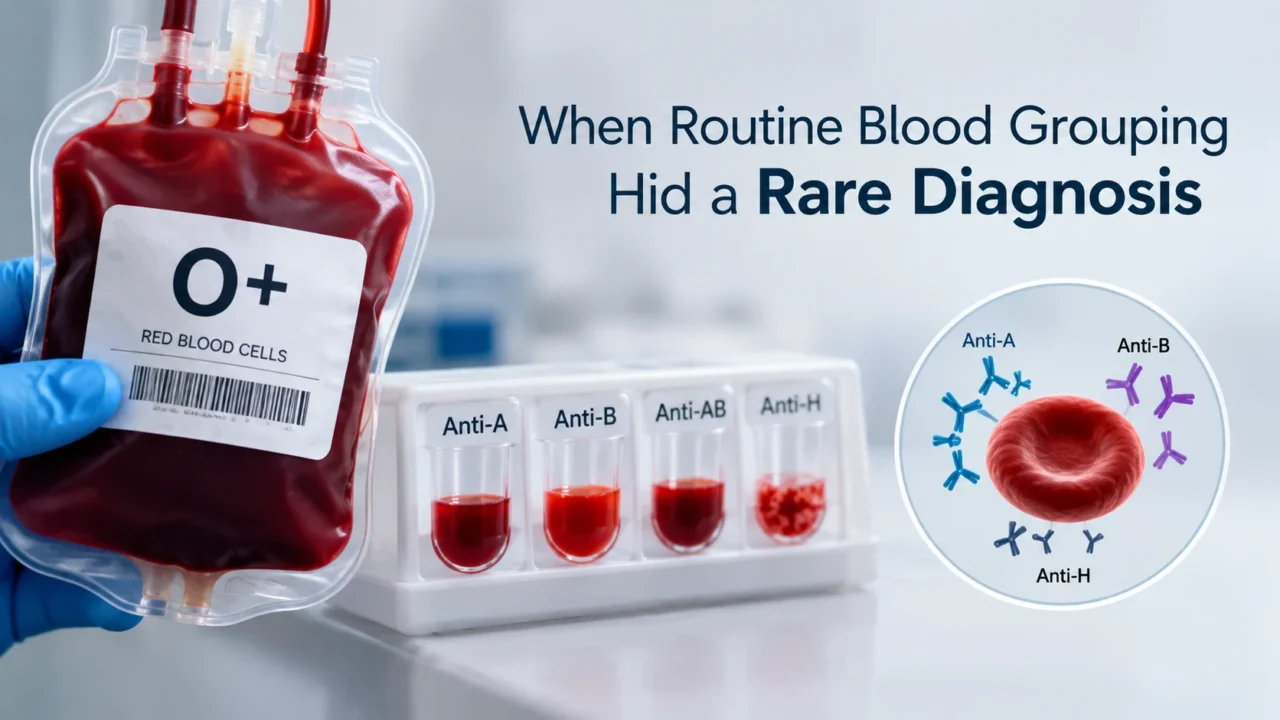
Subham Banerjee: When Routine Blood Grouping Hid a Rare Diagnosis
Subham Banerjee, General Practitioner at Nightingale Nursing Home, Junior Resident of Medicine Department at COMJNMH, shared a post on LinkedIn:
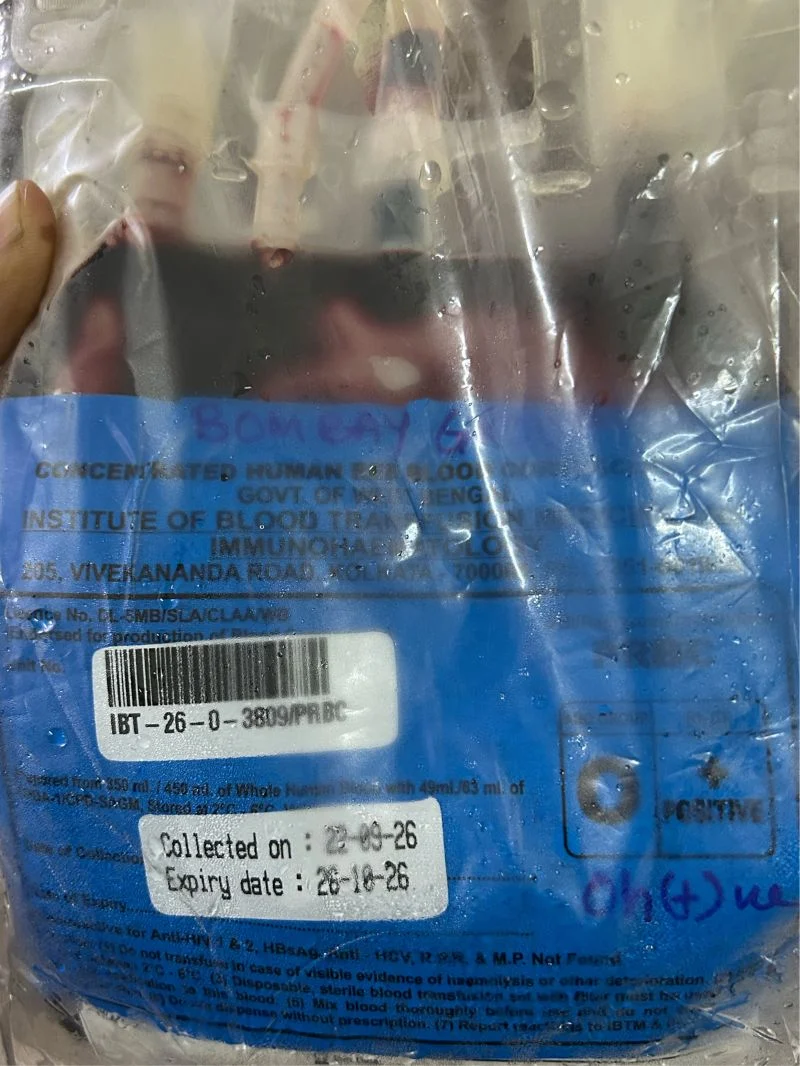
“When ‘O positive’ wasn’t actually O positive – a rare transfusion challenge
A patient with severe anemia (Hb approximately 6 g/dL) required blood transfusion.
What initially seemed like a routine transfusion soon turned into an unusual diagnostic challenge.
Multiple blood samples were tested, but none of the available blood units were compatible on crossmatching.
The pattern raised suspicion that this was not a routine ABO grouping problem.
Further evaluation revealed something extremely rare – the patient had the Bombay blood group phenotype (Oh/hh).
The Bombay phenotype is fascinating because it is different from the usual ABO blood groups at a fundamental level.
In a normal individual, the H antigen acts as the precursor on which A or B antigens are formed.
In group O individuals, H antigen is still present – in fact, it is present in relatively high amounts.
In the Bombay phenotype, however, the H antigen is absent because of a defect affecting its formation.
Consequently, A and B antigens also cannot be expressed on the red cells, making the patient’s cells appear like group O on routine forward grouping.
The important difference is in the plasma: Bombay phenotype individuals generally have anti-A, anti-B and anti-H antibodies.
That means ordinary O blood is NOT compatible, because even O red cells carry H antigen.
Transfusion with ordinary ABO blood can therefore cause a severe hemolytic transfusion reaction.
And this is where the case became a team effort.
With no compatible blood readily available, NGO or rare-donor networks were contacted to search for a Bombay-phenotype donor.
A compatible Bombay blood unit was eventually identified at Apollo Hospitals, Vellore, and a cold-chain transport pathway was arranged to bring the unit to JNM Hospital.
After the long search, coordination and transportation, the rare blood unit finally reached our hospital and was successfully transfused to the patient.
The Bombay phenotype was first described in Mumbai in 1952, and its estimated frequency in India is around 1 in 7,600-10,000 people, although prevalence varies considerably between populations.
What makes this case particularly memorable is that it wasn’t simply about finding ‘O negative’ or ‘O positive’ blood.”
Stay updated with Hemostasis Today.
-
Sep 28, 2026, 14:45Access Real-Time Bleeding Disorder Guidelines with the New WFH Resource Hub – WFH
-
Sep 28, 2026, 14:41Francois Roubille: Can Low-Dose Colchicine Prevent Atrial Fibrillation After CABG?
-
Sep 28, 2026, 14:39William Aird: Gulliver’s Atlas – Mapping the Evolution of the Vertebrate Red Cell
-
Sep 28, 2026, 14:30Rafael Zubiran: High Lp(a) Drives 1 in 15 Cases of Aortic Stenosis
-
Sep 28, 2026, 14:23Heghine Khachatryan: Measuring the Human Impact of Gene Therapy on the Hemophilia
-
Sep 28, 2026, 13:48Can the Immune System Be Reprogrammed to Treat Aplastic Anemia?
-
Sep 28, 2026, 13:20Elif Susan Elcin։ PRP for Skin Rejuvenation – Is It Worth the Hype?
-
Sep 28, 2026, 13:07Alexandru Stieber: Looking Beyond MDS in VEXAS Syndrome
-
Sep 28, 2026, 12:53Shifa Maharani: Research Innovation and Recognition at JSMID 8th