


Tareq Abadl: Can Vitamin C Trick a Glucose Reading?
Tareq Abadl, Medical Laboratory Specialist and Director of the Blood Bank at Dr. Abdelkader Al-Mutawakkil Hospital, shared a post on LinkedIn:
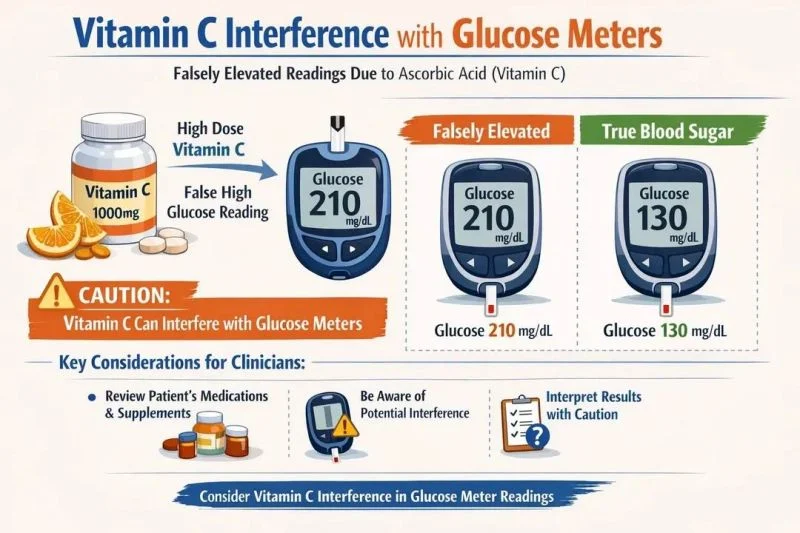
”Can Vitamin C Trick a Glucose Reading?
In clinical biochemistry and medical laboratory science, not every ‘high glucose’ result reflects a patient’s true blood sugar level.
Ascorbic acid (vitamin C) can interfere with some point-of-care glucose meters and continuous glucose monitoring (CGM) systems, leading to falsely elevated glucose readings on certain devices.
The ADA 2026 Standards of Care highlight an important point:
Clinicians should always consider medication and substance interference-including vitamin C-when interpreting glucose results.
Why does this matter?
Because a falsely high glucose value can lead to:
- Incorrect clinical interpretation
- Unnecessary or inappropriate treatment
- Potential risk to the patient
In fact, hospital evaluations have shown that 2 out of 3 glucose meters tested produced falsely elevated readings when vitamin C levels increased.
Lab Takeaway: Think Beyond the Number
When a glucose result doesn’t match the clinical picture, ask:
- Is the patient taking high-dose vitamin C or receiving IV ascorbic acid?
- Is the device known to be susceptible to interference?
- Should the result be confirmed with laboratory plasma glucose or a different method?
Guidance for CGM systems also notes that high doses of vitamin C may falsely elevate readings-confirmation is recommended when values don’t match symptoms.”
Other posts featuring Tareq Abadl on Hemostasis Today.
-
Oct 24, 2026, 14:28Satyam Arora: Umbilical Cord Blood for Neonatal Transfusions
-
Oct 24, 2026, 13:24Amelia Carro Hevia: Ischaemic Stroke Risk in Atrial Flutter vs Atrial Fibrillation
-
Oct 24, 2026, 12:27Emeka Patrick Chukwuka: Ferritin Falls First – Iron Deficiency Before Anaemia
-
Oct 24, 2026, 11:57Priyanka Kandalgaokar: Sharing India’s Patient Advocacy Journey at MPN Horizon 2026
-
Oct 24, 2026, 11:40Uli Schotten: Coagulation Factors May Influence Cardiac Remodelling
-
Oct 24, 2026, 11:20Edward Lee Carter: Anticoagulation After Intracranial Hemorrhage – Encouraging Data, but an Unresolved Tradeoff
-
Oct 24, 2026, 11:16Aram Hovhannisyan: New Evidence on CAT from the THEO Study
-
Oct 24, 2026, 10:49Shahram Kordasti: Investigating Novel Immune Targets in MPN
-
Oct 24, 2026, 10:32Amber Yates: A Major Milestone for the RISE UP Phase 3 Study