


Umar Jawed: The Most Dangerous Anti-D Result Is Not the Highest One – It’s the One You Underestimate Early
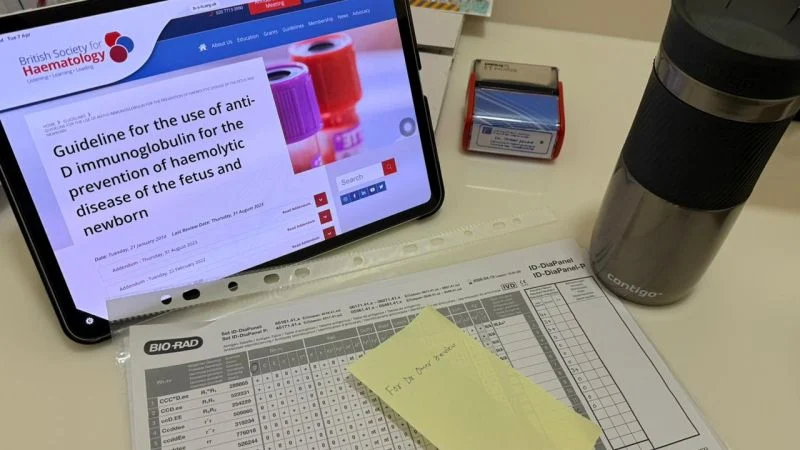
Umar Jawed, Consultant Haematologist at King’s College Hospital London, Jeddah, shared a post on LinkedIn:
“‘The most dangerous Anti-D result is not the highest one – it’s the one you underestimate early.’
My morning today at King’s College Hospital London – Jeddah started with exactly that.
A routine antenatal screen.
Young patient. Early gestation.
- Anti-D detected.
- Titre: High.
And instantly, what looks like a lab result becomes a time-sensitive fetal risk assessment problem.
Because:
- High-titre Anti-D this early is never reassuring.
It raises one critical question:
Are we already behind in this pregnancy?
The Clinical Shift (Not Just ‘Follow the Titre’)
Following principles from Royal College of Obstetricians and Gynaecologists (RCOG), British Committee for Standards in Haematology (BCSH) and American College of Obstetricians and Gynecologists (ACOG):
This was not a ‘watch and wait’ case.
Management mindset shifted immediately to:
- Early risk stratification
- Urgent fetal medicine referral
- Consideration of fetal RhD genotyping (non-invasive where available)
- Planning for MCA Doppler surveillance
Because once sensitisation is established:
Titre is not the disease – fetal anemia is.
What Makes Anti-D Different
In transfusion medicine, Anti-D is unique:
- Preventable – yet still encountered
- Predictable – yet still underestimated
- Detectable early – but often acted on late
And importantly:
Early high titre is not equal mild disease starting early
It may reflect a sensitised immune system already primed for rapid fetal impact
The Bigger Perspective
This is where transfusion medicine extends beyond the lab.
It becomes:
- Predictive medicine
- Fetal risk stratification
- Multidisciplinary decision-making
Because one antibody, detected at the right time, can completely alter the trajectory of a pregnancy.
Questions for colleagues in transfusion and fetal medicine:
- At what titre (and gestation) do you escalate immediately to fetal medicine?
- Are you routinely integrating non-invasive fetal RhD typing into your pathway?”
Stay updated on Hemostasis Today.
-
Oct 18, 2026, 06:27Gregory Makris: NEJM Study Supports Earlier Catheter-Directed Intervention in Intermediate-High–Risk PE
-
Oct 18, 2026, 06:26Danny Hsu: BLOOD 2026 Return to Aotearoa
-
Oct 18, 2026, 02:43Priya Sriskandarajah: Diagnosis and Management of PV and JAK2-Unmutated Erythrocytosis
-
Oct 18, 2026, 02:41C. Michael Gibson: A Meta-Analysis of DOACs and DAPT After Left Atrial Appendage Closure
-
Oct 18, 2026, 02:27What Hematologists Should Remember About the Person Behind the Platelet Count – ASH
-
Oct 18, 2026, 01:44Marta Velia Antonini: How to Deliver CRRT during ECMO?
-
Oct 18, 2026, 01:19Aamir Saeed: Anticoagulation, Cirrhosis, and Other Risk Factors for Post-ERCP Bleeding
-
Oct 18, 2026, 00:33Elad Asher: Does Opening the Clot Change How a Patient Feels Three Months Later?
-
Oct 18, 2026, 00:22Richa Sharma: Evaluating Heterogeneity in Anticoagulation Treatment Effects in Cryptogenic Stroke