


William Tembo: Advancing Stroke Care by Validating Acute Ischemic Treatment
William Tembo, Stroke Research Fellow, Acute Care Research Coordinator at University of Minnesota, shared on LinkedIn:
“Trial thursday
Clinical Vignette
A 67 year old right handed man was at a park eating a burger with his family when he suddenly developed difficulty speaking and mild weakness of the right arm at approximately 1:00 PM.
Over the next 20 minutes, his symptoms progressed to dense right sided weakness and worsening speech difficulty, prompting his family to call emergency medical services.
He arrived at the emergency department at 1:40 PM.
On examination, he was alert with nonfluent speech, right facial droop, and dense weakness of the right arm and leg, with an NIH Stroke Scale score of 14.
A noncontrast CT scan of the head performed on arrival showed no evidence of intracranial hemorrhage, and a diagnosis of acute ischemic stroke was made.
Questions
- What is the appropriate treatment option in this patient?
- Do the potential benefits outweigh the risks?
Study Design
These were the exact questions that led to the NINDS rt-PA Stroke Trial, which sought to determine whether early thrombolysis could improve outcomes in acute ischemic stroke despite the risk of intracerebral hemorrhage.
The NINDS trial was a randomized, double blind, placebo controlled study that enrolled patients with acute ischemic stroke who could be treated within three hours of symptom onset.
Patients were assigned to receive either intravenous alteplase or placebo, with outcomes assessed at three months using measures of functional recovery.
Results
Among patients presenting with acute ischemic stroke within three hours of symptom onset, those treated with alteplase were at least 30 percent more likely to have minimal or no disability at three months compared to those receiving placebo.
This benefit was seen across multiple functional outcome measures.
However, treatment was associated with an increased risk of symptomatic intracerebral hemorrhage, occurring in approximately 6.4 percent of patients in the tPA group versus 0.6 percent in the placebo group.
Despite this increased bleeding risk, overall mortality was not significantly different between the two groups.
My Takeaway
The trial changed stroke care by showing that acute ischemic stroke can be treated, not just observed.
It taught us that time sensitive reperfusion can improve functional outcomes, even though that benefit may come with real bleeding risk.
The lasting lesson is that in the right patient, treated quickly and appropriately, the potential benefit can outweigh the risk.
Disclaimer
This is a hypothetical clinical vignette created for educational purposes and does not represent a real patient.
The views expressed are my own and do not represent any institution.
This content is not medical advice.”
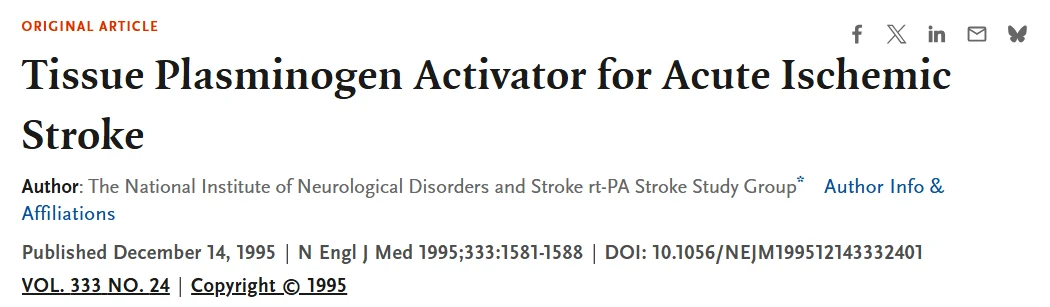
Title: Tissue Plasminogen Activator for Acute Ischemic Stroke
Authors: The National Institute of Neurological Disorders and Stroke rt-PA Stroke Study Group
Read the Full Article on NEJM
Stay updated with Hemostasis Today.
-
Sep 30, 2026, 01:52Javed Anees: DADA2 – When a Young Stroke Is More Than a Stroke
-
Sep 30, 2026, 01:51How a Venous Thrombus Becomes Revascularized – ISTH
-
Sep 29, 2026, 22:45Victor Agunyego: Paracetamol – The Most Common Drug We Underestimate
-
Sep 29, 2026, 22:42Nova Sinclair: Advancing the Future of Hematology – Meet Our 2027 Organizing Committee
-
Sep 29, 2026, 22:41Lorenz Räber: Intracoronary Imaging in PCI – Why, When, How, and Which Modality?
-
Sep 29, 2026, 22:31Selma Turkovic: Pleased to Deliver the Opening Presentation at Kingston Hospital
-
Sep 29, 2026, 22:31Miguel Teran: Ultrasound and Simulation in Arterial Blood Sampling
-
Sep 29, 2026, 22:28Mohammad Refaei: Navigating Your Career in Hematology From Training to Practice
-
Sep 29, 2026, 22:27Matteo Foschi: 10 Clinical Pearls for Antithrombotic Therapy in Secondary Stroke Prevention