


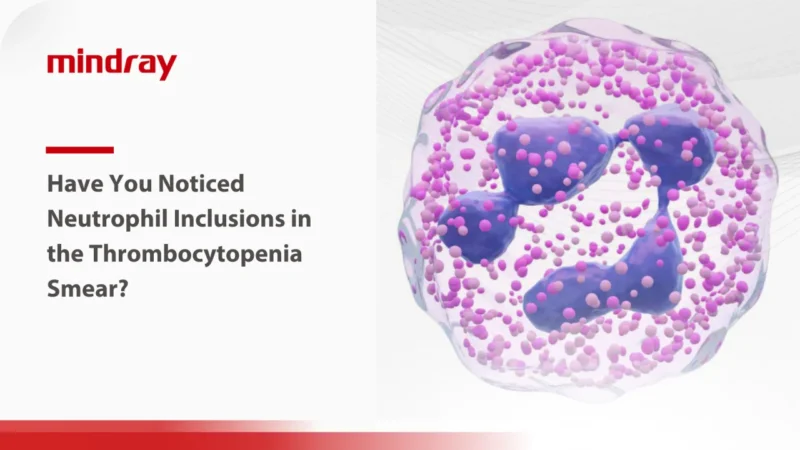
Rameez Ashraff: Have You Noticed Neutrophil Inclusions in a Thrombocytopenia Smear?
Rameez Ashraff, Quality Assurance Manager at Medispot (Pvt) Ltd, shared on LinkedIn:
”Beyond Platelet Count: The Critical Role of Morphology in Diagnosing Thrombocytopenia.
Thrombocytopenia can result from various mechanisms, and relying only on platelet counts may lead to misinterpretation.
This case highlights a 45-year-old patient with chronic thrombocytopenia, where advanced hematology analysis showed higher platelet counts than previous results.
Further investigation using scattergrams and digital morphology revealed large/giant platelets and Döhle-like inclusions in neutrophils, pointing toward MYH9-related disease (MYH9-RD) – a hereditary condition often missed in routine testing.
The case emphasizes that:
- Not to rely on platelet count alone — it can be misleading in certain conditions.
- Always correlate analyzer results with peripheral smear findings.
- Large/giant platelets may cause underestimation in automated counts.
- Döhle-like inclusions in neutrophils are a key clue for MYH9-related disease.
- Advanced hematology analyzers plus digital morphology improve diagnostic accuracy.
- Early and accurate diagnosis helps avoid unnecessary interventions and ensures safe clinical outcomes.
Thrombocytopenia, defined by a decreased platelet count, can arise from multiple pathophysiological mechanisms such as reduced platelet production, increased destruction, sequestration, or even pseudothrombocytopenia. In clinical practice, identifying the underlying cause requires careful laboratory evaluation and detailed morphological examination.
A clinical case reported by Dr. Cai Qi from Ruijin Hospital (Shanghai Jiaotong University School of Medicine) highlights the importance of integrating advanced hematology analysis with peripheral blood smear review.
Case Overview
A 45-year-old male with a two-year history of thrombocytopenia was evaluated prior to thyroid surgery.
Earlier records showed a platelet count of 14 × 10⁹/L.
When analyzed using the Mindray BC-6800Plus Auto Hematology Analyzer, the platelet count was 56 × 10⁹/L, prompting further investigation.
Advanced parameters and scattergrams revealed:
- Elevated PLT histogram tail
- Highlighted clusters in large platelet regions
- Evidence of large platelets
These findings suggested that conventional platelet counting methods might underestimate platelet counts in certain cases.
Morphological Examination
Peripheral blood smears were automatically prepared using the Mindray SC-120 Slide Maker and Stainer and analyzed with the Mindray MC-80 Digital Cell Morphology Analyzer.
Key findings included:
- Numerous large and giant platelets
- Döhle bodies within neutrophils
The combination of thrombocytopenia, large platelets, and neutrophil inclusions strongly indicated MYH9 mutation-related disease (MYH9-RD).
Following clinical evaluation and surgical preparation, the patient underwent a successful thyroidectomy with no postoperative bleeding complications.
Understanding MYH9-Related Disease
MYH9-RD is one of the most common hereditary thrombocytopenias, with an estimated incidence of 1 in 100,000.
It is characterized by:
- Peripheral thrombocytopenia
- Large platelets
- Döhle-like inclusions in neutrophils
Some patients may also develop renal dysfunction, hearing loss, or cataracts.
The Role of Advanced Laboratory Diagnostics
Accurate diagnosis of thrombocytopenia requires combining automated hematology analysis with morphological evaluation.
Modern laboratory technologies can help detect abnormalities that may be missed through traditional methods.
Systems such as the Mindray MC-80 support automated leukocyte classification, platelet estimation, and detailed morphological imaging, assisting laboratory professionals in identifying rare hematological conditions more efficiently.
Key Takeaway
Peripheral blood morphology remains essential in the investigation of thrombocytopenia.
The presence of large platelets and neutrophil inclusions can provide critical diagnostic clues and guide further clinical evaluation.
Through integrated hematology solutions and advanced digital morphology analysis, laboratories can enhance diagnostic confidence and support more precise patient management.
Acknowledgement: Special thanks to Dr. Cai Qi from Ruijin Hospital, Shanghai Jiaotong University School of Medicine, for sharing this informative clinical case.”
Stay updated with Hemostasis Today.
-
Sep 30, 2026, 01:52Javed Anees: DADA2 – When a Young Stroke Is More Than a Stroke
-
Sep 30, 2026, 01:51How a Venous Thrombus Becomes Revascularized – ISTH
-
Sep 29, 2026, 22:45Victor Agunyego: Paracetamol – The Most Common Drug We Underestimate
-
Sep 29, 2026, 22:42Nova Sinclair: Advancing the Future of Hematology – Meet Our 2027 Organizing Committee
-
Sep 29, 2026, 22:41Lorenz Räber: Intracoronary Imaging in PCI – Why, When, How, and Which Modality?
-
Sep 29, 2026, 22:31Selma Turkovic: Pleased to Deliver the Opening Presentation at Kingston Hospital
-
Sep 29, 2026, 22:31Miguel Teran: Ultrasound and Simulation in Arterial Blood Sampling
-
Sep 29, 2026, 22:28Mohammad Refaei: Navigating Your Career in Hematology From Training to Practice
-
Sep 29, 2026, 22:27Matteo Foschi: 10 Clinical Pearls for Antithrombotic Therapy in Secondary Stroke Prevention