


Wolfgang Miesbach Just Published: Our Comprehensive Roadmap for Clinics to Deliver Gene Therapy Safely and Consistently
Wolfgang Miesbach, Professor of Medicine at Frankfurt University Hospital, shared on LinkedIn:
“Metro Map for Gene Therapy of Haemophilia. Just published: our comprehensive roadmap for clinics to deliver gene therapy safely and consistently.
The Problem
Gene therapy is approved. But implementation varies wildly. Without unified guidance, clinics struggle with inconsistent protocols and fragmented care.
The Solution
The ISTH study led by Caroline Mussert and Frank Leebeek with the International Society on Thrombosis and Haemostasis (ISTH) SSC Working Group on Gene Therapy synthesizes all current regulatory requirements and guidance into one comprehensive care pathway and covers every phase of gene therapy delivery—from patient screening to long-term follow-up.
What Makes This Paper Unique
This is the first complete overview integrating eleven current national and international guidance documents, plus regulatory SMPCs (Summaries of Product Characteristics) from both the FDA and EMA into a single, actionable care pathway.
The paper introduces a Metro Map visualization of the care pathway, adapted from oncology care design, providing a clear and visual roadmap of all actions, contact points, and responsibilities across the gene therapy journey.
The Metro Map is available as an editable Microsoft Visio file, enabling clinics to tailor it to their local context.
Additionally, the paper includes comprehensive tables covering:
- Overview of all 15 current guidance documents and SMPCs
- Inclusion/exclusion criteria for hemophilia A and B gene therapies
- Diagnostic assessments required for eligibility screening
- Additional pre-therapy assessments (musculoskeletal, psychological, QoL)
- Product handling and preparation protocols
- Monitoring schedules for hepatic function and factor activity
- Corticosteroid treatment regimens for hepatotoxicity management
Gaps Remain
- Anti-AAV antibody assays lack standardization
- Factor activity measurement varies between methods (1.5-1.6-fold higher with one-stage vs chromogenic assays)
- Liver health thresholds differ across countries
- Hub and Spoke implementation needs regional adaptation”
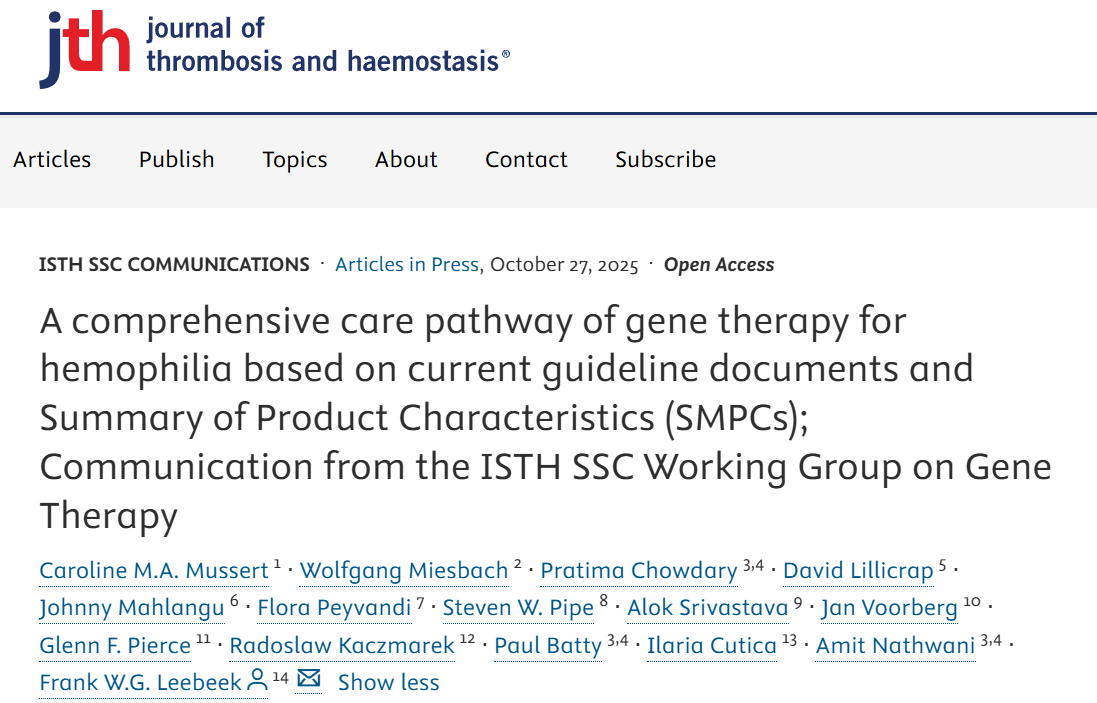
Title: A comprehensive care pathway of gene therapy for hemophilia based on current guideline documents and Summary of Product Characteristics (SMPCs); Communication from the ISTH SSC Working Group on Gene Therapy
Authors: Caroline M.A. Mussert, Wolfgang Miesbach, Pratima Chowdary, David Lillicrap, Johnny Mahlangu, Flora Peyvandi, Steven W. Pipe, Alok Srivastava, Jan Voorberg, Glenn F. Pierce, Radoslaw Kaczmarek, Paul Batty, Ilaria Cutica, Amit Nathwani, Frank W.G. Leebeek
Read full article here.
Stay updated with Hemostasis Today.
-
Sep 30, 2026, 01:52Javed Anees: DADA2 – When a Young Stroke Is More Than a Stroke
-
Sep 30, 2026, 01:51How a Venous Thrombus Becomes Revascularized – ISTH
-
Sep 29, 2026, 22:45Victor Agunyego: Paracetamol – The Most Common Drug We Underestimate
-
Sep 29, 2026, 22:42Nova Sinclair: Advancing the Future of Hematology – Meet Our 2027 Organizing Committee
-
Sep 29, 2026, 22:41Lorenz Räber: Intracoronary Imaging in PCI – Why, When, How, and Which Modality?
-
Sep 29, 2026, 22:31Selma Turkovic: Pleased to Deliver the Opening Presentation at Kingston Hospital
-
Sep 29, 2026, 22:31Miguel Teran: Ultrasound and Simulation in Arterial Blood Sampling
-
Sep 29, 2026, 22:28Mohammad Refaei: Navigating Your Career in Hematology From Training to Practice
-
Sep 29, 2026, 22:27Matteo Foschi: 10 Clinical Pearls for Antithrombotic Therapy in Secondary Stroke Prevention