

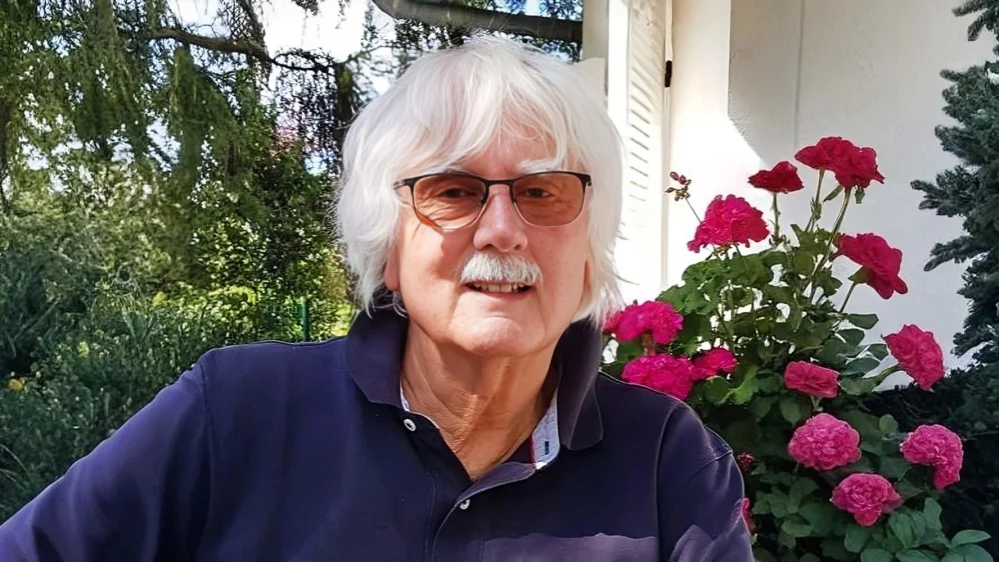
Alan Nurden: CRISPR-Mediated Megakaryocyte Modeling in Glanzmann Thrombasthenia
Alan Nurden, Emeritus Research Director at CNRS, Co-Founder of the French National Reference Centre for Inherited Platelet Disorders (CRPP), shared a post on LinkedIn about a recent article by Yasuhiro Kosaka et al., published in AJHG, adding:
”High-throughput sequencing has provided a much-needed stimulus towards achieving a molecular diagnosis for patients with an inherited platelet disorder.
Nevertheless, in the absence of family studies or multiple occurrences of a new genetic variant in unrelated families, the majority of the gene variants remain of unknown significance (VUS) or have an area of doubt and therefore their interpretation and clinical use pose a problem.
Jesse Rowley and his colleagues from Utah, have attacked this problem for variants in the ITGA2B and ITGB3 genes in patients with Glanzmann thrombasthenia (GT) by adopting CRISP–Cas-mediated homology-directed repair (HDR) to reproducibly insert precise gene variants into human cord blood and adult CD34+ cell-derived megakaryocytes (MKs).
Their platform (named CRIMSON-HD) validated mutations giving type I (ITGA2B p.G201S), type II (ITGA2B p.A777D and p.Q778P) and type III variant-type GT (Japanese KO variant: ITGA2B p.F191_S192insRT insertion) and functionally classified several variants whose significance was previously unresolved or controversial.
This included an ITGB3 p.R119Q variant originally suggested to be a functional type III variant that surprisingly also distantly interfered with the binding of the HPA-1a alloantibody to its distant ITGB3 L59P epitope.
However, the current study p.R119Q clearly gave rise to a type I phenotype showing that any lack of binding of HPA-1a alloantibody was simply due to a loss of beta3 and thereby clearing up an enigma.
The article is well-written and superbly illustrated.
It is highly recommended and it is nice to see the presence of Paul Bray who pioneered mutation analysis on GT patients some 30 years ago. So, the technology now exists to rapidly prove the pathogenicity of disease-causing variants in GT, something that is essential prior to contemplating irreversible cures such as stem cell transplantation or hopefully, in the future, gene therapy.
But it is technically demanding and requires a skilled team for the technology and its interpretation.
The next question is how to make this available on a worldwide basis and to patient groups in third-world countries.”
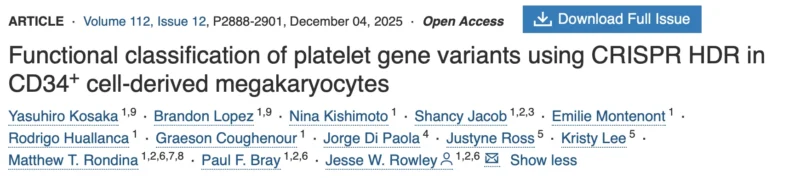
Title: Functional classification of platelet gene variants using CRISPR HDR in CD34+ cell-derived megakaryocytes
Authors: Yasuhiro Kosaka, Brandon Lopez, Nina Kishimoto, Shancy Jacob, Emilie Montenont, Rodrigo Huallanca, Graeson Coughenour, Jorge Di Paola, Justyne Ross, Kristy Lee, Matthew T. Rondina, Paul F. Bray, Jesse W. Rowley
Stay updated on all scientific advances with Hemostasis Today.
-
Sep 25, 2026, 12:43Thomas Dayspring: Reshaping the Biology of Atherosclerotic Plaques with New Therapies
-
Sep 25, 2026, 12:14Garima Sharma: Community Clinical Linkages for Better Postpartum Cardiovascular Care
-
Sep 25, 2026, 10:49Shefina S: From Presenting to Hosting at TRANSCON 2026
-
Sep 25, 2026, 10:37Michelle Leona Cecil: Hemophilia Advocacy and the Power of Community
-
Sep 25, 2026, 10:13Michael Baria: Platelet Concentration and PRP Outcomes in Partial Rotator Cuff Tears
-
Sep 25, 2026, 09:49Haley Coleman: Volunteering to Support Hemophilia Awareness
-
Sep 25, 2026, 08:55Hitarth Mehta: BHMS Students Gain Practical Exposure to Haemophilia Diagnosis
-
Sep 25, 2026, 07:25Varun Capoor: How Therapeutic Apheresis and Transfusion Medicine Can Complement Clinical Management in SCD
-
Sep 25, 2026, 07:14Manshi Kesharwani: SAK-GQDs Modulate Thrombus Burden and Endothelial Function in Deep Vein Thrombosis