


Aloke Finn: The Role of Silent Plaque Rupture in Atherosclerotic Disease Evolution
Aloke Finn, President and Chief Scientific Officer at CVPath Institute, Inc., Clinical Professor at University of Maryland School of Medicine, shared a post on LinkedIn:
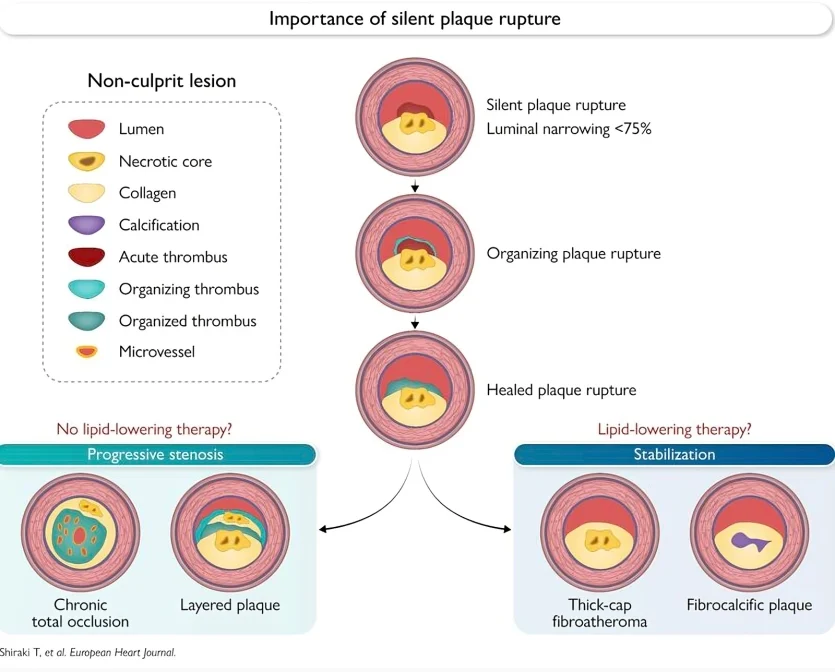
”Plaque rupture is often thought of as a terminal event leading to occlusive thrombus formation and the development of acute myocardial infarction. However, pathological studies have shown that high-grade stenoses often contain sites of multiple prior plaque ruptures, even in patients without a history of a coronary event, suggesting that silent plaque rupture may occur and be a driver of disease progression.
Here we comment on a novel study by Kakizaki et al. and Lorenz Räber, published in the European Heart Journal using pooled data from the IBIS-4 and PACMAN-AMI trials which examined 783 non-culprit lesions in 336 patients with acute myocardial infarction who underwent serial multimodality intracoronary imaging at baseline and 52 weeks. Silent plaque rupture was identified in 41 non-culprit lesions (5.2%), with visible thrombus present in only 10 of these lesions (1.3%). Among the 41 non-culprit lesions with plaque rupture at baseline, serial OCT at 52 weeks revealed that 21 (51.2%) had healed, with the healed lesions showing fibrous plaque (61.9%), layered plaque (28.6%), and thick-cap fibroatheroma (9.5%).
Their findings reinforce the concept that coronary artery disease progression is driven not only by de novo plaque growth but also by repetitive cycles of subclinical rupture and healing. Future studies with larger sample sizes, longer follow-up periods, and systematic evaluation of the pharmacological interruption of this cycle are needed to fully elucidate the clinical implications of silent plaque rupture and to identify patients who may benefit from intensified preventive strategies before further disease progression occurs. ”
Stay updated on all scientific advances with Hemostasis Today.
-
Sep 21, 2026, 20:56George Touma: ApoB Should Be Central to All Lipid Guidlines
-
Sep 21, 2026, 20:55Christopher Robinson: Obstetric Risks Are Seen at the Extremes of Birthweight
-
Sep 21, 2026, 20:54Emicizumab for Refractory GI Bleeding in Myeloma-Associated Acquired VWD – JTH
-
Sep 21, 2026, 20:52Ross Baker: ASH 2026 Guidelines on Iron Deficiency in HMB and Bleeding Disorders
-
Sep 21, 2026, 20:50Rainer Kaiser: Genes and Signalling Pathways Implicated in Procoagulant Platelet Generation
-
Sep 21, 2026, 20:49Natalia Dovlatova: Celebrating Stan Heptinstall and His Legacy in Platelet Science
-
Sep 21, 2026, 20:48Norm Roulet: The Interaction of Pb and SARS-CoV-2 and Its Impact on the Cardiovascular System
-
Sep 21, 2026, 20:45Felix Scholkmann: The Spleen Plays a Key Role in Regulating Platelet Activity
-
Sep 21, 2026, 20:43Claire Pomeroy: Celebrating the 2026 Lasker Awards and Why Medical Research Matters