


Bawan Ahmed: New Evidence May Shift DOAC Choice in Acute DVT Management
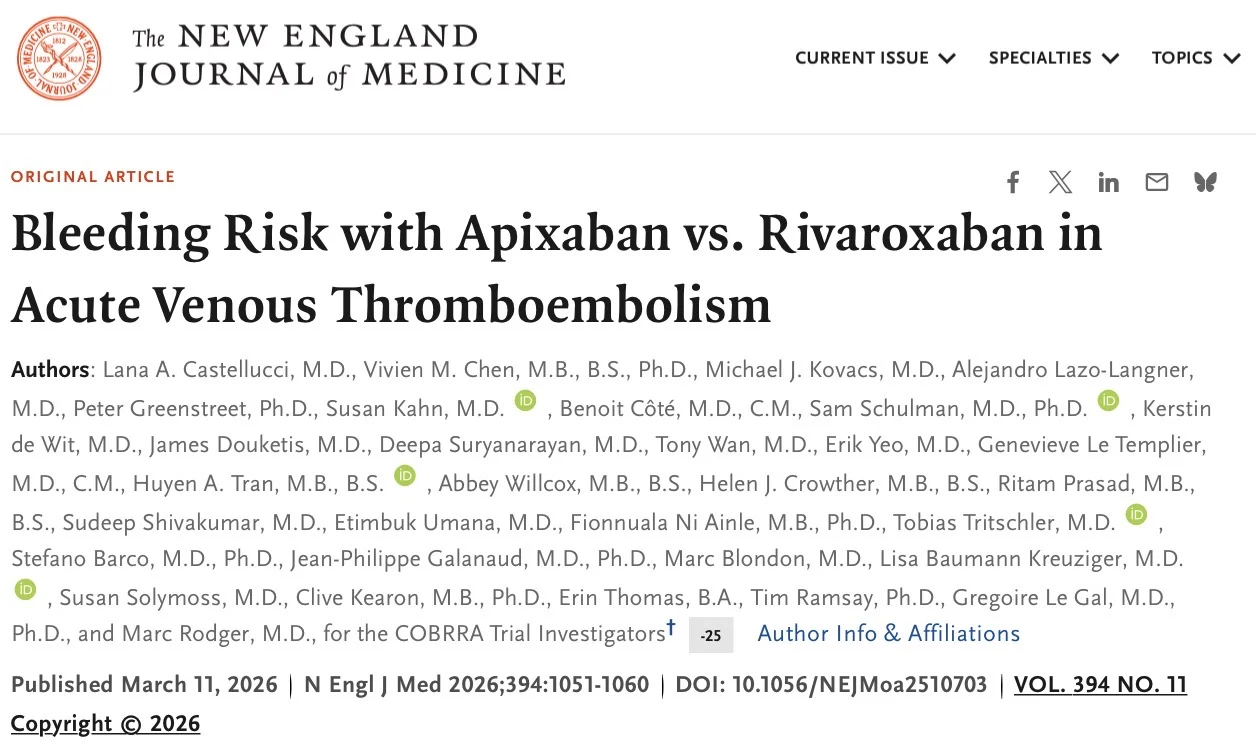
Bawan Ahmed, Lecturer at University of Greenwich, shared a post on LinkedIn about a recent article by Lana A. Castellucci et al, published in The New England Journal of Medicine, adding:
“Last week, the findings of the COBRRA trial, an important study in venous thromboembolism, were published in NEJM.
The data suggest that during the crucial initial 3-month treatment period, the risk of clinically significant bleeding was considerably lower with Apixaban, a factor Xa inhibitor, than with Rivaroxaban, another factor Xa inhibitor for the acute treatment of venous thromboembolism. Clinically relevant bleeding: 3.3% with apixaban vs 7.1% with rivaroxaban (RR 0.46; 95% CI 0.33–0.65; p < .001).
The findings could have an immediate impact on clinical practice globally for the management of acute DVT, particularly regarding the choice of DOAC.
In light of this, the following points are worth considering for clinical practice, as questions will arise, especially when most guidelines allow flexibility in prescribing both agents without indicating a preference.
For new cases, the superior safety profile of Apixaban makes a compelling case for its use as the preferred agent. If twice daily administration is not an issue.
Practicality of switch: If a patient is stable and beyond the acute phase, the benefits of switching should be balanced against the risks of moving from a once-daily to a twice-daily (BD) regimen. Non-adherence is the primary risk factor for sub-therapeutic anticoagulation post-switch.
In both cases, ensure creatinine clearance is appropriate!”
Title: Bleeding Risk with Apixaban vs. Rivaroxaban in Acute Venous Thromboembolism
Authors: Lana A. Castellucci, Vivien M. Chen, Michael J. Kovacs, Alejandro Lazo-Langner, Peter Greenstreet, Susan Kahn, Benoit Côté, Sam Schulman, Kerstin de Wit, James Douketis, Deepa Suryanarayan, Tony Wan, Erik Yeo, Genevieve Le Templier, Huyen A. Tran, Abbey Willcox, Helen J. Crowther, Ritam Prasad, Sudeep Shivakumar, Etimbuk Umana, Fionnuala Ni Ainle, Tobias Tritschler, Stefano Barco, Jean-Philippe Galanaud, Marc Blondon, Lisa Baumann Kreuziger, Susan Solymoss, Clive Kearon, Erin Thomas, Tim Ramsay, Gregoire Le Gal, Marc Rodger
Read the Full Article on The New England Journal of Medicine
Stay updated on all scientific advances with Hemostasis Today.
-
Sep 17, 2026, 16:30Daria Camilli: Empowering Bleeding Disorder Advocacy Through Health Economics
-
Sep 17, 2026, 16:17Mehran Ghasemzadeh: Platelet NK Cell Crosstalk in Advanced Coronary Artery Disease
-
Sep 17, 2026, 16:16Barbara Adams Krolak: Do GLP-1s Affect Blood Clot Risk?
-
Sep 17, 2026, 15:46Heghine Khachatryan: Clinical Context at the Core of Thrombosis and Thrombophilia Management
-
Sep 17, 2026, 15:33Alexandros Makis: When Microcytic Anemia Has an Inherited Cause
-
Sep 17, 2026, 15:22α2-Antiplasmin Inhibition and the Future of Thrombolysis
-
Sep 17, 2026, 15:20Fatma M. Attia: Expanding the Evidence Base for Therapeutic Plasma Exchange Across Multiple Indications
-
Sep 17, 2026, 15:19Conan McIlwrath: The Haemophilia Society Engages With IBCA
-
Sep 17, 2026, 15:06Eleftheria Hatzimichael: A Contemporary Diagnostic Approach to Inherited Microcytic Anemias