


Danny Hsu and Nicola Pozzi on “Tetra-Positive” APS
Danny Hsu, President of THANZ, reposted from Nicola Pozzi on LinkedIn:
”Are we overlooking the “Tetra-Positive” APS patient?
Lupus Anticoagulant (LAC) remains our most valuable predictor of thrombosis, yet it is plagued by analytical interference and false positives.
A compelling new Historical Sketch in JTH by Prof Vittorio Pengo and A/Prof Nicola Pozzi argues it is time to embrace antiprothrombin antibodies to resolve these diagnostic dilemmas.
Key Takeaways for the Lab and Clinic:
- The Rise of “Tetra-Positivity”: Patients positive for LAC, aCL, anti-β2GPI, and aPS/PT (anti-phosphatidylserine/prothrombin) represent a distinct, high-risk phenotype with persistent antibody profiles.
The LAC Surrogate: When LAC results are compromised by acute phase reactants or anticoagulants (heparin/DOACs), aPS/PT testing offers a critical safety net. If aCL, anti-β2GPI, and aPS/PT are all positive, consider the patient high-risk even without a confirmed LAC.
Mechanism Matters (Type I vs. Type II): Not all antibodies are equal. Prothrombin exists in “open” and “closed” forms.
– Type I Antibodies: Recognize the open form (cryptic epitopes). They show weak LAC activity.
– Type II Antibodies: Recognize both forms. These are the drivers of strong LAC activity.
The Future: Keep an eye on aPT-Bio, a new assay using biotinylated recombinant prothrombin that retains native structure, potentially offering higher specificity than current ELISAs.
It is time to refine our risk stratification beyond the standard ‘Triple Positive.”’
Quoting Nicola Pozzi‘s post:
”Hematologists and coagulation enthusiasts—this one’s for you!
Lupus anticoagulant: What is it? How do we measure it?
Why does it matter for Antiphospholipid Syndrome (APS)?
Vittorio Pengo and I revisit this highly debated topic with a historical perspective, and share novel mechanistic insights we uncovered in recent years that could reshape how we understand and test for lupus anticoagulant.
Could it be time to rewrite the coagulation textbook?
Time (and good science) will tell…”
Read the full article in JTH.
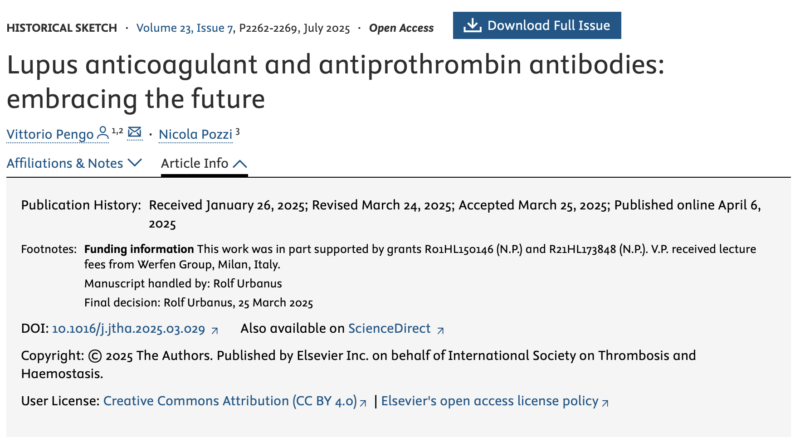
Article: Lupus anticoagulant and antiprothrombin antibodies: embracing the future
Authors: Vittorio Pengo, Nicola Pozzi
Stay updated on all scientific advances with Hemostasis Today.
-
Oct 20, 2026, 05:02Sanam Loghavi: Test Your Hematology Knowledge at ASH 2026!
-
Oct 20, 2026, 04:13Ifeanyichukwu Ifechidere: DOACs Are Not the Answer to Every Anticoagulation Question
-
Oct 20, 2026, 04:04Sadia Kamal: Honored to Receive the Outstanding Abstract Award at the 20th Midwest Platelet Conference
-
Oct 20, 2026, 04:03Yu-Hsuan Chen: One Antibody, Two Diseases from FcRn Biology to Clinical Translation
-
Oct 20, 2026, 03:49Domenico Simone Castiello: Rethinking Prolonged DAPT in Multivessel PCI – Insights from the DAPT-MVD Trial
-
Oct 20, 2026, 03:37Rucha Patil: Scaling POC Diagnostics for Haemophilia A and VWD Across India
-
Oct 20, 2026, 03:31Zena Vexler: Targeting Neutrophil Elastase and NETosis to Mitigate Infection-Triggered Childhood Stroke
-
Oct 20, 2026, 03:24Chaza Alaji: Diagnosing Protein C and Protein S Deficiency
-
Oct 20, 2026, 03:24Mou Nandi: How Maternal Health During Pregnancy May Shape Infant Development