


Danny Hsu: Are Elastic Compression Stockings Ineffective in Preventing Post-Thrombotic Syndrome?
Danny Hsu, President of THANZ, shared on LinkedIn about a recent article by Jean-Philippe Galanaud et al, published in RPTH Journal:
”The Great Stocking Debate: It’s Not About ‘If,’ It’s About ‘How Much’
For years, the efficacy of Elastic Compression Stockings (ECS) in preventing Post-Thrombotic Syndrome (PTS) has been controversial.
Are they ineffective, or are they just sitting in the drawer?
This RPTH Journal publication sheds more light on the debate, courtesy of Dr Jean-Philippe Galanaud’s team.
A new prespecified analysis of the CELEST trial suggests that adherence is the independent predictor we’ve been looking for.
The Data: The ‘50%’ Threshold
This double-blind trial compared PTS rates at 2 years based on how often patients actually wore their stockings.
The results reveal a clear ‘tipping point’:
- < 50% Adherence: 38.4% PTS rate
- 50–79% Adherence: 24.5% PTS rate
- ≥ 80% Adherence: 27.5% PTS rate
Clinical Pearl: The “All or Nothing” Myth
Perfection isn’t required. Wearing ECS ≥50% of the time significantly decreased the risk of PTS (aOR=0.51).
Who Benefits the Most?
The study identified a specific phenotype where adherence yields the highest return.
Non-obese patients with extensive DVT (≥4 venous segments) saw a massive benefit:
- Adherent (≥50%): 29.8% developed PTS
- Non-Adherent: 54.3% developed PTS
Risk Factors for PTS Identified:
- Obesity (aOR=4.73)
- Extensive DVT (≥4 segments aOR=15.59)
- Patient height
The Verdict:
Adherence matters, but we can be realistic with our patients.
Aiming for at least 50% wear time makes a clinically significant difference, particularly for our high-risk patients with extensive proximal DVT.
Does this data change how you counsel patients on compression adherence?”
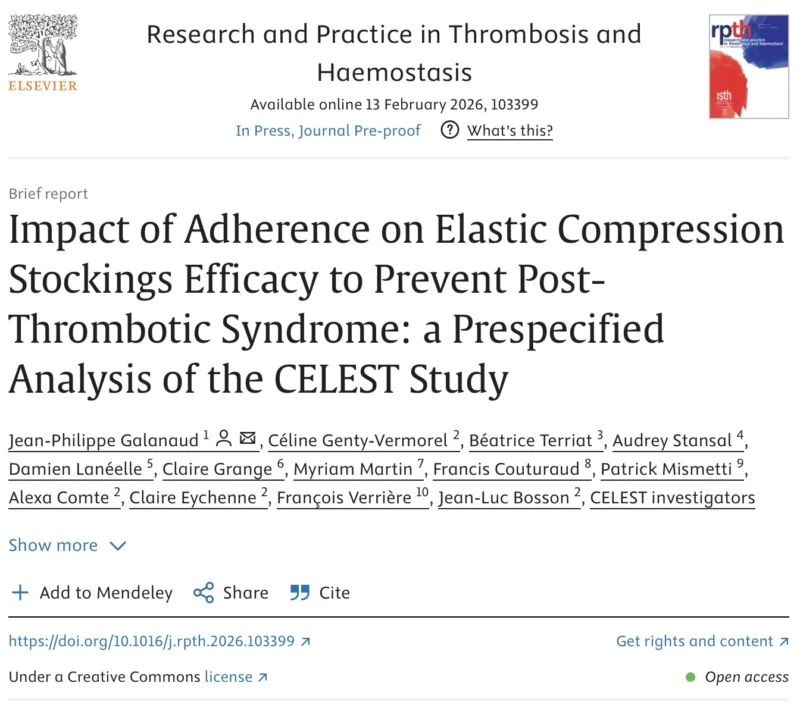
Title: Impact of Adherence on Elastic Compression Stockings Efficacy to Prevent Post-Thrombotic Syndrome: a Prespecified Analysis of the CELEST Study
Authors: Jean-Philippe Galanaud, Céline Genty-Vermorel, Béatrice Terriat, Audrey Stansal, Damien Lanéelle, Claire Grange, Myriam Martin, Francis Couturaud, Patrick Mismetti, Alexa Comte, Claire Eychenne, François Verrière, Jean-Luc Bosson, CELEST investigators
Read the Full Article on RPTH Journal
Stay updated on all scientific advances with Hemostasis Today.
-
Oct 9, 2026, 16:23David Boone: Distinguishing Stroke Prevention from Rhythm Control in Atrial Fibrillation
-
Oct 9, 2026, 15:27Mohamed Hegazi: Geostatistical Modelling Maps Global β-Thalassaemia Carrier Prevalence
-
Oct 9, 2026, 15:15Maha Othman: Uncovering the Consensus on TXA in TBI – Call for Collaboration on a Landmark Umbrella Review
-
Oct 9, 2026, 15:07Daniel D. Han: How Inhalation Product Exposure Impairs Cardiac and Platelet Recovery After MI
-
Oct 9, 2026, 14:58William Toole: How Ultrasound-Guided PRP Therapy Relieves Joint and Tendon Pain
-
Oct 9, 2026, 14:50Shayan Mohammadmoradi: In Corpus Christi for the 20th Midwest Platelet Conference
-
Oct 9, 2026, 14:37Tariq Tramboo: High Platelet Concentrate for Osteoarthritis Knee – Recent Meta-Analyses
-
Oct 9, 2026, 14:26Yousma Khan: Hematology Series – Beyond RBCs, WBCs and Platelets
-
Oct 9, 2026, 14:13Jesus Ardila Novoa: Why the WHO’s Historic Essential Medicines List Decision Is Just the Beginning