


Gonçalo Ferraz Costa: Modern Thrombolytic Strategies and the Risk–Benefit Balance in Valve Thrombosis
Gonçalo Ferraz Costa, Cardiologist at ULS de Coimbra, shared on LinkedIn about a recent article he and his colleagues co-authored, adding:
”TL;DR: In obstructive prosthetic valve thrombosis, surgery achieves higher immediate valve-function restoration, while contemporary low-dose/slow-infusion alteplase protocols may offer comparable efficacy with a potentially more favorable risk–benefit profile in selected patients.
Treatment should be individualized.
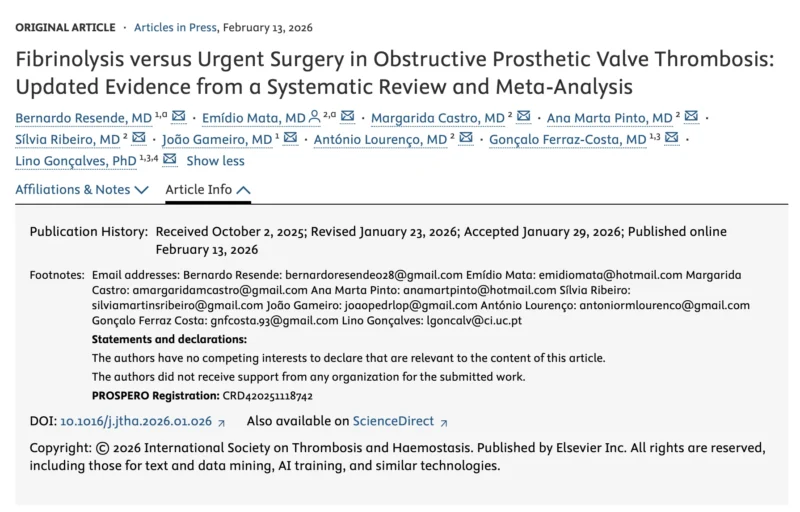
I’m pleased to share our latest publication in the Journal of Thrombosis and Haemostasis: ‘Fibrinolysis versus Urgent Surgery in Obstructive Prosthetic Valve Thrombosis: Updated Evidence from a Systematic Review and Meta-Analysis.’
1.Obstructive prosthetic valve thrombosis (PVT) is life-threatening, and the optimal first-line strategy remains debated. In this updated meta-analysis (12 observational studies + 1 RCT; n=1300), we found:
- No statistically significant difference in in-hospital mortality
- Surgery associated with higher rates of complete restoration of valve function
- Fibrinolysis associated with higher stroke/systemic embolism and recurrent PVT
- No statistically significant difference in major bleeding or follow-up mortality
2. However, in analyses focusing on contemporary alteplase-based protocols (low-dose/slow-infusion regimens), results suggest:
- Lower in-hospital mortality
- Comparable efficacy to surgery
- Meta-regression indicating better outcomes with modern protocol characteristics
Clinical implication: the ‘fibrinolysis vs surgery’ debate is no longer binary.
Contemporary thrombolytic strategies may shift the risk–benefit balance in selected patients.
Decisions should integrate embolic risk, surgical risk, valve position, hemodynamic stability, and institutional expertise.
Special thanks to Bernardo Lisboa Resende and Emidio Mata for their outstanding work!”
Title: Fibrinolysis versus Urgent Surgery in Obstructive Prosthetic Valve Thrombosis: Updated Evidence from a Systematic Review and Meta-Analysis
Authors: Bernardo Resende, Emídio Mata, Margarida Castro, Ana Marta Pinto, Sílvia Ribeiro, João Gameiro, António Lourenço, Gonçalo Ferraz-Costa, Lino Gonçalves
Read the Full Article on JTH
Stay updated on all scientific advances with Hemostasis Today.
-
Oct 10, 2026, 07:12Hamzah Khan: The Role of Genuine Curiosity in Driving High-Impact Academic Research
-
Oct 10, 2026, 06:58Nita Radhakrishnan: Turning Evidence Into Action for Hemophilia Care in India
-
Oct 10, 2026, 06:48Nutan Kaushik: HemeNext 2.0 Brings Global Perspectives to Hematology
-
Oct 10, 2026, 06:43Suthesh Sivapalaratnam: Advancing Bleeding Disorder Care at EHC 2026
-
Oct 10, 2026, 02:38Brianne D.: Sex Differences in RIPK1 Signaling Following Intracerebral Hemorrhage
-
Oct 10, 2026, 02:17Dino Mehic: Managing Heavy Menstrual Bleeding in Patients with BDUC
-
Oct 10, 2026, 00:34Raphaëlle Dodart: Discussing the Mechanisms of Menstrual Hemostasis
-
Oct 10, 2026, 00:26Barbara Adams Krolak: Discussing the Growing Need for Blood Clot Prevention in Asia
-
Oct 9, 2026, 23:59Ana Pedrero Gil: Is Coagulopathy with Fibrinolysis Present in All Obstetric Hemorrhages?