


Heghine Khachatryan: Rethinking Hemostatic Targets in Pregnancy for von Willebrand Disease
Heghine Khachatryan, Editor-in-Chief of Hemostasis Today, Head of Hemophilia and Thrombosis Center at Yeolyan Hematology and Oncology Center, shared International Society on Thrombosis and Haemostasis’s post on LinkedIn:
”Rethinking Hemostatic Targets in Pregnancy: A Paradigm Shift in von Willebrand Disease Management
Emerging evidence published in the International Society on Thrombosis and Haemostasis Journal of Thrombosis and Haemostasis (JTH) challenges long-standing prophylactic thresholds in pregnant women with von Willebrand disease.
The study highlights a critical recalibration of peripartum hemostatic strategies:
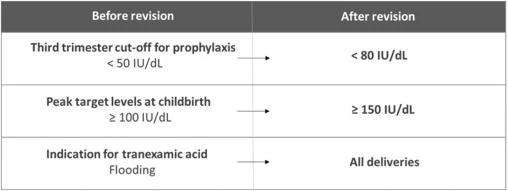
- Higher third-trimester thresholds for initiating prophylaxis (<80 IU/dL vs <50 IU/dL)
- More ambitious peak targets at delivery (≥150 IU/dL vs ≥100 IU/dL)
- Universal consideration of tranexamic acid across all deliveries, rather than selective use
These findings reflect a broader shift—from reactive bleeding control toward proactive hemostatic optimization.
Importantly, pregnancy represents a unique physiological stress test of the coagulation system, where even “borderline” factor levels may prove insufficient under the hemostatic challenge of delivery. This study reinforces the concept that traditional thresholds may underestimate true bleeding risk in women with VWD.
From a clinical standpoint, this raises several implications:
- Should we redefine prophylactic cut-offs globally, particularly in resource-variable settings?
- Are we adequately integrating dynamic risk stratification (phenotype, bleeding history, obstetric factors)?
- Could standardized use of antifibrinolytics reduce variability in postpartum hemorrhage outcomes?
This work contributes to a growing body of evidence advocating for precision-guided hemostasis in obstetric care, where individualized targets—not static thresholds—drive management.
At Hemostasis Today, we view this as part of a necessary evolution: from protocol-driven care to data-informed, patient-specific hemostatic stewardship.”
Quoting International Society on Thrombosis and Haemostasis’s post:
”New Journal of Thrombosis and Haemostasis (JTH) research: Does higher-dosed clotting factor prophylaxis reduce postpartum hemorrhage in women with von Willebrand disease? ”
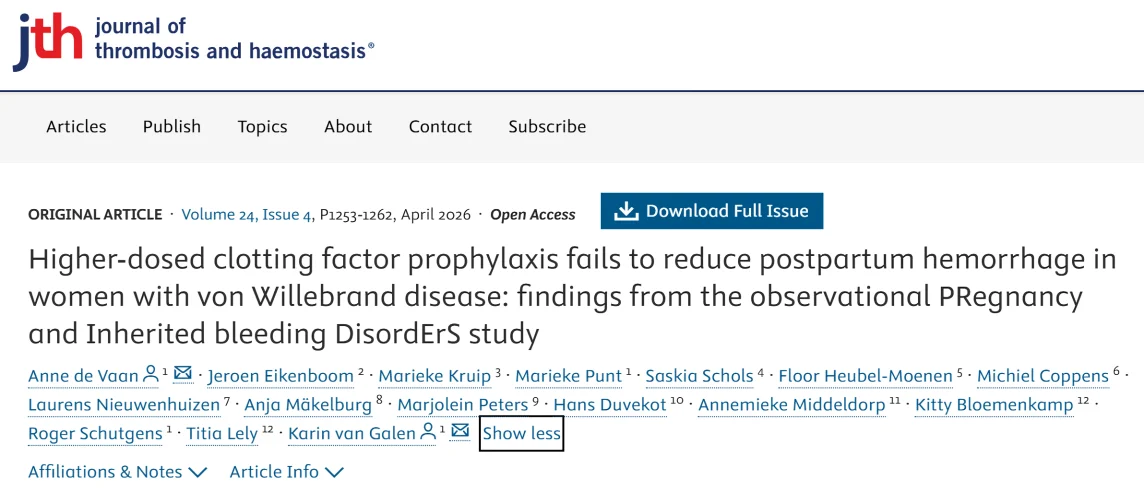
Title: Higher-dosed clotting factor prophylaxis fails to reduce postpartum hemorrhage in women with von Willebrand disease: findings from the observational PRegnancy and Inherited bleeding DisordErS study
Authors: Anne de Vaan, Jeroen Eikenboom, Marieke Kruip, Marieke Punt, Saskia Schols, Floor Heubel-Moenen, Michiel Coppens, Laurens Nieuwenhuizen, Anja Mäkelburg, Marjolein Peters, Hans Duvekot, Annemieke Middeldorp, Kitty Bloemenkamp, Roger Schutgens, Titia Lely, Karin van Galen
Read the Full Article on Journal of Thrombosis and Haemostasis
Other posts featuring Heghine Khachatryan on Hemostasis Today.
-
Sep 30, 2026, 14:41Bruna Gigante: Balancing Thrombosis and Bleeding in Cardiovascular Care
-
Sep 30, 2026, 14:13Ashok Choudhury: Portal Vein Thrombosis and Outcomes in Cirrhosis
-
Sep 30, 2026, 13:57Leslye Conde Bazán: When Conventional Imaging Is Not Enough – The Role of IVUS
-
Sep 30, 2026, 13:41Huda Salah Eldin: The Challenge of Balancing Antithrombotic Therapy After PCI
-
Sep 30, 2026, 13:29Abdus Salam: What Can CT Venography Reveal About the Veins?
-
Sep 30, 2026, 13:03Amira Mohy: Diagnostic Flow Cytometry Panels for Hematological Malignancies
-
Sep 30, 2026, 12:52Paul Watton: Could Repetitive Head Impacts Leave a Molecular Memory?
-
Sep 30, 2026, 12:41The Journey to ISTH 2027 Starts in Vancouver
-
Sep 30, 2026, 11:36Basit Ali: A Closer Look at CT Venography