


Khaled Elshazly: Can We Stop Chemotherapy-Induced Thrombocytopenia from Delaying Treatment?
Khaled Elshazly, Head of Oncology Clinical Pharmacists and the IV Admixture Unit at Agouza Hospital, shared a LinkedIn post about a recent article by Hanny Al-Samkari et al., published in The New England Journal of Medicine:
”Breakthrough in cancer care: Can we stop chemotherapy-induced thrombocytopenia (CIT) from delaying treatment?
A major challenge in oncology is having to reduce or delay life-saving chemotherapy because it destroys platelet-producing bone marrow cells. But a new global Phase 3 clinical trial just published in the New England Journal of Medicine (NEJM) offers a highly effective solution.
Led by investigators at Mass General Brigham, the trial evaluated Romiplostim vs. Placebo for Chemotherapy-Induced Thrombocytopenia (CIT).
Here are the game-changing results:
- The Trial: 165 patients (109 on romiplostim, 56 on placebo).
- The Impact: Patients taking romiplostim had a >10-fold lower odds of needing a chemotherapy dose reduction due to CIT.
- Efficacy: A remarkable 84% of patients in the romiplostim group required no chemotherapy dose modifications at all, compared to just 36% in the placebo group.
- Safety: The drug was well-tolerated. While overall adverse events were slightly higher in the treatment group, this primarily reflected the fact that these patients were successfully able to receive higher, un-reduced doses of their multi-agent chemotherapy.
Why this matters:
Romiplostim effectively boosts the bone marrow’s resilience, allowing patients to maintain their critical platelet counts. This means fewer treatment interruptions, optimal chemotherapy dosing, and better overall outcomes for cancer patients.”
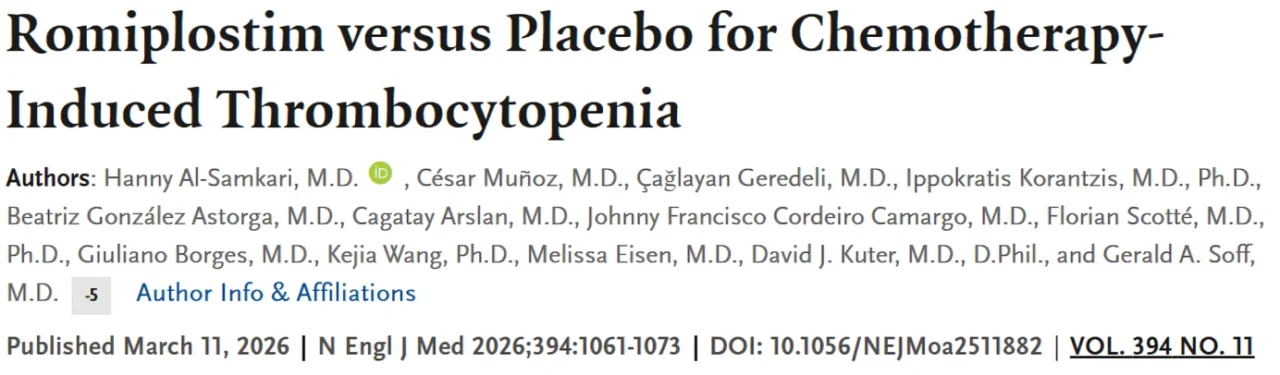
Title: Romiplostim versus Placebo for Chemotherapy-Induced Thrombocytopenia
Authors: Hanny Al-Samkari, César Muñoz, Çağlayan Geredeli, Ippokratis Korantzis, Beatriz González Astorga, Cagatay Arslan, Johnny Francisco Cordeiro Camargo, Florian Scotté, Giuliano Borges, Kejia Wang, Melissa Eisen, David J. Kuter, Gerald A. Soff
Read the Full Article on The New England Journal of Medicine
Stay updated on all scientific advances with Hemostasis Today.
-
Sep 30, 2026, 01:52Javed Anees: DADA2 – When a Young Stroke Is More Than a Stroke
-
Sep 30, 2026, 01:51How a Venous Thrombus Becomes Revascularized – ISTH
-
Sep 29, 2026, 22:45Victor Agunyego: Paracetamol – The Most Common Drug We Underestimate
-
Sep 29, 2026, 22:42Nova Sinclair: Advancing the Future of Hematology – Meet Our 2027 Organizing Committee
-
Sep 29, 2026, 22:41Lorenz Räber: Intracoronary Imaging in PCI – Why, When, How, and Which Modality?
-
Sep 29, 2026, 22:31Selma Turkovic: Pleased to Deliver the Opening Presentation at Kingston Hospital
-
Sep 29, 2026, 22:31Miguel Teran: Ultrasound and Simulation in Arterial Blood Sampling
-
Sep 29, 2026, 22:28Mohammad Refaei: Navigating Your Career in Hematology From Training to Practice
-
Sep 29, 2026, 22:27Matteo Foschi: 10 Clinical Pearls for Antithrombotic Therapy in Secondary Stroke Prevention