


Lee Peter Bee: Silent mtDNA Mutations and the Secret Life of Ageing Clon
Lee Peter Bee, Business Owner at Interim HealthCare of St Charles, shared a post on LinkedIn about a recent article by Rahul Gupta et al., published in Nature, adding:
“The Hidden Clock in Your Blood: How ‘Silent’ mtDNA Mutations Reveal the Secret of Ageing Clones
They thought oxidative stress was the culprit. It wasn’t. The real story involves TERT, clonal expansion, and a two-step betrayal.
For decades, we’ve known that mitochondrial DNA (mtDNA) mutations pile up as we age – especially in blood.
The classic explanation?
A ‘vicious cycle’ of reactive oxygen species damaging mtDNA, leading to more damage.
But when Gupta, Durham, Chau, and the Mootha/Neale teams analyzed whole‑genome sequences from approximately 750,000 individuals (UK Biobank and All of Us), the data told a completely different story.
The mutations that accumulate after age 60 are C more than T and A more than G transitions with a strong strand bias – the signature of mtDNA replication errors, not oxidative lesions.
And these variants sit at very low heteroplasmy (often less than 0.2), show no signs of positive selection, and appear functionally neutral.
So why do they suddenly become detectable in older blood?
The answer shocked even the authors.
A GWAS for mtSNV burden didn’t point to mitochondrial maintenance genes – it pointed straight at clonal haematopoiesis (CH).
Top hits: TERT, TCL1A, SMC4 – all known CH drivers. Rare‑variant analysis confirmed that people with high mtSNV burden carry mutations in DNMT3A, TET2, ASXL1, JAK2.
Even after removing known CH carriers, the genetic signal persisted.
This means mtDNA mutations are ‘passengers’ – they arise randomly from replication errors but stay cryptic until an independent nuclear driver mutation causes a haematopoietic clone to expand, dragging the mtSNVs into detectability.
The two‑step model (Fig. 6 in the paper) is a beauty.
- Step 1: replication errors create low‑level mtDNA variants.
- Step 2: clonal expansion (via CH) amplifies them to measurable levels.
This explains why mtSNV burden correlates so strongly with blood cancers (myelodysplastic syndrome, leukemias) – it’s a readout of somatic mosaicism.
And the TERT variant that lengthens telomeres? It also increases CH risk and mtSNV burden.
The authors propose that mtSNV count could be a sensitive, cheap biomarker for undetected CH, even before classic driver mutations are found.
One of the cleanest examples of how population genetics can solve a 25‑year‑old mystery.”
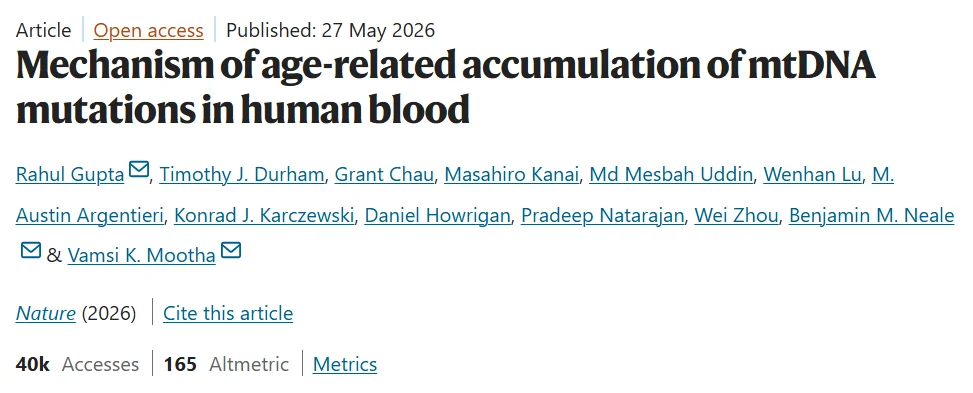
Title: Mechanism of age-related accumulation of mtDNA mutations in human blood
Authors: Rahul Gupta, Timothy J. Durham, Grant Chau, Masahiro Kanai, Md Mesbah Uddin, Wenhan Lu, M. Austin Argentieri, Konrad J. Karczewski, Daniel Howrigan, Pradeep Natarajan, Wei Zhou, Benjamin M. Neale, Vamsi K. Mootha
Stay updated on all scientific advances with Hemostasis Today.
-
Sep 22, 2026, 18:11Bharath Kumar V.։ Advancing Safer Anticoagulation for Cancer-Associated Thrombosis
-
Sep 22, 2026, 18:10Fatima Zahra: ASH Released New Guidelines on the Diagnosis of Iron Deficiency
-
Sep 22, 2026, 17:49Nirav Dhanesha: Targeting FXI for Safer Anticoagulation
-
Sep 22, 2026, 17:17Eric Lambert: Intravascular Imaging and the Future of Precision PCI
-
Sep 22, 2026, 16:45Claudiu Stoicescu: Are We Starting Cardiovascular Risk Assessment Too Late?
-
Sep 22, 2026, 16:35Complement – Coagulation Crosstalk in Thrombosis
-
Sep 22, 2026, 16:20Ila Bappa Ibrahim: Bringing Sickle Cell Innovation Closer to Communities
-
Sep 22, 2026, 16:02Ana Pedrero Gil: Peri-operative Management of Patients Undergoing Day Surgery
-
Sep 22, 2026, 15:27Zia Ullah: RBC-Derived Extracellular Vesicles as Potential Biomarkers of Thrombotic Risk in Dengue