


Ney Carter Borges: Hormone Therapy and Cardiovascular Risk in Postmenopausal Women
Ney Carter Borges, Member Cardiologist of Global Physician Association at Cleveland Clinic Florida, shared on LinkedIn about a recent article by Lingyu Xu et al, adding:
“Menopausal Hormone Therapy and Cardiovascular Risk: Evidence from Women Veterans
Menopausal hormone therapy (HT) has long been prescribed to alleviate vasomotor symptoms such as hot flashes and night sweats and to prevent postmenopausal conditions including osteoporosis.
However, its cardiovascular safety remains controversial.
A large retrospective cohort study involving women veterans investigated the association between HT and the incidence of cardiovascular disease (CVD), providing important insights into the risks associated with this therapy.
The study analyzed electronic health records from the Veterans Health Administration and included 241,943 women aged 45 years or older, among whom 9,295 were users of hormone therapy.
Using propensity score matching to balance baseline characteristics between HT users and non-users, investigators evaluated the occurrence of several cardiovascular outcomes, including ischemic heart disease, stroke, heart failure, atrial fibrillation, pulmonary hypertension, peripheral arterial disease, venous thromboembolism, and aortic stenosis.
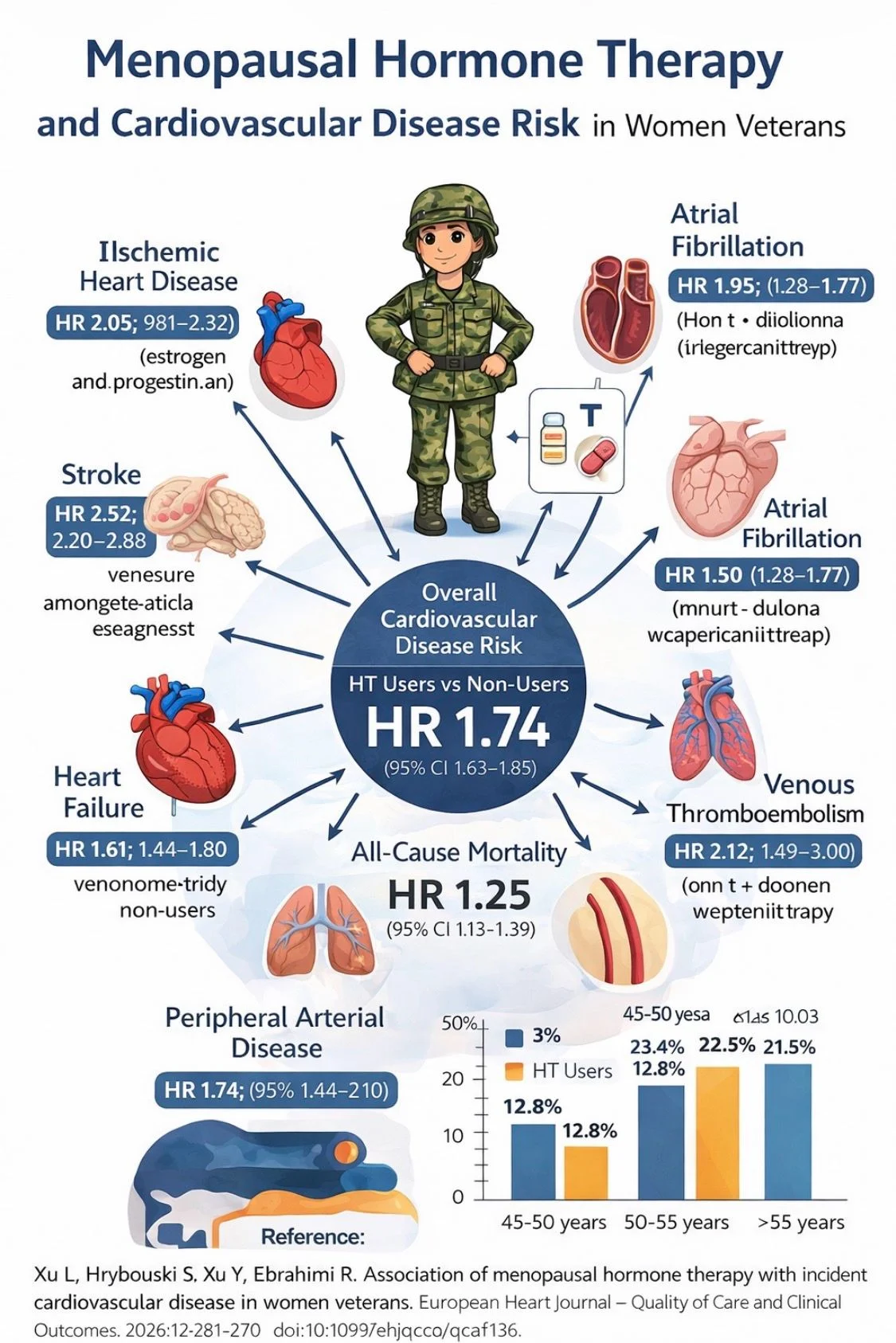
The results demonstrated a significantly higher incidence of cardiovascular disease among HT users compared with non-users (22.4% vs. 11.7%, P less than 0.001).
In multivariable Cox regression analysis, hormone therapy was independently associated with an increased risk of CVD with a hazard ratio (HR) of 1.74 (95% CI 1.63–1.85).
Furthermore, HT use was linked to elevated risks across several specific cardiovascular outcomes, including ischemic heart disease (HR 2.05), stroke (HR 2.52), heart failure (HR 1.61), atrial fibrillation (HR 1.50), peripheral arterial disease (HR 1.74), venous thromboembolism (HR 1.61), and aortic stenosis (HR 2.12).
All-cause mortality was also modestly higher among HT users (HR 1.25).
Importantly, the increased cardiovascular risk persisted across different age strata (45–50, 50–55, and more than 55 years), suggesting that the timing of hormone therapy initiation does not eliminate the association with adverse cardiovascular outcomes.
These findings align with prior evidence from trials such as HERS and the Women’s Health Initiative, which also reported increased risks of thromboembolic and cardiovascular events associated with hormone therapy.
Overall, this large observational study indicates that menopausal hormone therapy may be associated with a broad spectrum of cardiovascular complications in women over 45 years of age.
Current clinical guidelines therefore recommend HT primarily for the treatment of menopausal symptoms rather than for cardiovascular prevention.
Careful cardiovascular risk assessment should guide therapeutic decisions when considering hormone therapy in postmenopausal women.”
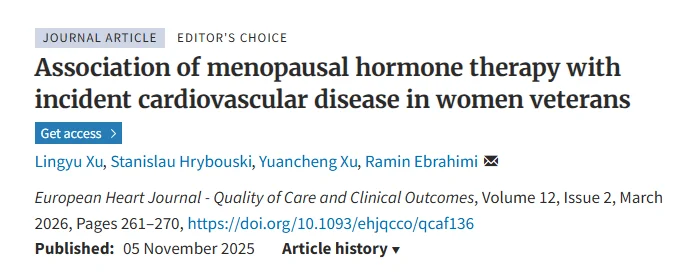
Title: Association of menopausal hormone therapy with incident cardiovascular disease in women veterans
Authors: Lingyu Xu, Stanislau Hrybouski, Yuancheng Xu, Ramin Ebrahimi
Read the Full Article on European Heart Journal – Quality of Care and Clinical Outcomes
Other posts featuring Ney Carter Borges on Hemostasis Today.
-
Sep 19, 2026, 03:15Paulus Kirchhof: Europe’s Safe Hearts Plan to Reduce Cardiovascular Mortality
-
Sep 19, 2026, 03:10James Smith: Brain Training and Exercise for Cognitive Recovery After Stroke
-
Sep 19, 2026, 03:03Lesley Van Wyk: ASH Releases New Iron Deficiency Diagnosis Guidelines
-
Sep 19, 2026, 02:53Francisco Chacón-Lozsán: Acute Ischemic Stroke in 2026 – Expanding the Treatment Window
-
Sep 19, 2026, 01:53Thomas Dayspring: Understanding Genome and Lipid Interactions in Lipidology
-
Sep 19, 2026, 01:47Abdurrahman Tufan: Combination Targeted Therapy in Refractory Systemic Autoinflammatory Diseases
-
Sep 19, 2026, 01:44Patrick James Lynch: Mother of a Thousand Sons Premieres at BDC 2026
-
Sep 19, 2026, 01:41Genetic Fate Mapping Reveals Endothelial Cells During Venous Thrombus Resolution – RPTH Journal
-
Sep 19, 2026, 01:39Mostafa Hammam: Three Different Platelet Defects – One Common Symptom