


Ney Carter Borges: Circadian Disruption and Melatonin Deficiency as Cardiovascular Risk Factors
Ney Carter Borges, Member Cardiologist of Global Physician Association at Cleveland Clinic Florida, shared on LinkedIn about a recent article by Jarosław Nuszkiewicz et al, adding:
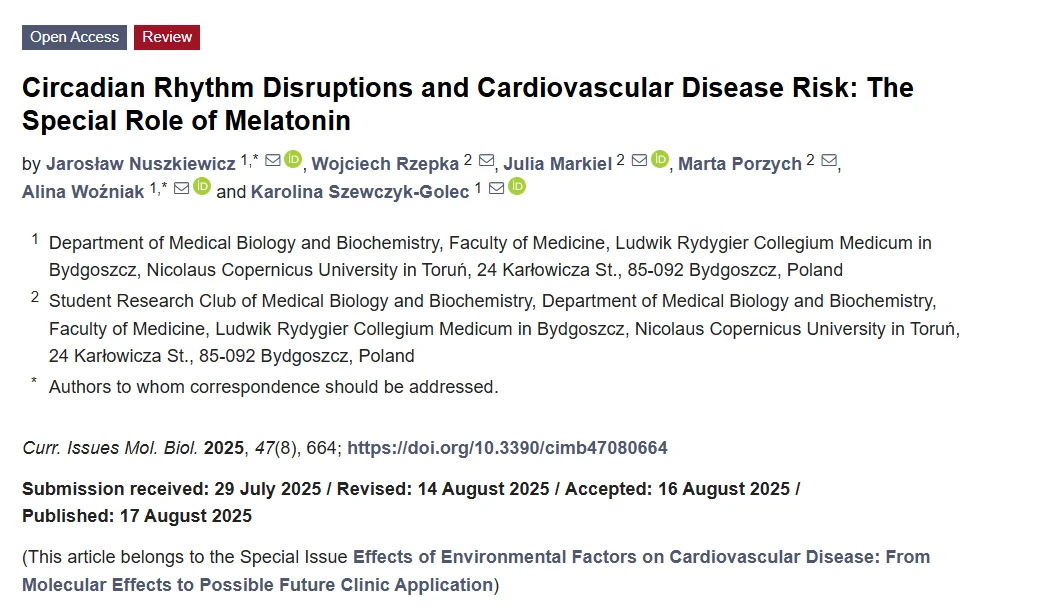
“Circadian Rhythm Disruption and Cardiovascular Risk: The Role of Melatonin
Circadian rhythms are endogenous 24-hour cycles that regulate key cardiovascular functions, including blood pressure, heart rate, vascular tone, and metabolic homeostasis.
These rhythms are orchestrated by the suprachiasmatic nucleus (SCN), which synchronizes peripheral clocks through neuroendocrine signaling, particularly via melatonin secretion.
Melatonin, produced by the pineal gland during darkness with peak levels between 2:00 and 4:00 AM, acts as a central modulator of circadian alignment and cardiovascular physiology.
Disruption of circadian rhythms – caused by factors such as artificial light at night, shift work, irregular sleep patterns, and mistimed feeding – leads to circadian misalignment.
This condition promotes autonomic imbalance characterized by increased sympathetic activity and reduced parasympathetic tone, alongside heightened oxidative stress and systemic inflammation.
These mechanisms contribute directly to endothelial dysfunction, impaired vascular reactivity, and loss of normal nocturnal blood pressure dipping.
Melatonin exerts cardioprotective effects through antioxidant, anti-inflammatory, and autonomic regulatory pathways.
It enhances nitric oxide bioavailability, reduces reactive oxygen species, improves heart rate variability, and lowers blood pressure.
Consequently, circadian disruption combined with reduced melatonin signaling is associated with increased risk of hypertension, atherosclerosis, and overall cardiovascular disease.”
Title: Circadian Rhythm Disruptions and Cardiovascular Disease Risk: The Special Role of Melatonin
Authors: Jarosław Nuszkiewicz, Wojciech Rzepka, Julia Markiel, Marta Porzych, Alina Woźniak, Karolina Szewczyk-Golec
Read the Full Article on Current Issues in Molecular Biology (CIMB)
Other posts featuring Ney Carter Borges on Hemostasis Today.
-
Sep 30, 2026, 01:52Javed Anees: DADA2 – When a Young Stroke Is More Than a Stroke
-
Sep 30, 2026, 01:51How a Venous Thrombus Becomes Revascularized – ISTH
-
Sep 29, 2026, 22:45Victor Agunyego: Paracetamol – The Most Common Drug We Underestimate
-
Sep 29, 2026, 22:42Nova Sinclair: Advancing the Future of Hematology – Meet Our 2027 Organizing Committee
-
Sep 29, 2026, 22:41Lorenz Räber: Intracoronary Imaging in PCI – Why, When, How, and Which Modality?
-
Sep 29, 2026, 22:31Selma Turkovic: Pleased to Deliver the Opening Presentation at Kingston Hospital
-
Sep 29, 2026, 22:31Miguel Teran: Ultrasound and Simulation in Arterial Blood Sampling
-
Sep 29, 2026, 22:28Mohammad Refaei: Navigating Your Career in Hematology From Training to Practice
-
Sep 29, 2026, 22:27Matteo Foschi: 10 Clinical Pearls for Antithrombotic Therapy in Secondary Stroke Prevention